Innovate Business Communication Instruction with Active Engagement
Introductory Summary
Revolutionizing business communication instruction is crucial in today’s dynamic educational landscape. With textbooks like Business Communication Today, 16th Edition by Courtland L. Bovee and John V. Thill, educators have robust tools to transform their teaching methods. This innovation benefits instructors aiming to equip a diverse group of students with modern communication skills vital for the digital age. Typically, educators encounter questions about integrating active learning and engagement in business communication courses—this article addresses those needs.
Learning Objectives
Upon completing this article, instructors will be able to:
- Identify key strategies for integrating active learning in business communication curricula.
- Implement innovative instructional techniques that enhance student engagement and interaction.
- Evaluate the effectiveness of these strategies in achieving learning outcomes.
Opening Framework: Context, Who Benefits, and Why Now
In an era where digital transformation affects every industry, the ability to communicate effectively within business contexts is more essential than ever. Educators are at the forefront of this transformation, tasked with preparing students to meet the demands of a rapidly changing world. Business Communication Today, 16th Edition offers resources that empower instructors to enrich their teaching with active learning strategies, thereby directly enhancing students’ skills to perform in diverse and globalized environments.
Direct Answer
To revolutionize business communication instruction, educators should incorporate active learning techniques that engage students in practical, real-world scenarios. Strategies like role-playing, case studies, and problem-based learning invite a diverse group of students to participate actively, fostering deeper understanding and retention of material. Business Communication Today, 16th Edition serves as an exemplary guide, coupling traditional instruction with innovative methods to fully engage modern students.
1. The Role of Active Learning in Business Communication
Active learning transforms passive student roles into participatory ones, leading to enhanced educational outcomes. Techniques such as group discussions, peer reviews, and interactive simulations encourage students from diverse backgrounds to articulate ideas, thus developing critical thinking and communication skills. Studies have shown that students engaged in active learning exhibit improved performance and retention rates (Freeman et al., 2014).

2. Innovative Teaching Techniques
Educators can employ a range of techniques to bring innovation into the classroom. Techniques like flipped classrooms, where students review lecture materials at home and engage in practical exercises during class, have shown significant promise. Flipped learning allows instructors to dedicate class time to interactive discussions and problem-solving exercises, which are central to effective communication training.

3. Technology Integration in Business Communication
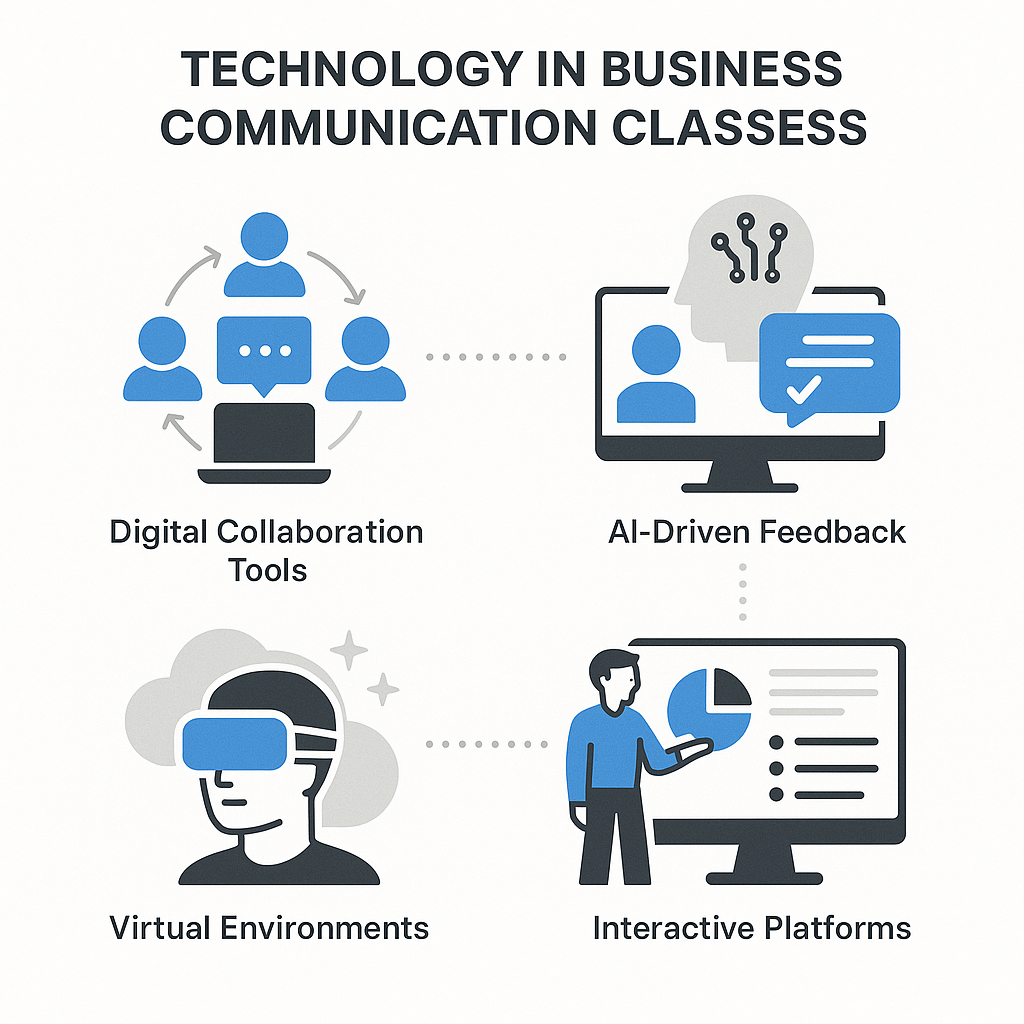
Integrating technology such as digital collaboration tools and AI-driven feedback systems can enhance the learning experience. These tools provide platforms for students to practice communication skills in virtual environments, mirroring real-world business settings. For instance, platforms like MyLab Business Communication by Pearson offer customized learning paths and immediate feedback, promoting continuous improvement and digital fluency.
Key Takeaways
- Active learning dramatically increases student engagement and communication competency.
- Techniques like flipped classrooms and simulations are effective in modernizing instruction.
- Technological tools, when integrated, offer practical experience with digital communication platforms.
- Business Communication Today, 16th Edition supports educators with comprehensive resources.
Glossary of Key Terms
Active Learning: An instructional method that engages students in the learning process through activities and/or discussions in class, as opposed to passively listening to an expert. It emphasizes hands-on, real-world engagement.
Flipped Classroom: An educational strategy that reverses the traditional learning environment by delivering instructional content, often online, outside of the classroom.
MyLab Business Communication: A digital tool by Pearson offering personalized learning paths and analytical insights for students in business communication courses.
Digital Fluency: The ability to effectively and critically navigate, evaluate, and create information using a range of digital technologies.
Simulation: An educational practice that uses models or virtual representations to replicate real-world systems or processes for learning and practice.
Related Questions
- What are the benefits of using active learning in business communication courses?
- How can educators effectively integrate technology in communication training?
- What is the role of MyLab Business Communication in instruction?
- How does flipping the classroom impact student engagement and learning outcomes?
- How can simulations improve business communication skills in students?
- What strategies best help a diverse group of students succeed in business communication?
- What resources does Business Communication Today, 16th Edition provide for innovative teaching?
References & Citations
- Freeman, S., Eddy, S. L., McDonough, M., Smith, M. K., Okoroafor, N., Jordt, H., & Wenderoth, M. P. (2014). Active learning increases student performance in science, engineering, and mathematics. Proceedings of the National Academy of Sciences, 111(23), 8410-8415. https://doi.org/10.1073/pnas.1319030111
- Bovee, C. L., & Thill, J. V. (2023). Business Communication Today (16th ed.). Pearson Education.
- Kuh, G. D. (2009). What student affairs professionals need to know about student engagement. Journal of College Student Development, 50(6), 683-706. https://doi.org/10.1353/csd.0.0099
- Prince, M. (2004). Does active learning work? A review of the research. Journal of Engineering Education, 93(3), 223-231. https://doi.org/10.1002/j.2168-9830.2004.tb00809.x
- Felten, P. (2013). Principles of good practice in SoTL. Teaching & Learning Inquiry: The ISSOTL Journal, 1(1), 121-125. https://doi.org/10.2979/teachlearninqu.1.1.121
Call to Action
If you’re eager to revolutionize your teaching approach with active learning techniques, delve into Business Communication Today, 16th Edition to discover a wealth of resources that empower educators and transform student learning experiences.