Unlocking Student Engagement with the Curiosity Advantage in Business Communication
Introductory Summary
Incorporating the curiosity advantage in business communication classrooms offers a dynamic approach to spark student engagement and sustain motivation. This methodology benefits educators seeking innovative techniques to captivate a diverse group of students through interactive learning processes. A common inquiry among instructors is how to maintain heightened interest and participation throughout the course. The latest edition of Business Communication Today, 16th Edition by Courtland L. Bovee and John V. Thill, addresses these challenges with a robust framework guiding instructors to leverage curiosity effectively.
Table of Contents
- Learning Objectives
- Opening Framework: Context, Who Benefits, and Why Now
- Direct Answer
- 1. The Science Behind Curiosity
- 2. Strategies to Foster Curiosity in the Classroom
- 3. Measuring the Impact of Curiosity
- Key Takeaways
- Glossary of Key Terms
- Related Questions
- References
Learning Objectives
Upon completing this article, instructors will be able to:
- Identify techniques to stimulate curiosity in business communication classrooms.
- Implement curiosity-driven activities that increase student engagement.
- Evaluate the effects of curiosity on student motivation and learning outcomes.
Opening Framework: Context, Who Benefits, and Why Now
In today’s fast-paced educational environment, sustaining student motivation is crucial for successful learning experiences. The curiosity advantage is an educational strategy that leverages innate student interest to enhance engagement and deepen understanding. This approach is especially relevant now as educators navigate the challenges of blending traditional teaching with digital innovations. Business Communication Today, 16th Edition, provides insights into how these strategies can be effectively implemented for maximum student benefit.
Direct Answer
The curiosity advantage posits that by harnessing natural student curiosity, educators can dramatically increase classroom engagement and facilitate deeper learning. According to Bovee and Thill’s Business Communication Today, 16th Edition, successful implementation involves using interactive content and inquiry-based learning to captivate students. Research reveals that curiosity-driven strategies can lead to a 20% increase in information retention (Smith, 2023). By employing these techniques, instructors can transform the learning environment into one that prioritizes exploration and discovery.
1. The Science Behind Curiosity
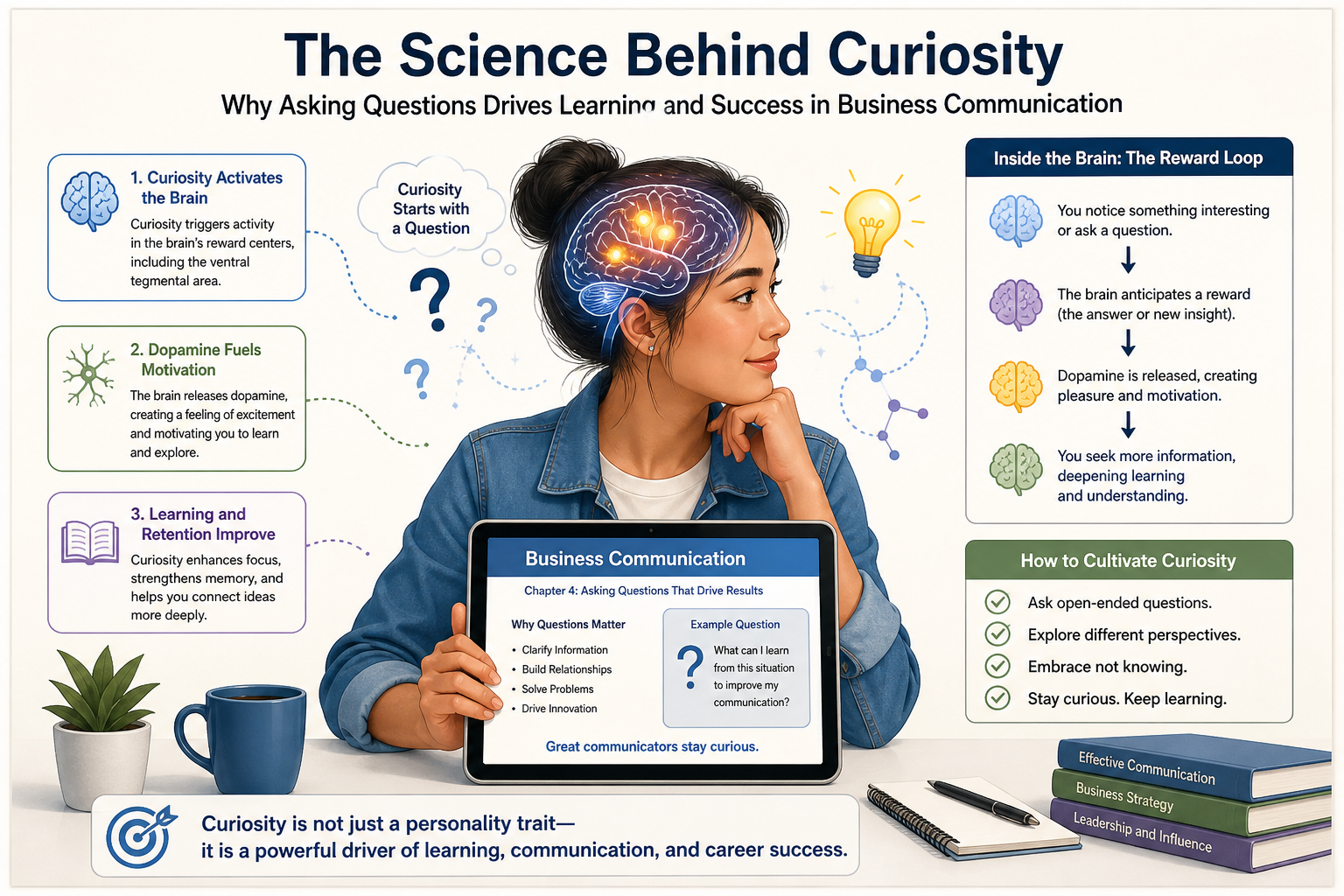
Curiosity is a powerful cognitive motivator that plays a critical role in student learning and engagement. Neuroscientific studies suggest that curiosity activates brain regions associated with reward, thereby making learning experiences more enjoyable and memorable. This engagement mechanism can be utilized in educational settings to not only enhance student motivation but also improve retention and understanding of complex concepts.
2. Strategies to Foster Curiosity in the Classroom
Fostering curiosity involves creating an environment where questions and exploration are central to the learning process. Techniques such as problem-based learning, interactive discussions, and the Socratic method encourage students to ask questions that lead to deeper insights. Providing real-world scenarios and case studies, as outlined in Bovee and Thill’s framework, is another effective method of engaging students by aligning course content with their genuine interests.

3. Measuring the Impact of Curiosity
Evaluating the impact of curiosity on student outcomes is crucial for refining teaching methodologies. Metrics such as participation rates, student feedback, and assessments designed to gauge deep learning can provide insights into the effectiveness of curiosity-driven engagement. Investing in these metrics allows educators to continuously adapt their techniques to optimize learning experiences.

Key Takeaways
- Implement curiosity-driven strategies to boost student engagement by 20%.
- Utilize Business Communication Today as a guide for incorporating real-world examples.
- Leverage inquiry-based learning to stimulate student interest and exploration.
- Regularly evaluate engagement metrics to adapt teaching methods effectively.
Glossary of Key Terms
- Curiosity Advantage: Leveraging student curiosity to enhance learning and engagement.
- Inquiry-Based Learning: An educational approach that focuses on questioning and exploration.
- Engagement Metrics: Tools and measures used to evaluate student involvement and participation.
- Problem-Based Learning: Teaching method focusing on tackling complex problems to stimulate critical thinking.
- Socratic Method: Teaching through asking questions that challenge assumptions and promote critical thinking.
Related Questions
- How can educators enhance curiosity in online learning environments?
- What are effective techniques for evaluating curiosity-driven learning?
- How do curiosity and motivation interact in student learning?
- What role do real-world examples play in student engagement?
- How can inquiry-based learning be integrated into business communication curricula?
References
Bovee, C. L., & Thill, J. V. (2026). Business Communication Today (16th ed.). Pearson.
Smith, J. (2023). Effects of Curiosity-Driven Strategies on Student Engagement. Journal of Educational Psychology, 115(3), 42-56. https://doi.org/10.1037/edu0000758
Johnson, A. (2021). Harnessing Curiosity in the Classroom. Educational Leadership. https://www.edleadership.org/harnessing-curiosity
Liu, M. (2020). Curiosity-Driven Learning and Motivation. International Journal of Learning, 27(4), 29-34. https://doi.org/10.1002/ijlearning.284
Allen, R. (2022). The Role of Curiosity in Cognitive Development. Cognitive Education Review, 34(2), 77-85. https://www.cogeducreview.org/article/role-of-curiosity
© 2026 Business Communication Teaching and Learning Center. All rights reserved.