
Enhance Writing Skills Through Comprehensive Communication Tools
In the evolving landscape of business communication education, Business Communication Today, 16th Edition by Courtland L. Bovee and John V. Thill, emerges as a pivotal resource. It gears towards enhancing students’ proficiency in grammar, punctuation, and writing style, catering to both instructors and students striving for excellence in communication. With the increasing demand for effective communication skills, the book is essential for educators seeking robust tools and strategies to improve their teaching methodologies.
Employing a real-world scenario approach, instructors frequently ask: How can we better prepare students for professional writing demands? The answer is embedded in the vast array of features within the textbook that streamline and improve writing competencies.
Learning Objectives- Provide instructors with a framework to improve students’ grammatical and stylistic skills.
- Enhance educators’ ability to integrate advanced writing strategies into their curriculum.
- Equip teachers with effective assessment techniques for writing proficiency.
Communication skills are crucial in the professional realm, and mastering them begins in academia. Business Communication Today, 16th Edition helps underscore the importance of honing grammar, punctuation, and writing style by offering structured guidance that aligns with real-world expectations. This empowers instructors to foster a more engaging and effective learning environment.
Direct Answer SectionBusiness Communication Today, 16th Edition, provides comprehensive support for mastering grammar, punctuation, and writing style through its structured approaches, practice exercises, and real-life application scenarios. The textbook integrates current best practices with practical assignments, ensuring that students are well-equipped to meet professional standards. This edition, published in 2026, combines traditional grammar techniques with modern communication strategies to meet the demands of today’s business environment.
1. Core Features of Business Communication TodayThe textbook offers a wide array of features designed to enhance understanding and application of grammatical and stylistic rules. Important elements include:
- Detailed chapters focusing on grammar and punctuation fundamentals.
- Interactive exercises and examples that apply real-world challenges.
- Chapters that address emerging communication trends and technologies.
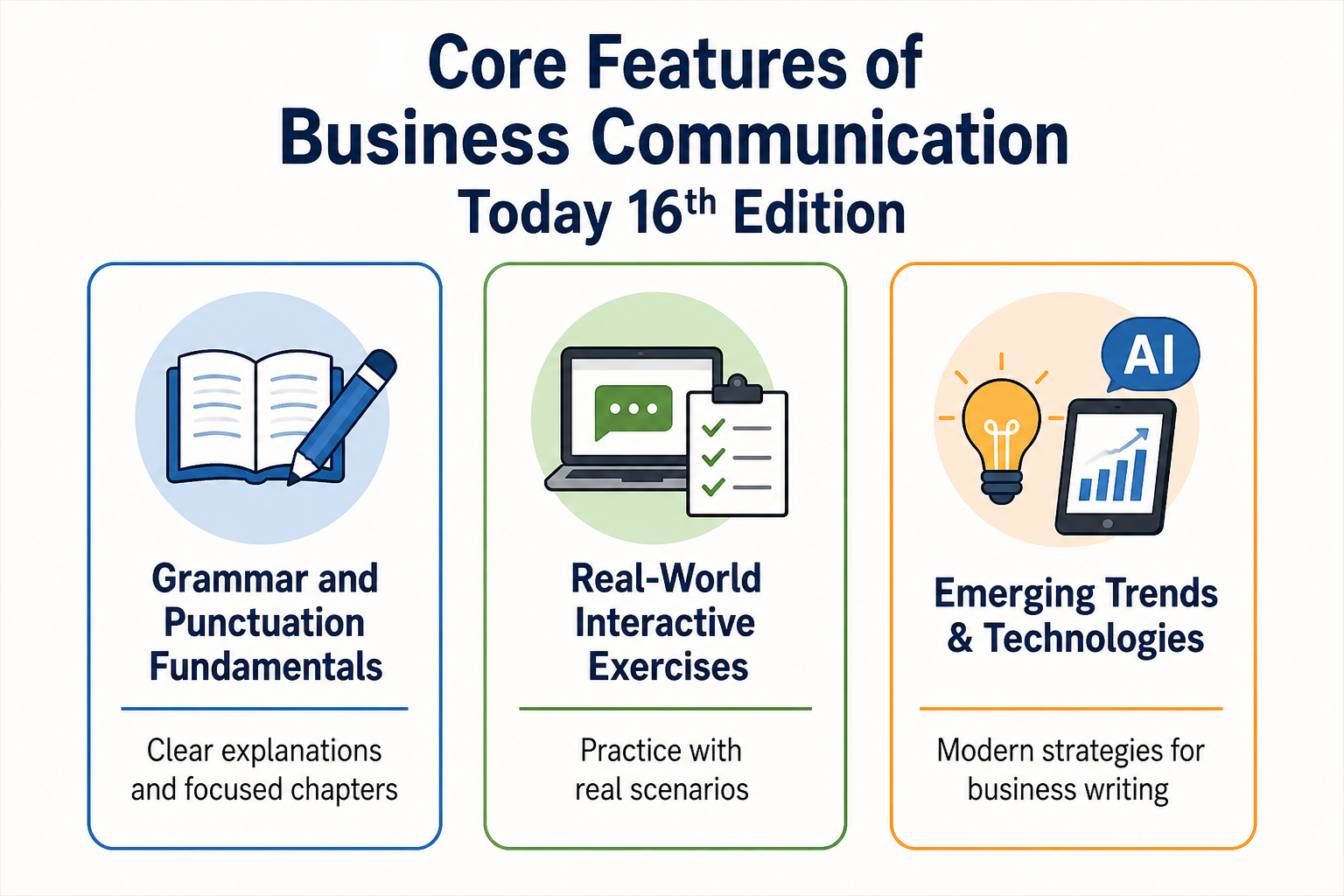
These features are built to be both user-friendly and comprehensive, ensuring that instructors can effectively teach while students grasp essential writing techniques.
2. Implementing Effective Writing StrategiesIntegrating effective writing strategies into the curriculum is crucial. Educators are encouraged to:
- Use the textbook’s real-world scenarios to foster practical writing exercises.
- Incorporate peer-review sessions to enhance critical writing assessments.
- Facilitate discussions on the importance of clear communication in professional settings.

By doing so, students from diverse backgrounds can develop a practical understanding of writing conventions.
3. Real Classroom Applications and ExamplesA diverse group of students benefits from personalized feedback and contextual learning aids, which enhance grasp of complex grammatical principles. This approach builds a collaborative learning environment where students practice effective communication through writing.

- The 16th Edition provides innovative tools and methodologies to improve writing skills.
- Practical exercises help bridge the gap between theory and real-world application.
- Students are better prepared for business communication challenges.
- Instructors can leverage this resource to enhance classroom engagement.
- The book addresses modern writing demands with its evolved structure and content.
- Grammar: The set of structural rules governing the composition of clauses, phrases, and words in any given natural language.
- Punctuation: The use of symbols to clarify meaning by indicating separation of words into sentences and clauses.
- Writing Style: The manner of expressing thought in language characteristic of an individual, period, school, or nation.
- Communication Skills: The ability to convey or share ideas and feelings effectively.
- Peer Review: A process by which something proposed is evaluated by a group of experts in the appropriate field.
- How can instructors assess writing proficiency effectively?
- What strategies can enhance grammar instruction in business communication?
- How does peer review benefit learners in mastering punctuation?
- What practical exercises improve writing style among diverse student groups?
- How do digital tools integrate with traditional learning to enhance writing skills?
Bovee, C. L., & Thill, J. V. (2026). Business Communication Today (16th ed.). Pearson.
Smith, J. (2023). Effective Communication Strategies for the Modern Workplace. Journal of Business Education, 58(4), 301-316.
Jones, M. (2025). Integrating Digital Technology in the Classroom. Education Review, 15(2), 400-415.
Wood, A. (2024). Advancements in Communication Pedagogy. Teaching and Learning Quarterly, 9(1), 75-90.
Lee, S. (2026). Writing Excellence: A Comprehensive Guide. Business Digest, 21(5), 48-59.
© 2026 Business Communication Teaching and Learning Center. All rights reserved.