This article takes on three misconceptions instructors often hear about their course — that it is less relevant than other business subjects, that it lacks rigor, and that technology makes communication skills unnecessary — and gives you points for answering each one with colleagues and students.
Uncover the Truth: Debunking Common Misconceptions in Business Communication Education
For instructors, understanding business communication extends beyond merely teaching strategies; it involves debunking misconceptions that may undervalue their role and the significance of their course. These misconceptions can hinder effective teaching and learning outcomes. This article benefits instructors who seek clarity and validation in their field, addressing concerns often raised by educators themselves.
Table of Contents
- Introduction
- Learning Objectives
- Direct Answer
- Main Sections
- Key Takeaways
- Glossary of Key Terms
- Related Questions
- References
Introductory Summary
Business communication instructors often face misconceptions about the validity and necessity of their teachings. These misunderstandings affect the perception of both instructors and their courses in educational settings. Addressing these misconceptions is crucial for enhancing the credibility and effectiveness of business communication education. Understanding these dynamics is more relevant now than ever due to evolving communication technologies and collaboration practices.
Learning Objectives
Upon completing this article, instructors will be able to:
- Identify three widespread misconceptions about business communication courses.
- Implement strategies to effectively communicate the relevance and impact of these courses.
- Evaluate and contrast misconceptions with real-world data and case studies.
- Design interventions that enhance students’ appreciation of business communication skills.
Direct Answer
Common misconceptions about business communication courses include the belief that they are irrelevant in modern academic environments, lack rigor compared to other business disciplines, and are unnecessary due to technological advancements. Contrary to these beliefs, Business Communication Today, 16th Edition, affirms the foundational role of effective communication in business success and emphasizes that teaching these skills is crucial amidst digital transformations in the workplace. Business communication remains a critical component for organizational efficiency and cultural competence.
1. Misconception: Relevance in Modern Academia
A significant misconception is that business communication courses do not hold the same relevance as other business topics. In reality, these courses equip students with essential skills like empathy, clarity, and ethical communication, which are indispensable in today’s diverse workplace environments.

Business communication classes foster skills that technology cannot easily replicate, such as empathy and ethical decision-making, making them irreplaceable despite technological progress.
2. Misconception: Lack of Rigor
Another misconception is that business communication lacks the rigor of other subject areas. However, these courses require students to engage critically with complex texts, develop persuasive arguments, and design multifaceted communication strategies—all demanding skills across professional domains.
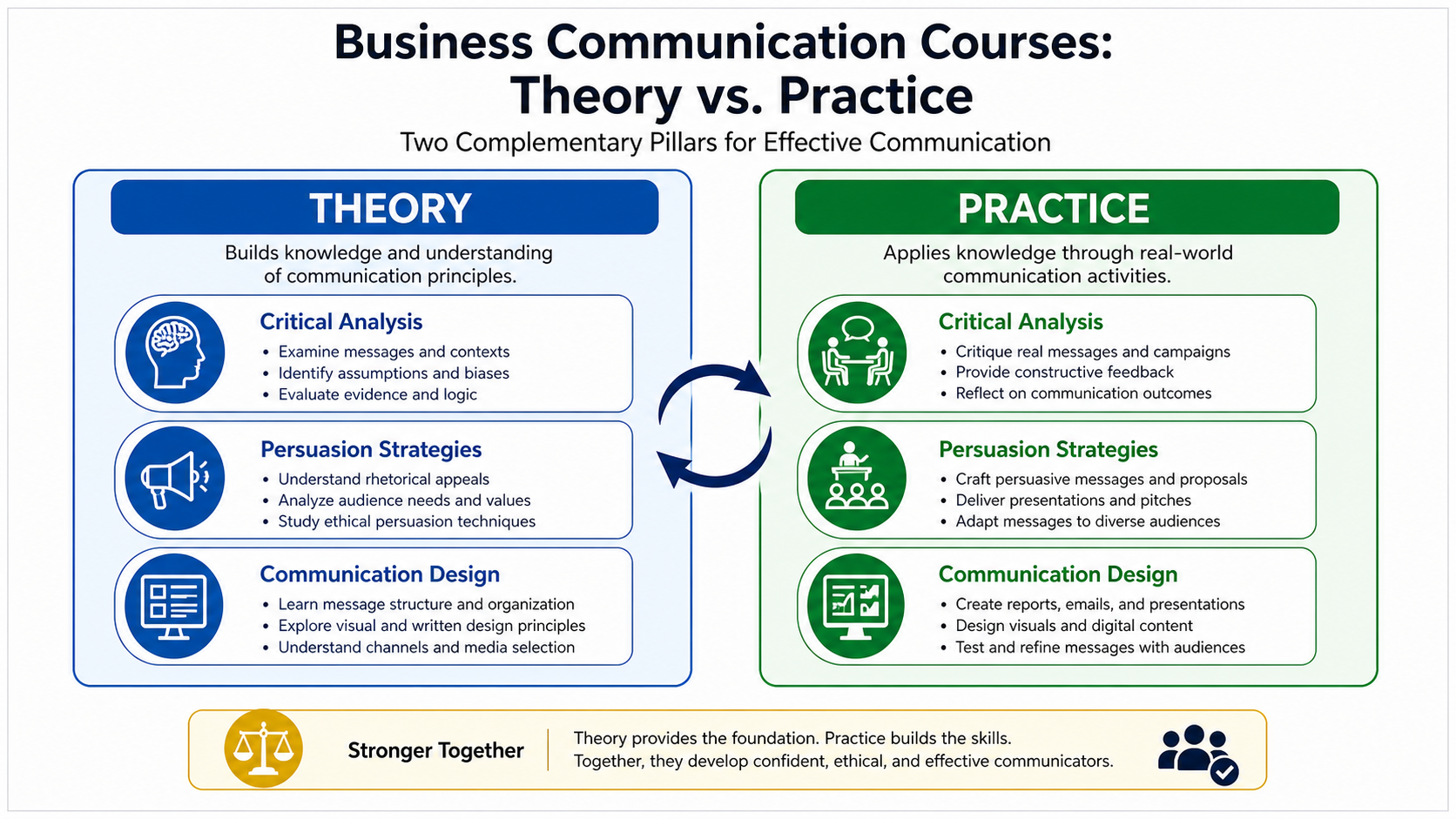
Successful business communication education demands a sophisticated blend of theory and practice.
3. Misconception: Technology Supplants Communication Skills
The advent of AI and automation has led some to believe that technical proficiency suffices over communication skills. However, technology enhances rather than replaces the need for strong communication abilities, which are essential for leading with empathy and engaging effectively in cross-cultural exchanges.
Empirical data reveal that employers consistently rank communication skills as top requirements across industries, underlining the perpetual need for education in this field.
Related reading: For a longer list of 21 myths — from “anyone can teach it” to “it’s only about writing” — each paired with what the course actually covers, see Debunking Common Misconceptions about Business Communication Instructors and the Course They Teach on the Bovée & Thill blog.
Key Takeaways
- Business communication courses are integral, not supplementary, to business education.
- These courses provide rigorous training that is critical for professional success.
- Communication skills complement, rather than compete with, technological proficiencies.
- Instructors should continue advocating for the relevance of their course content.
- Aligning course outcomes with industry demands enhances educational value.
Glossary of Key Terms
- Empathy: The ability to understand and share the feelings of another, crucial in effective communication.
- Communication Rigor: The quality of being thorough and accurate, a key aspect of business communication courses.
- Ethical Communication: Communicating in ways that align with moral principles in business contexts.
- Digital Transformation: Integration of digital technology into business operations to enhance productivity.
- Cultural Competence: The capability to engage effectively in intercultural communication.
How can business communication instructors convey the importance of their courses?
Address the three misconceptions directly: that the course is less relevant, that it lacks rigor, and that technology makes communication skills unnecessary. Employer data showing that communication skills rank as top requirements is the strongest counterargument.
What strategies counter the misconception of business communication courses being “soft”?
Point to the evidence. Employers consistently rank communication skills as top requirements across industries, which shows the course teaches skills that are anything but optional.
Why do employers prioritize communication skills over technical skills?
Employer surveys consistently show communication skills valued above technical proficiency, even as AI and automation change the workplace. Technical skill alone doesn’t get work done when people can’t explain it, persuade or collaborate.
How are communication courses evolving in response to digital advancements?
The article rejects the idea that technology makes communication skills unnecessary. Courses remain essential because new tools still depend on people who can communicate clearly.
What is the future of business communication education?
The article argues that the need for communication education is lasting, since employers keep ranking communication skills at the top even as AI and automation spread.
References
Bovée, C. L., & Thill, J. V. (2026). Business Communication Today, 16th Edition. Pearson.
- What Microtrends Are Reshaping Business Communication and Are You Missing Them?
- What Makes a Business Communication Instructor Truly Excellent: Five Essential Traits from Three Decades of Observation?
- Questions Business Communication Instructors Ask GenAI Relating to Adoption
© 2026 Business Communication Teaching and Learning Center. All rights reserved.