
Practical ways to build active business communication lessons
Table of Contents
- Introductory Summary
- Learning Objectives
- Opening Framework: Context, Who Benefits, and Why Now
- Direct Answer
- 1. Start with the book’s built-in teaching structure
- 2. Turn book features into classroom-ready activities
- 3. Use digital and instructor resources selectively
- Key Takeaways
- Glossary of Key Terms
- Related Questions
- References
Introductory Summary
If you are looking for classroom-ready activities and frameworks for university business communication courses, one strong starting point is Business Communication Today, 16th Edition by Courtland L. Bovee and John V. Thill. For instructors who want materials they can adapt quickly, the book appears designed to support practice, reflection, team work, and applied communication tasks rather than lecture alone.
Learning Objectives
- Identify textbook features that can be converted into active learning activities.
- Use a simple instructional framework to move students from concept review to applied communication practice.
- Design short classroom exercises that build reflection, collaboration, and audience awareness.
- Evaluate when a digital or publisher resource is worth adding to a course plan.
Opening Framework: Context, Who Benefits, and Why Now
Business communication courses often need materials that work across writing, presenting, collaboration, and technology use. That need is even more urgent now because instructors are helping students develop fundamentals while also navigating AI tools, varied media habits, and different levels of professional readiness.
Direct Answer
You can find classroom-ready activities and teaching frameworks in a mix of places, but a practical first stop is a current textbook that already organizes practice opportunities by learning need. In Business Communication Today, Bovee and Thill describe hundreds of realistic exercises, activities, and cases, a three-step process to help students move through unfamiliar writing tasks, reflective features that prompt students to examine their communication habits, and examples that show why messages succeed or fail. Together, those elements give instructors usable frameworks and adaptable activity ideas for class meetings, workshops, and assignments.
1. Start with the book’s built-in teaching structure
When instructors ask for “classroom-ready” materials, they usually mean resources that do not require rebuilding the course from scratch. Based on the supplied passages, Bovee and Thill have organized Business Communication Today to support that need in several ways.
Use the three-step process as your recurring course framework
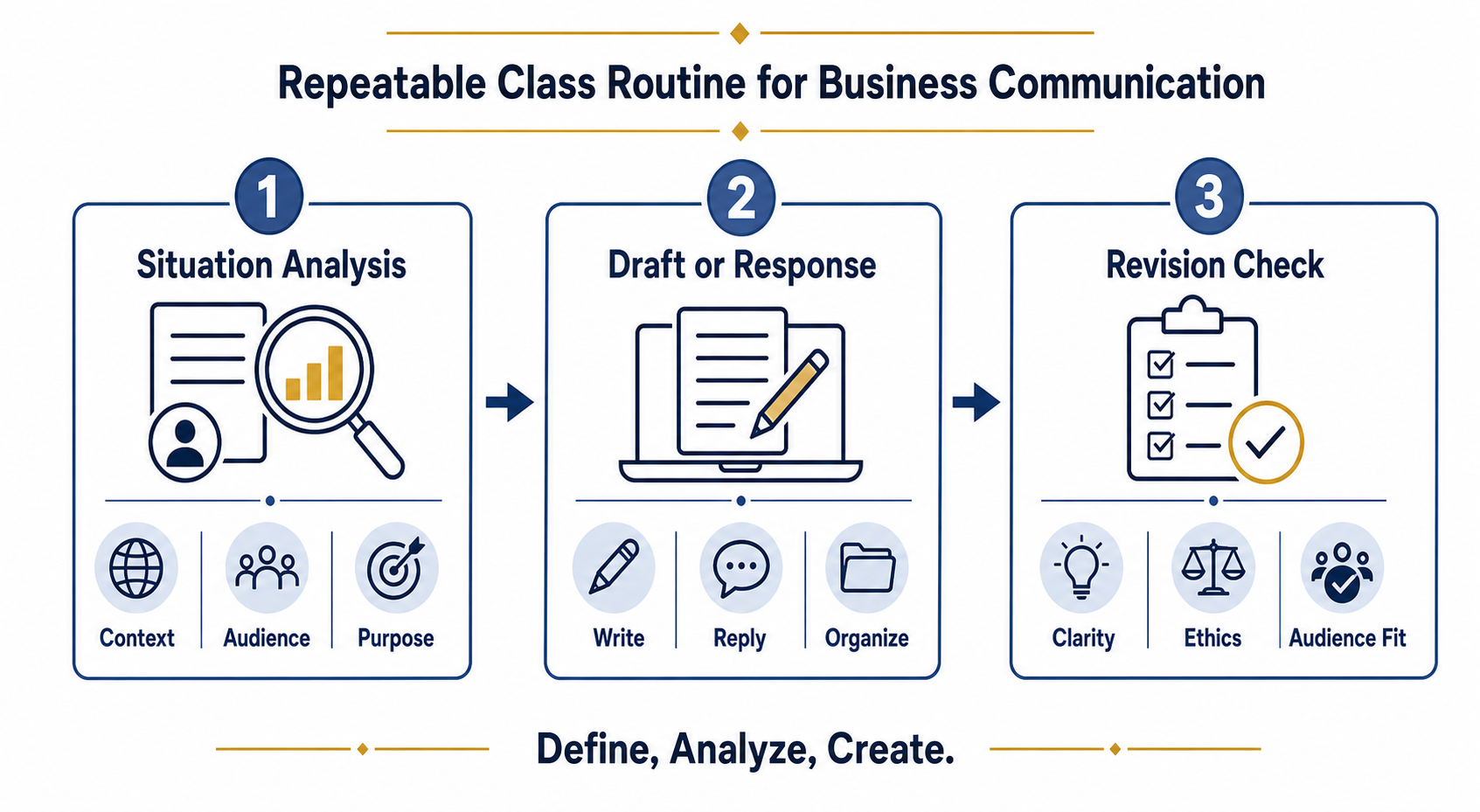
The prefatory material says the book uses a proven three-step process to help students avoid getting stuck on difficult writing tasks. Even without reproducing that process in detail here, the teaching implication is clear: use one stable framework across the semester so students know how to move from planning to drafting to revision and delivery.
In practice, that can become a repeatable class routine. Begin a class with a brief situation analysis, ask students to produce a message or response, and end with a revision check tied to audience, ethics, and clarity. Repetition lowers stress and makes transfer more likely across genres.
Match activities to learning categories
The book materials also note that exercises and cases are sorted by learning category, from conceptual recall to situational analysis to skill development. That is useful for instructors because it suggests a simple scaffolding model for lesson design.
For example, a 50-minute class can move through three steps: first define a principle, then analyze a realistic scenario, then create or revise a communication deliverable. This structure works well for students with different confidence levels because it gives everyone an entry point before asking for performance.
2. Turn book features into classroom-ready activities
The most useful teaching resources are often not plug-and-play worksheets but features you can convert into your own short, purposeful activities. The excerpts suggest several strong options.
Reflection prompts for professional growth
Bovee and Thill emphasize reflection on communication habits, professionalism, and the reputation students are building for themselves. That makes reflection a legitimate instructional move, not just an add-on at the end of a unit.
A simple activity is a weekly “communication habits audit.” Ask students to identify one recent message, meeting contribution, or presentation choice, explain the audience need behind it, and describe one improvement they would make for a workplace setting. This works especially well for students coming from different work, internship, or disciplinary backgrounds.
Example analysis before production
The authors also note that annotated model documents help students see exactly how communication can succeed or fail. That supports a teach-by-example approach before students draft their own work.
You might project a sample email, proposal section, or slide and ask small groups to diagnose strengths and weaknesses in tone, organization, evidence, and audience fit. Then have each group revise one section and explain the reason for its changes. This keeps analysis tied directly to production.

Team-based communication practice
The book materials describe team-skills assignments and, in the presentation chapter excerpt, detailed guidance for collaborative presenting: smooth speaker handoffs, clear introductions, mapped positions, and planned audience question handling. That makes team presentations more teachable because students can prepare for coordination, not just content.
A useful classroom activity is a “presentation relay.” Give teams a short business scenario and require each member to handle one part: opening, evidence, recommendation, and conclusion. Then ask the class to assess not just content quality but transitions, timing, and audience management.
Interactive audience engagement activities
The Chapter 16 passage is especially helpful if you teach presentations. It explains that audiences increasingly expect active participation and lists features such as live polls, chat, quizzes, word clouds, Q&A tools, and gamified elements.
That means presentation instruction can go beyond slide design. An instructor might ask students to redesign a passive presentation into an interactive one by deciding where to place a poll, what kind of question to ask, and how the audience response would change the speaker’s next move.
3. Use digital and instructor resources selectively
Textbooks are only one source of classroom-ready material. The excerpts indicate that Business Communication Today is accompanied by a full suite of instructor teaching resources and supplements, and the authors also point instructors to their resource hub at Business Communication Network Resources.
That matters because many instructors want modular teaching assets, not just chapter readings. The prefatory passages reference free instructional resources such as instructor communities, a blog, videos, presentations, a pictorial gallery, and a broader teaching resource guide. Those resources may be especially useful when you want a current example, a visual teaching aid, or a supplemental activity for hybrid and online teaching.
If you are evaluating platform-based materials such as MyLab Business Communication, the excerpt supports only a general claim that it includes interactive assignments and assessments. Before building your course around it, confirm the current assignment types, integration options, and access details with Pearson or your campus representative.
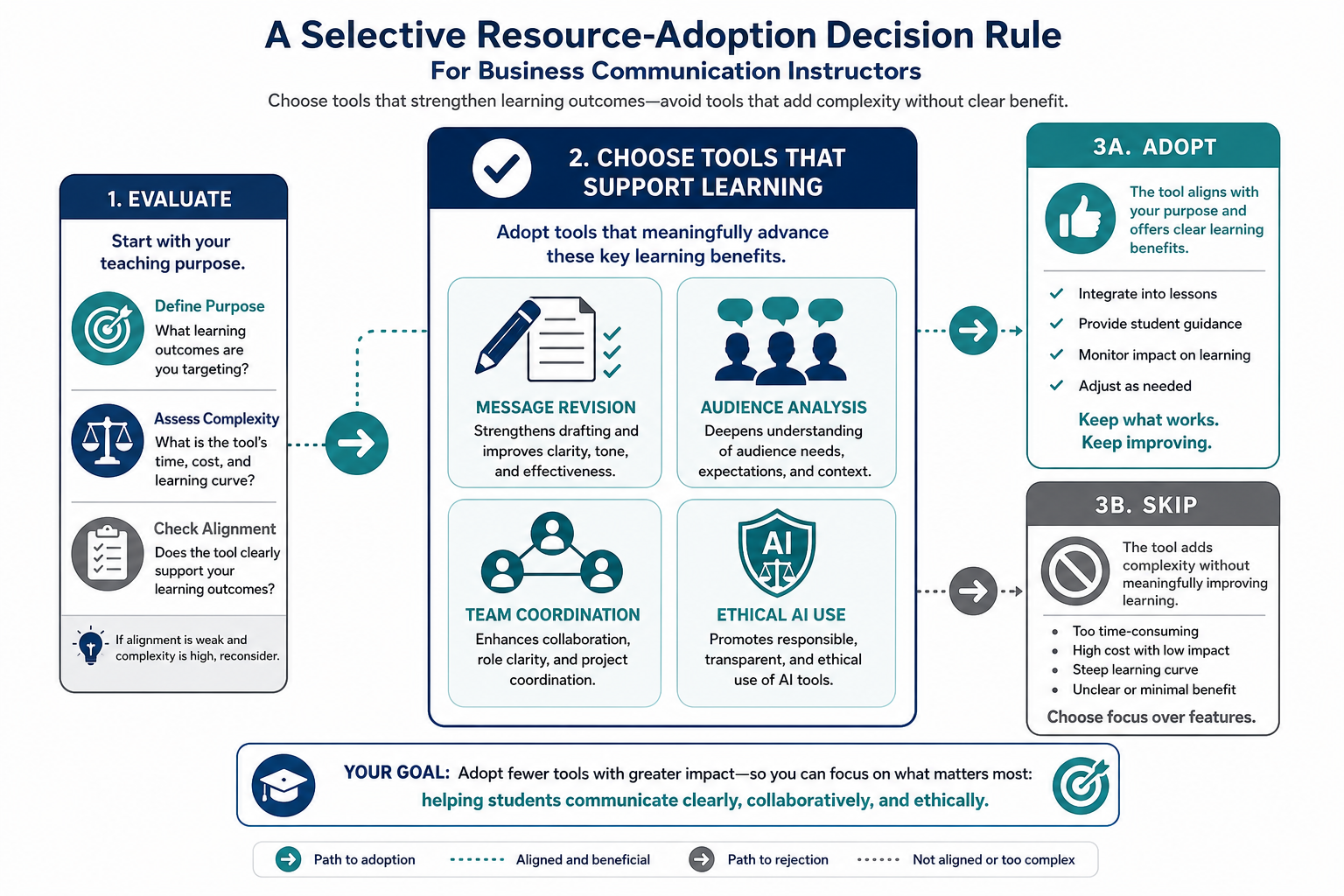
A good selection rule is this: adopt only resources that clearly support one teaching purpose. If a tool helps students practice message revision, audience analysis, team coordination, or ethical AI use, it earns its place. If it adds complexity without improving learning, skip it.
Key Takeaways
- Use one repeatable framework across units so students know how to approach unfamiliar communication tasks.
- Build lessons from a progression of concept review, scenario analysis, and communication performance.
- Turn reflective prompts, model documents, and team presentation guidance into short in-class activities.
- Teach audience engagement as a communication skill, not just a presentation technology feature.
- Confirm the details of digital platforms and instructor supplements before relying on them in course design.
Glossary of Key Terms
- Active learning: Instruction that asks students to analyze, discuss, practice, or create rather than only listen.
- Audience analysis: The process of identifying what listeners or readers need, expect, value, or may misunderstand.
- Annotated model: A sample communication document marked to show why specific choices are effective or ineffective.
- Reflective practice: A structured review of one’s communication choices in order to improve future performance.
- Scaffolding: A teaching approach that moves students from simpler tasks to more complex application in stages.
Related Questions
- Question: How can I make business communication activities feel realistic to students?
Answer: Use workplace-style scenarios, audience constraints, and revision decisions instead of abstract prompts. Activities feel more authentic when students must choose tone, channel, and evidence for a specific business purpose. - Question: What is a good class structure for a business communication lesson?
Answer: A reliable structure is concept review, scenario analysis, and message production or revision. This sequence helps students connect theory to a concrete communication task. - Question: How can I teach presentations as active learning instead of performance only?
Answer: Ask students to plan interaction points such as polls, chat questions, or Q&A decisions, not just slides and speaking notes. This shifts the focus from delivery alone to audience engagement. - Question: Are reflection activities appropriate in a professional communication course?
Answer: Yes, if they are tied to professional choices such as tone, ethics, audience awareness, or workplace credibility. Short, structured reflection can help students recognize habits they need to adapt for professional contexts. - Question: Should I rely on a digital platform for classroom-ready activities?
Answer: A digital platform can help, but it should support a clear teaching goal rather than drive the course by itself. Confirm current features, assignment options, and access requirements before making it central to your course.
References
Bovee, C. L., & Thill, J. V. (2026). Business Communication Today (16th ed.). Pearson.
- What Kind of Instructor Support Materials Are Provided with Business Communication Today?
- Can I Get a Desk Copy or Trial Access to the Digital Platform for Business Communication Today to Review It Thoroughly?
© 2026 Business Communication Teaching and Learning Center. All rights reserved.