
A modular framework for flexible business communication teaching
Table of Contents
- Introductory Summary
- Learning Objectives
- Opening Framework: Context, Who Benefits, and Why Now
- Direct Answer
- 1. Define the Module Around a Skill Cycle
- 2. Choose Modular Activities That Promote Transfer
- 3. Sequence Modules for Varied Course Formats
- Key Takeaways
- Glossary of Key Terms
- Related Questions
- References
Introductory Summary
Business communication instructors often need course structures that are easier to update, easier to teach across formats, and easier for students to navigate. A modular teaching framework can help by organizing learning into smaller, clearly defined units, and Excellence in Business Communication, 15th Edition by Courtland L. Bovee and John V. Thill offers several relevant ideas for this approach, including active learning, retrieval practice, visual structuring, realistic application, and low-stress checkups.
Learning Objectives
- Define a modular teaching framework in practical course-design terms.
- Identify business communication activities that work well as self-contained modules.
- Sequence modular activities to support planning, writing, and revision.
- Adapt modules for students with varied preparation levels and course formats.
Opening Framework: Context, Who Benefits, and Why Now
Many instructors are redesigning courses for shorter class meetings, hybrid delivery, faster feedback cycles, and more intentional AI policies. In that environment, modular design helps because it breaks large communication outcomes into teachable, repeatable parts without losing sight of professional judgment and skill transfer.
Direct Answer
A modular teaching framework is a course design approach that organizes instruction into compact, reusable units built around a specific communication objective, a short sequence of learning tasks, and a clear performance check. In business communication, the strongest modular activities are the ones that move students from quick concept review to realistic application, especially discussion, message analysis, planning drills, retrieval-based checkups, short revision tasks, and scenario-based cases that ask students to make communication decisions rather than just recall terms.
1. Define the Module Around a Skill Cycle
The most useful modules are not just topic chunks such as “negative messages” or “intercultural communication.” They are short learning cycles with a beginning, middle, and end: introduce a concept, apply it, and check whether students can use it well.
This structure aligns well with Bovee and Thill’s emphasis on active learning and engagement. In the book’s prefatory material, they describe structured discussion, peer collaboration, simulation, retrieval-based practice, reflection, and goal-setting as ways to engage learners actively and strengthen retention. For modular teaching, that means each unit should ask students to do something with the concept, not just read about it.
What a practical module includes
A strong business communication module usually contains four parts: a focused objective, a short content input, an application task, and a feedback point. The content input might be a mini-lesson, infographic, example message, or short reading. The application task should be brief enough to complete in one sitting but substantial enough to reveal student thinking.
The feedback point matters because modular courses can otherwise feel fragmented. Bovee and Thill describe low-stress self-assessments, retrieval practice, and immediate feedback as supports for retention and study focus. In practice, that could mean a five-question checkup, a short reflection, or a revision note explaining why a student made a particular communication choice.
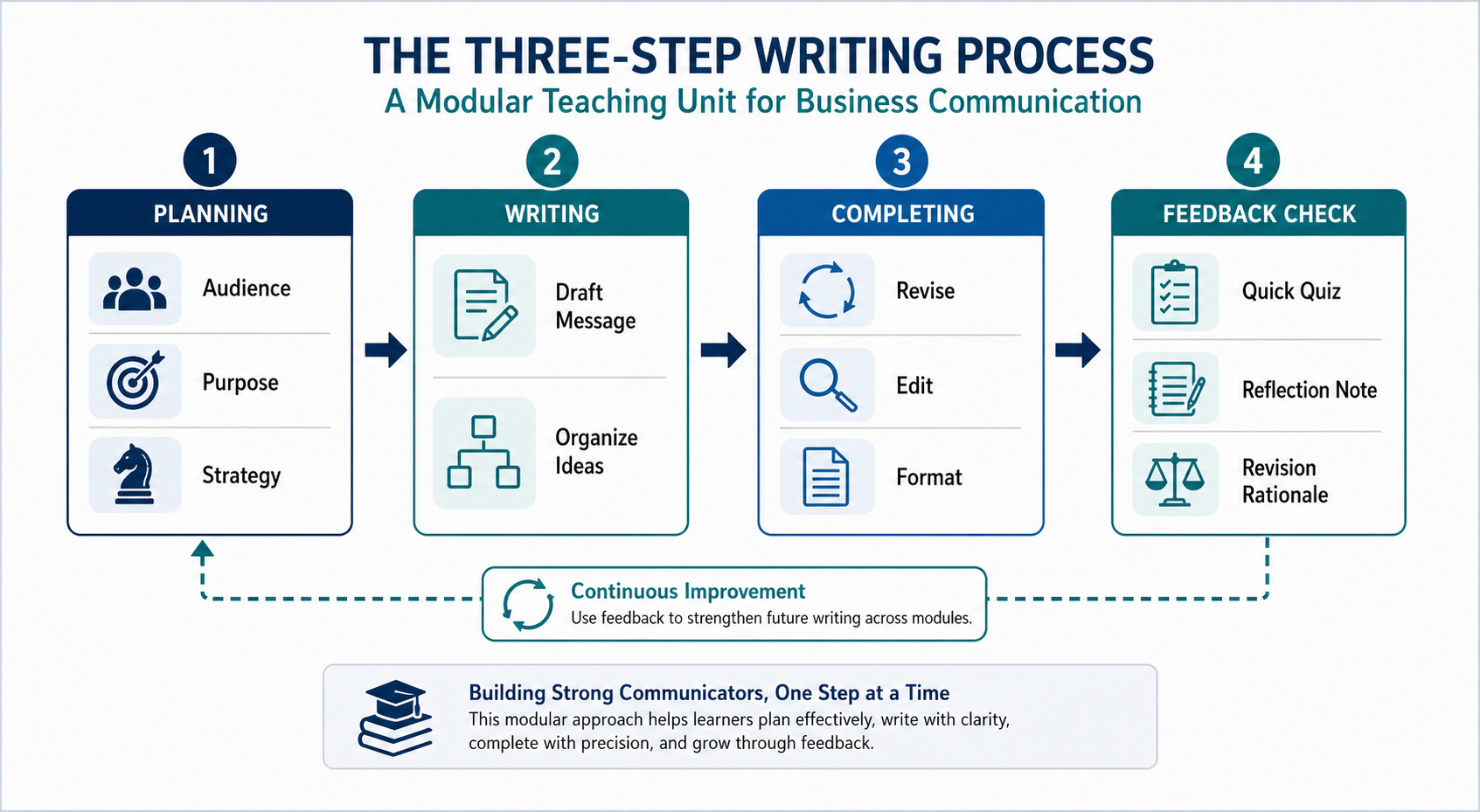
One especially useful organizing model comes from the book’s three-step writing process: planning, writing, and completing messages. Even if you are not teaching a fully textbook-driven course, those three stages make an excellent backbone for modules because they reflect the actual workflow students need in workplace writing.
2. Choose Modular Activities That Promote Transfer
The best modular activities in business communication are the ones students can revisit across assignments and contexts. They work because they build habits, not just one-time performance.
Best activity type 1: Message analysis modules
Short analysis tasks are highly modular because they require limited setup and can fit almost any topic. The prefatory material for Excellence in Business Communication notes “Messages for Analysis” that ask students to evaluate real-world communication examples and identify strengths and weaknesses. As an instructor-designed module, you might give students one email, memo, or announcement and ask them to diagnose audience awareness, tone, clarity, and organization in ten minutes.
This activity works especially well early in a course because students can discuss quality before producing polished work of their own. It also supports classes with mixed preparation levels because students can contribute observations even if their writing confidence is still developing.
Best activity type 2: Planning drills
Planning is one of the most transferable communication skills, and it is easy to modularize. Chapter 5 materials emphasize defining purpose, profiling audience, choosing medium, selecting approach, and outlining content. A planning module can ask students to complete only those front-end decisions for a scenario before they draft anything.
These modules are efficient because they reduce cognitive overload. The book’s discussion of cognitive load management highlights sequencing, subheadings, summaries, bite-sized lessons, and self-paced structures that make complex learning easier to handle. Instructors can apply that principle by separating planning from drafting instead of grading everything at once.
Best activity type 3: Retrieval and checkup modules
Not every module needs a full writing product. Bovee and Thill describe Learning Objectives Checkups as low-stress opportunities for retrieval practice. In your own course, a module might ask students to recall three principles of audience adaptation, choose the best opening for a difficult message, or explain when a direct approach is preferable.
These activities work best when they are short, repeated, and clearly connected to future assignments. Their value is cumulative.

Best activity type 4: Scenario-based decision modules
Another strong option is a communication decision module built around a realistic situation. The excerpts describe prompts that ask students to weigh trade-offs, make decisions, reflect on habits, and apply newly learned skills to everyday situations. That format is ideal for business communication because students often struggle less with sentence-level correctness than with choosing the right strategy under pressure.
For example, you might present a scenario involving an AI-suggested revision, a cross-cultural misunderstanding, or a message that must preserve a relationship while delivering unwelcome news. Students then justify their choice in a short paragraph or discussion post.
Best activity type 5: Integrated case modules
Longer modules are also useful, particularly near the end of a unit. The book describes communication cases that require students to analyze situations, make strategic decisions, and create effective messages in realistic business settings. In a modular course, these function well as capstone units after students have completed smaller planning, analysis, and revision modules.
3. Sequence Modules for Varied Course Formats
Modular teaching works best when the sequence feels intentional rather than atomized. A simple pattern is preview, practice, produce, and reflect.
Start with a preview module that activates prior knowledge and introduces key concepts through a mini-lesson, checklist, or visual organizer. The book’s emphasis on infographics, quick-reference materials, and simplified presentation supports this kind of opening move, especially for students who benefit from clearer information structuring.
Next, assign a practice module such as message analysis, planning, or a short discussion. Then use a production module for drafting, revising, or presenting. Close with a reflection or checkup module so students consolidate what they learned and identify what they still need to improve.
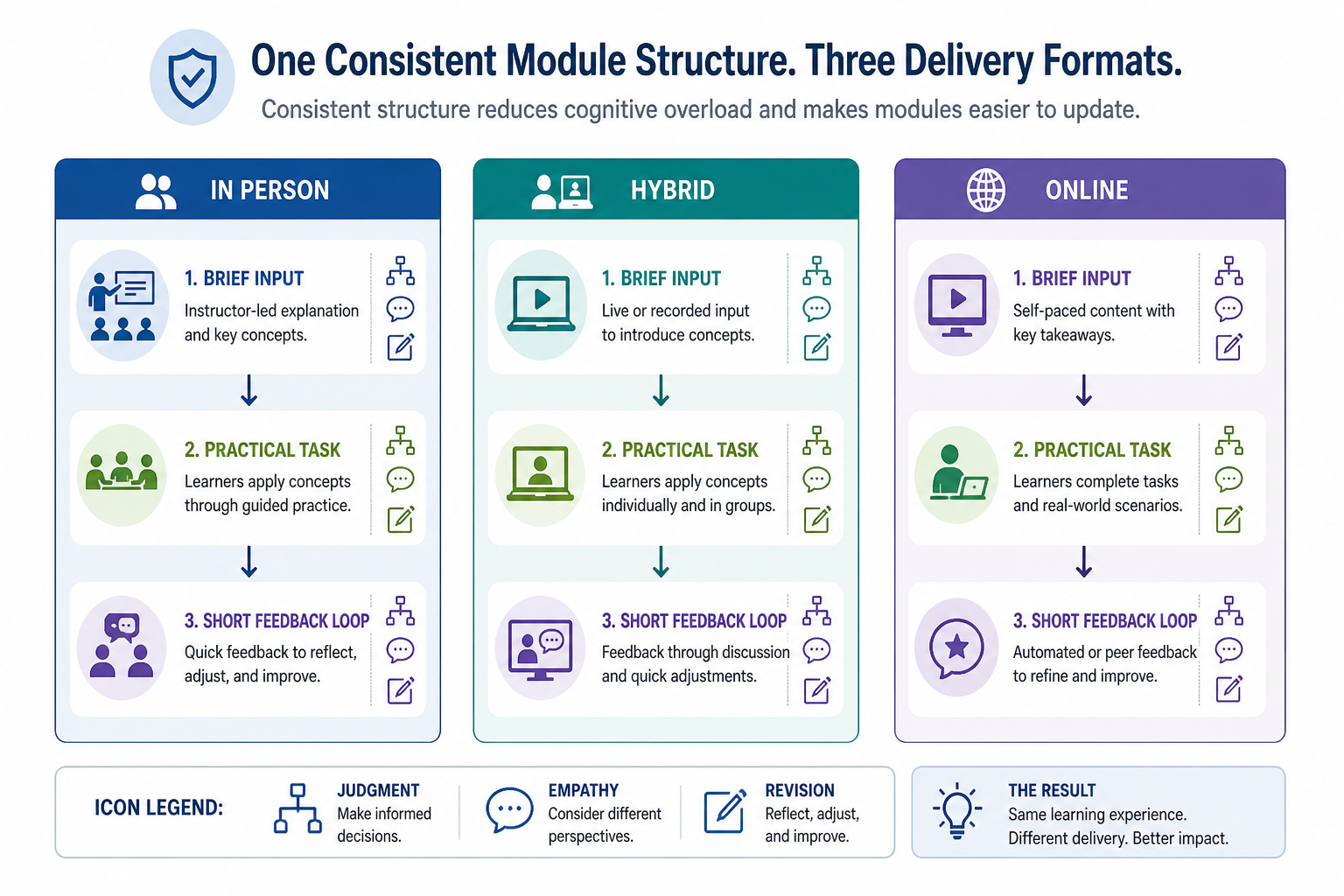
This sequence works in face-to-face, hybrid, and online formats because each module has a clear purpose and manageable scope. It also makes it easier to swap or update individual units when workplace genres, technologies, or course constraints change.
If you are redesigning a full course, keep the modules consistent in shape even when the content changes. Students adapt faster when they know what to expect: a brief input, a practical task, and a short feedback loop. That consistency reduces confusion and gives more room for deeper work on judgment, empathy, and revision.
Key Takeaways
- Use modules as short skill cycles, not just topic chunks.
- Center modular work on application, especially analysis, planning, and decision-making.
- Include low-stakes retrieval or reflection so each module has a feedback point.
- Sequence modules from preview to practice to production to reflection.
- Keep module structure consistent across delivery formats to reduce cognitive overload.
Glossary of Key Terms
- Modular teaching framework: A course design approach that organizes learning into smaller, self-contained instructional units.
- Retrieval practice: A learning strategy in which students strengthen memory by recalling information rather than only rereading it.
- Cognitive load: The mental effort required to process information during a learning task.
- Skill transfer: The ability to apply a concept or process in a new context rather than only in the original lesson.
- Planning module: A short instructional unit focused on purpose, audience, medium, and organization before drafting begins.
Related Questions
- Question: How long should a business communication module be?
Answer: A good module is usually short enough to complete in one class session or one online learning block. The key is not time alone but whether the unit has one clear objective, one meaningful task, and one feedback point. - Question: Are modular activities better for online courses than face-to-face courses?
Answer: They work well in both formats because they make expectations visible and manageable. Online courses benefit from clearer structure, while face-to-face courses benefit from easier pacing and more flexible discussion or workshop use. - Question: Which module should come first in a redesigned business communication course?
Answer: Start with a planning-focused module because it gives students a process they can reuse across the term. Early attention to purpose, audience, and organization improves later drafting and revision work. - Question: How can modular teaching support students with different readiness levels?
Answer: Modular design helps because students can practice one communication move at a time instead of handling every demand at once. It also allows instructors to vary support, examples, or follow-up tasks without rewriting an entire course. - Question: Do modular activities reduce rigor?
Answer: Not if the modules build toward larger performances and ask students to justify their choices. In many cases, modular design increases rigor because it makes professional thinking, revision, and transfer more visible.
References
Bovee, C. L., & Thill, J. V. (2026). Excellence in Business Communication (15th ed.). Pearson.
© 2026 Business Communication Teaching and Learning Center. All rights reserved.