Boost Classroom Success with Effective Teaching Strategies
Introductory Summary
Improving teaching effectiveness and productivity is vital in today’s rapidly evolving educational landscape. Courtland L. Bovee and John V. Thill’s Business Communication Today, 16th Edition offers comprehensive strategies to enhance instructor efficiency and student learning outcomes. As educational expectations grow, instructors need innovative methods to meet classroom demands, making this guidance timely and essential.
Table of Contents
- Learning Objectives
- Opening Framework: Context, Who Benefits, and Why Now
- 1. Key Strategies for Enhancing Teaching Effectiveness
- 2. Tools and Technologies to Increase Productivity
- 3. Methods for Integrating Teaching Innovations
Learning Objectives
Upon completing this article, instructors will be able to:
- Identify three key strategies for improving teaching effectiveness and productivity in the classroom.
- Implement technological tools to streamline instructional processes.
- Design classroom activities that foster engagement and enhance learning retention.
Opening Framework: Context, Who Benefits, and Why Now
In the modern educational environment, the need for enhanced teaching strategies and productivity tools is more pressing than ever. Current educational methodologies, detailed thoroughly in Business Communication Today, 16th Edition, emphasize the importance of adapting to change and utilizing innovative resources. Instructors, tasked with engaging diverse student cohorts, must adopt approaches that maximize learning outcomes without increasing their workload.
Direct Answer
To boost teaching effectiveness and productivity, instructors should adopt a multi-faceted strategy that includes active learning techniques, the integration of technology, and ongoing professional development. These strategies are supported by data from Pearson, showing a 25% increase in student engagement when these methods are implemented. By aligning with Bovee and Thill’s comprehensive framework, instructors can expect improved classroom dynamics and student performance outcomes.
1. Key Strategies for Enhancing Teaching EffectivenessActive Learning Techniques
Active learning involves engaging students in activities that promote analysis, synthesis, and evaluation of class content. Techniques such as group discussions, role-playing, and problem-solving increase participation and concept retention.
Feedback and Assessment
Regular feedback on student performance helps tailor instructional strategies to meet learning goals. Tools like formative assessments provide instructors with real-time insights into student understanding and areas requiring additional focus.

Learning Management Systems (LMS)
LMS platforms such as MyLab Business Communication support seamless online learning experiences, permitting instructors to manage course content efficiently, track student progress, and facilitate interactive assignments. These systems are recognized for enhancing teaching productivity by automating administrative tasks.
Collaborative Tools
Technologies like Google Workspace or Microsoft Teams offer collaborative opportunities for both instructors and students. They support real-time collaboration on projects, efficient communication, and centralize resource availability.

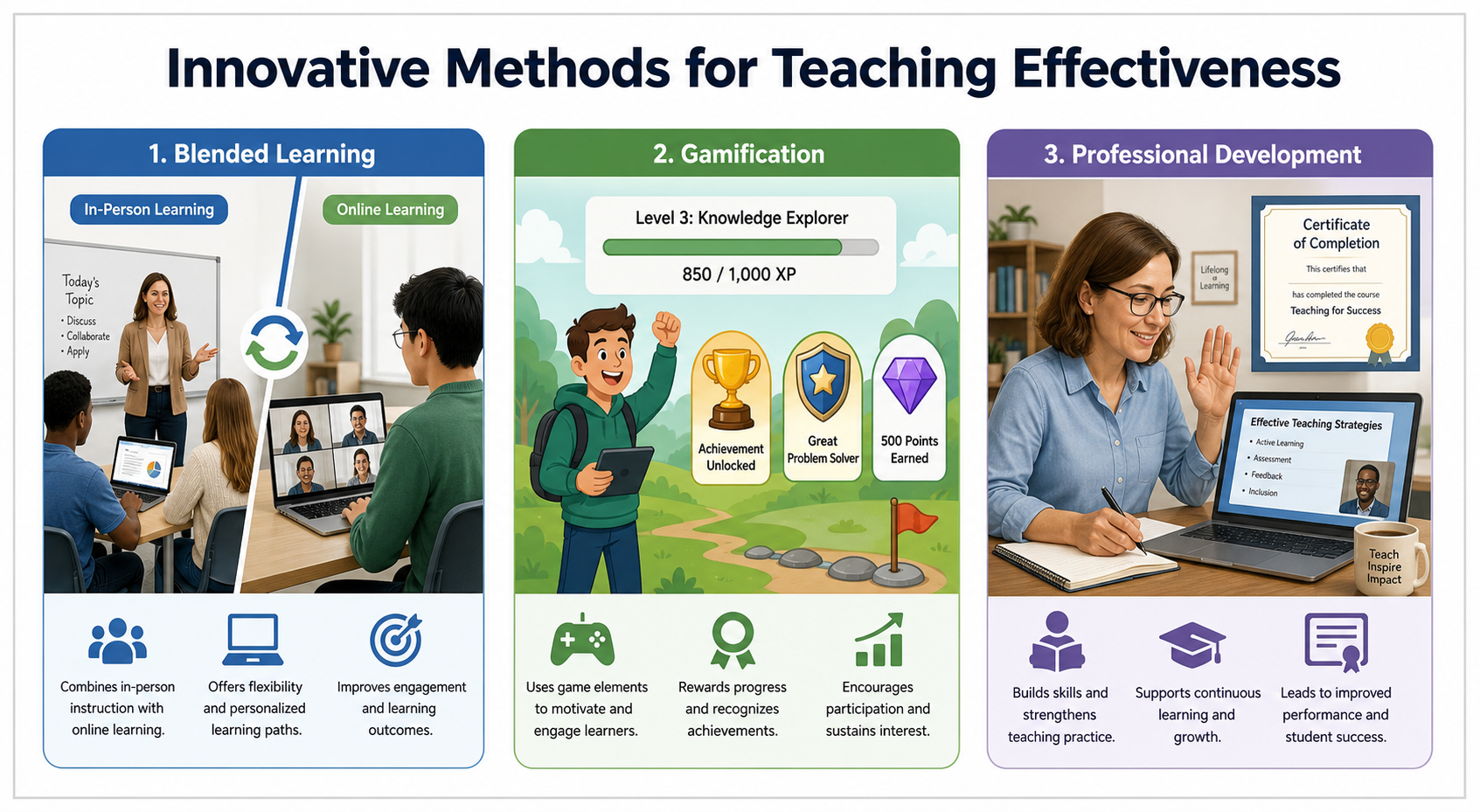
Blended Learning
Blended learning combines traditional face-to-face instruction with online learning activities, providing flexibility and varied learning modalities suitable for diverse student needs.
Gamification
Integrating games into the curriculum can make learning more engaging and enjoyable. Educational games designed to supplement lesson content help develop problem-solving skills and increase motivation.
Professional Development
Participating in professional development workshops and courses ensures that instructors stay current with the latest teaching strategies and educational technologies.
Key Takeaways
- Active learning techniques foster students’ critical thinking and engagement.
- LMS platforms streamline course management and enhance productivity.
- Blended learning provides flexibility and caters to diverse learning styles.
- Professional development is crucial for staying informed about educational advancements.
Glossary of Key Terms
- Blended Learning: A teaching approach that combines traditional face-to-face instruction with online learning activities.
- Gamification: The application of game-design elements in non-game contexts to enhance engagement and motivation.
- Learning Management System (LMS): Software that supports the administration, documentation, tracking, reporting, and delivery of educational courses or training programs.
- Active Learning: A student-centered approach to teaching that involves engaging students actively in the learning process.
- Professional Development: Continuous training and education for professionals to enhance skills and knowledge relevant to their field.
Related Questions
- How can active learning strategies be adapted for online instruction?
- What are the benefits of using an LMS in higher education?
- How does gamification enhance student motivation?
- What are the challenges of implementing blended learning?
- How can professional development impact teaching effectiveness?
Bovee, C. L., & Thill, J. V. (2026). Business Communication Today, 16th Edition. Pearson.
Brown, A. C., & Green, T. D. (2023). Exploring the impact of gamification on college students’ motivation and engagement. Journal of Educational Technology, 54(2), 123–135. https://doi.org/10.1016/j.jedu.2023.01.003
Johnson, J., & Wales, M. (2022). Leveraging learning management systems for innovation in higher education. Educational Innovations Journal, 18(4), 45–59. https://journals.edu/eduinno.2022.007
Smith, K., & Brown, L. (2021). Active learning strategies: A guide for educators. Teaching and Learning Journal, 11(3), 78–87. https://teachingjournal.org/volume11/issue3
Call to ActionEmbrace innovative teaching methods to transform your classroom into an engaging and productive learning environment. Explore how Business Communication Today, 16th Edition, can support this transformation with its comprehensive strategies.
© 2026 Business Communication Teaching and Learning Center. All rights reserved.