How does active learning improve business communication teaching?
Quick answer: Students don’t learn communication by reading about it or listening to lectures—they learn by doing it. Active learning turns students from passive recipients into engaged practitioners who develop genuine competence through practice, feedback, and reflection. You don’t need to transform everything at once: start small, build confidence, and expand your repertoire over time.
Use this hub to choose an active learning focus and go directly to the article that covers it.
At a glance: active learning approaches and articles
On smaller screens, scroll horizontally within the table to see all four columns.
| Teaching focus | Activity or approach | Learning purpose | Related article |
|---|---|---|---|
| Active learning foundations | Active vs. passive learning, core principles, and entry points for instructors new to active learning | Understand active learning principles and implement them effectively | Igniting Active Learning in Business Communication Courses |
| Dynamic strategies | Quick 5-10 minute engagement boosters, extended activities, low-prep and high-impact options | Build a varied engagement repertoire matched to learning objectives | How Can These 40 Dynamic Strategies Ignite Passion and Drive Success |
| Innovative methods | Intentional failure activities, reverse teaching, gamification, and student-designed assignments | Use unconventional methods that outperform traditional approaches | Which of These 10 ‘Crazy’ Teaching Ideas Actually Works Better Than Traditional Methods |
| Classroom transformation | Physical environment, psychological climate, community building, and ritual and tradition | Create classrooms students want to be in, physically and psychologically | How Do You Turn a Business Communication Classroom Into a Place Students Actually Want to Be |
| Revolutionary instruction | Case-based, project-based, flipped, and competency-based instructional models | Rethink fundamental assumptions about how business communication should be taught | How Can Educators Revolutionize Business Communication Instruction |
| Breakthrough moments | Cognitive dissonance, strategic surprise, metaphor and analogy, and reflection prompts | Make “aha moments” regular occurrences rather than random luck | What If You Could Engineer Aha Moments Instead of Waiting for Them to Happen |
| Visual learning | Mind mapping, infographics and data visualization, sketch noting, and multimodal instruction | Reach students who struggle with text-heavy instruction | What If Visual Learning Could Finally Engage Every Student in Your Classroom |

Active Learning & Engagement
Transforming Passive Audiences into Active Practitioners
Hub Overview: Students don’t learn communication by reading about it or listening to lectures—they learn by doing it. Active learning transforms students from passive recipients into engaged practitioners who develop genuine competence through practice, feedback, and reflection. This hub explores proven active learning strategies, innovative teaching methods, classroom transformation approaches, and techniques for creating breakthrough learning moments.
Related Pillar: Teaching Strategies & Innovation
Why Active Learning Matters
Traditional business communication instruction relies heavily on:
- Lectures explaining concepts and principles
- Reading textbook chapters
- Individual writing assignments
- End-of-chapter exercises
While these elements have value, they’re insufficient for deep skill development. Research consistently shows that active learning—where students practice, discuss, create, analyze, and apply—produces significantly better outcomes than passive instruction alone.
Yet many instructors hesitate to implement active learning because:
- “I don’t have time to cover less content”
- “Active learning activities take too much class time”
- “My students resist anything besides lecture”
- “I’m not confident facilitating activities”
- “I don’t know where to start”
This hub addresses these concerns while providing:
- Research-backed rationale for active learning
- Practical strategies you can implement immediately
- Innovative methods that outperform traditional approaches
- Classroom transformation techniques that engage reluctant learners
- Breakthrough moment engineering that accelerates learning
- Visual learning integration that reaches all students
Topics and Featured Articles
Active Learning Foundations: Getting Started
Cluster Focus: Understanding active learning principles and implementing them effectively in business communication courses.
Igniting Active Learning in Business Communication Courses
Active learning isn’t a single technique—it’s a pedagogical approach that engages students in the learning process through practice, discussion, and application.
This article examines:
- Active vs. Passive Learning: Understanding the critical differences
- Research Evidence: Why active learning produces better outcomes
- Core Principles: What makes active learning effective
- Common Misconceptions: Debunking myths about active learning
- Implementation Barriers: Addressing instructor concerns
- Getting Started: Entry points for instructors new to active learning
- Assessment Integration: Measuring learning in active classrooms
Key Questions Answered:
- What exactly is active learning?
- Why does it work better than lecture?
- How do you get started with active learning?
- What if students resist?
Dynamic Strategies: Comprehensive Toolkit
Cluster Focus: A broad repertoire of engagement strategies that work across various course contexts and student populations.
How Can These 40 Dynamic Strategies Ignite Passion and Drive Success

Effective engagement requires variety. Different strategies work for different learning objectives, student characteristics, and instructional contexts.
This article provides:
- Strategy Categories: Discussion, collaboration, creation, analysis, application
- Quick Activities: 5-10 minute engagement boosters
- Extended Activities: Activities spanning full class periods or multiple sessions
- Low-Prep Options: Strategies requiring minimal preparation
- High-Impact Options: Time-intensive strategies with exceptional results
- Matching Strategies to Objectives: Choosing appropriate activities
- Implementation Tips: Making each strategy work effectively
Key Questions Answered:
- What active learning strategies work best for business communication?
- How do you choose appropriate strategies?
- Which strategies provide maximum impact for time invested?
- How do you build a varied engagement repertoire?
Target Keywords: student engagement strategies, teaching strategies, active learning techniques, engagement activities, student participation
Innovative Methods: Unconventional Approaches That Work
Cluster Focus: Teaching methods that seem unconventional but produce remarkable results.
Which of These 10 ‘Crazy’ Teaching Ideas Actually Works Better Than Traditional Methods
Sometimes the most effective teaching approaches feel counterintuitive or risky. This article explores unconventional methods that research and experience show outperform traditional approaches.
This article examines:
- Intentional Failure Activities: Learning through productive struggle
- Reverse Teaching: Students teach concepts before instructor explanation
- Chaotic Collaboration: Controlled chaos that drives engagement
- Performance-Based Assessment: Real audiences and authentic stakes
- Gamification: Competition and play in service of learning
- Constraint-Based Creativity: How limitations enhance innovation
- Public Critique: Safe vulnerability that accelerates improvement
- Technology-Free Days: Unplugging to deepen learning
- Student-Designed Assignments: Autonomy within structure
- Failure Celebration: Normalizing mistakes as learning opportunities

Key Questions Answered:
- What unconventional methods actually work?
- Why do these “crazy” ideas succeed?
- How do you implement risky approaches safely?
- What if students resist unconventional methods?
Target Keywords: innovative teaching methods, unconventional teaching, creative pedagogy, teaching innovation, experimental teaching approaches
Classroom Transformation: Creating Spaces Students Want to Inhabit
Cluster Focus: Transforming the physical and psychological classroom environment to enhance engagement and learning.
How Do You Turn a Business Communication Classroom Into a Place Students Actually Want to Be
Students vote with their attention and attendance. Creating classrooms they want to be in—physically and psychologically—dramatically improves engagement and outcomes.
This article explores:
- Physical Environment: Seating arrangements, flexibility, resources, ambiance
- Psychological Climate: Safety, belonging, intellectual curiosity, play
- Community Building: Relationships among students and with instructor
- Ritual and Tradition: Consistent elements that create comfort
- Surprise and Novelty: Unexpected elements that maintain interest
- Student Ownership: How involvement creates investment
- Belonging Signals: Communicating that students matter and belong
Key Questions Answered:
- What makes students want to attend and engage?
- How do you create psychological safety?
- Can you transform a classroom without major resources?
- How do you build community in large classes?
Target Keywords: engaging business communication classroom, classroom environment, student engagement, classroom community, learning space design
Revolutionary Instruction: Fundamental Transformation
Cluster Focus: Moving beyond incremental improvements to fundamentally transform business communication instruction.
How Can Educators Revolutionize Business Communication Instruction
Sometimes incremental improvement isn’t enough. Revolutionary transformation requires rethinking fundamental assumptions about how business communication should be taught.

This article examines:
- Challenging Assumptions: What if our fundamental approach is limited?
- Radical Alternatives: Completely different instructional models
- Case-Based Learning: Building entire courses around authentic cases
- Project-Based Learning: Extended real-world projects as course backbone
- Flipped Classroom: Reversing traditional in-class and out-of-class activities
- Competency-Based Progression: Students advance by demonstrating mastery
- Collaborative Construction: Students build course content together
- Assessment Revolution: Moving beyond traditional grading
Key Questions Answered:
- What would truly revolutionary instruction look like?
- Should you pursue incremental or revolutionary change?
- What are the risks of fundamental transformation?
- How do you build support for radical approaches?
Target Keywords: revolutionizing business communication teaching, transformative pedagogy, innovative instruction, fundamental teaching change, pedagogical revolution
Breakthrough Moments: Engineering Insight
Cluster Focus: Creating conditions where “aha moments” become regular occurrences rather than random luck.
What If You Could Engineer Aha Moments Instead of Waiting for Them to Happen
Breakthrough moments—when concepts suddenly click and students experience genuine insight—don’t have to be accidental. You can create conditions that make them more likely.
This article explores:
- Cognitive Science of Insight: Understanding how breakthroughs occur
- Creating Cognitive Dissonance: Productive confusion that drives learning
- Strategic Surprise: Unexpected information that reshapes understanding
- Pattern Revelation: Helping students see underlying structures
- Metaphor and Analogy: Powerful tools for conceptual understanding
- Experiential Learning: Direct experience creating visceral understanding
- Reflection Prompts: Questions that catalyze insight
- Timing: When students are most receptive to breakthrough moments
Key Questions Answered:
- Can you really engineer breakthrough moments?
- What conditions promote insight?
- How do you know when students have genuine understanding?
- What role does productive struggle play?
Target Keywords: creating learning breakthroughs, aha moments teaching, insight learning, transformative learning experiences, conceptual understanding
Visual Learning: Engaging All Students
Cluster Focus: Leveraging visual communication and learning to reach students who struggle with text-heavy instruction.
What If Visual Learning Could Finally Engage Every Student in Your Classroom
Many students are visual learners who struggle with traditional text-based instruction. Visual learning strategies can transform their engagement and success.

This article examines:
- Visual Learning Research: Why visuals enhance learning for everyone
- Visual Communication Skills: Teaching students to create and interpret visuals
- Infographics and Data Visualization: Making information visual
- Mind Mapping: Visual organization of concepts and ideas
- Sketch noting: Drawing to enhance understanding and retention
- Video and Animation: Dynamic visuals for complex concepts
- Visual Metaphors: Images that illuminate abstract concepts
- Multimodal Instruction: Combining text, visual, and audio
Key Questions Answered:
- How do you incorporate visual learning into a traditionally text-based course?
- What visual strategies work best for business communication?
- How do you teach visual literacy alongside written communication?
- Can visual learning work in large classes?
Target Keywords: visual learning strategies, visual communication teaching, infographics teaching, visual pedagogy, multimodal learning
Synthesis: Building Your Active Learning Practice
Implementing active learning doesn’t require abandoning everything and starting over. Use this progressive framework:
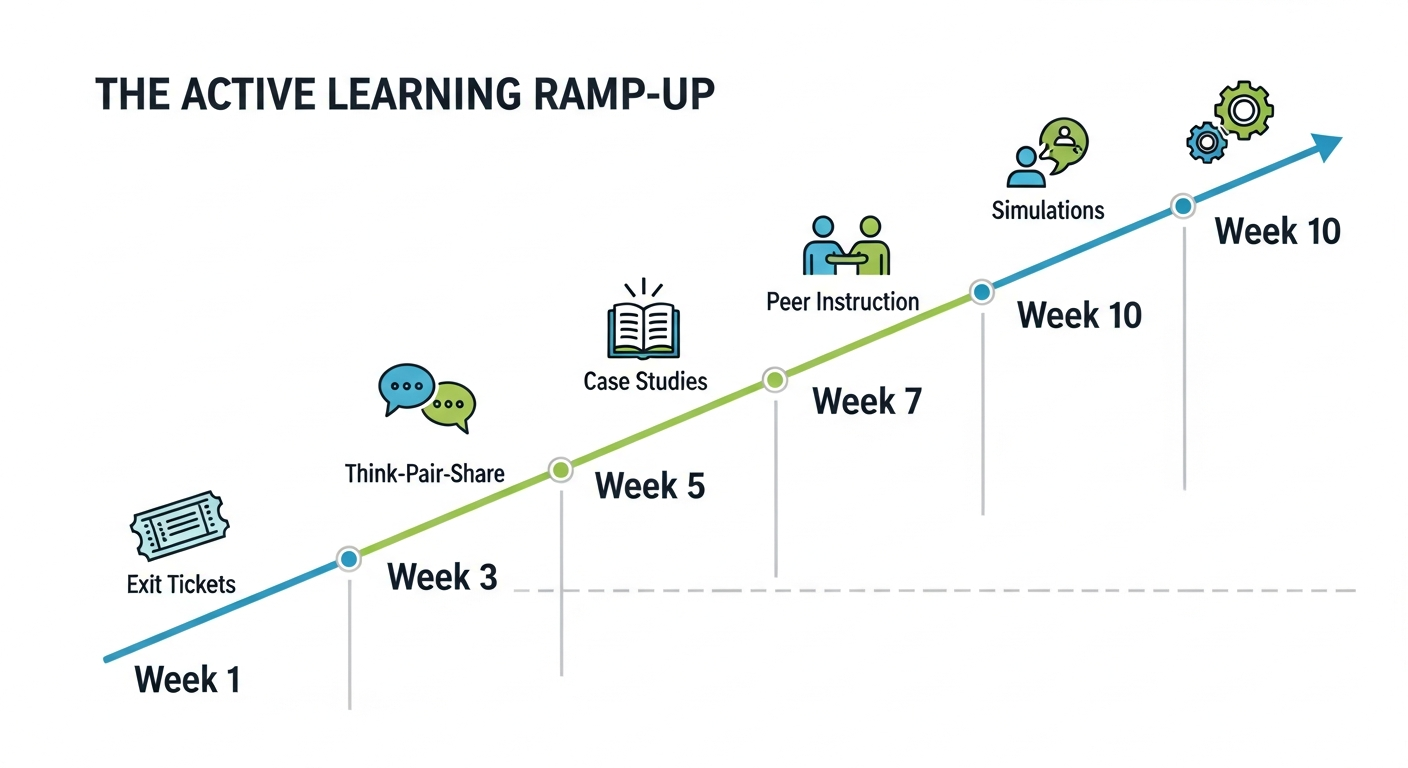
Stage 1: Foundations (Weeks 1-4)
Start with Low-Risk Activities:
- Think-Pair-Share: Students think individually, discuss with partner, share with class
- Exit Tickets: Brief end-of-class reflections or questions
- Peer Review: Structured feedback on drafts
- Case Analysis: Brief scenarios for discussion
- Quick Writes: 5-minute responses to prompts
Build Confidence:
- Start small and simple
- Establish classroom norms for participation
- Model effective discussion and feedback
- Celebrate participation efforts
Stage 2: Expansion (Weeks 5-10)
Add More Complex Activities:
- Debates: Structured argumentation practice
- Simulations: Role-playing business scenarios
- Collaborative Writing: Group document creation
- Presentation Workshops: Practice with peer feedback
- Problem-Based Learning: Solving authentic challenges
Increase Sophistication:
- Longer activities spanning multiple class periods
- More student autonomy in execution
- Higher-stakes application
- Integration across topics
Stage 3: Integration (Weeks 11-16)
Make Active Learning Default:
- Project-Based Units: Extended real-world projects
- Student-Led Teaching: Students present and facilitate
- Portfolio Development: Cumulative skill demonstration
- Authentic Assessment: Real audiences and purposes
- Reflective Practice: Meta-cognition about learning
Refine and Deepen:
- Student feedback guides improvement
- Activities become more sophisticated
- Student ownership increases
- Assessment aligns with active learning
Ongoing: Iteration and Growth
Continuous Improvement:
- Document what works and what doesn’t
- Try new strategies each semester
- Share approaches with colleagues
- Attend workshops and read research
- Build your active learning repertoire
The Active Learning Mindset

Effective active learning requires shifting your instructor identity:
From Sage to Facilitator
Your role isn’t primarily delivering information but creating conditions for learning
From Coverage to Depth
Better to deeply understand fewer concepts than superficially cover many
From Perfection to Iteration
Activities don’t need to be perfect—they need to be tried, assessed, and refined
From Control to Trust
Students learn through productive struggle and occasional failure
From Individual to Community
Learning happens through interaction and collaboration
From Assessment to Feedback
Focus on growth and improvement, not just measurement
From Teaching to Learning
The question isn’t “What did I teach?” but “What did students learn?”
Addressing Common Concerns

“Active learning takes too much time”
Reality: Active learning often takes less time than you think, and produces better outcomes per minute invested. One hour of active learning beats three hours of passive lecture. Plus, less content covered deeply beats more content covered superficially.
Strategy: Start with 10-minute activities. Build from there. Replace the least effective lecture time first.
“My students resist participation”
Reality: Students resist poorly designed activities or threatening environments, not well-designed active learning in safe spaces.
Strategy: Build psychological safety first. Start with low-stakes activities. Make participation expectations clear. Model and celebrate good participation.
“I’m not comfortable facilitating activities”
Reality: Facilitating active learning is a learned skill. Everyone feels awkward at first.
Strategy: Start with structured activities that practically run themselves. Observe effective colleagues. Practice and reflect. Join teaching communities for support.
“Class time is too limited”
Reality: You already have the time—it’s currently spent on less effective activities.
Strategy: Flip content delivery to pre-class. Use class time for application only. Eliminate low-value activities. Focus ruthlessly on active practice.
“I can’t assess active learning”
Reality: Active learning is often easier to assess than passive learning because you observe students performing skills.
Strategy: Use rubrics for activities. Provide immediate feedback during practice. Make process visible through portfolios or reflections.
Instructor takeaways
- Start small. Begin with 10-minute, low-risk activities such as Think-Pair-Share or exit tickets, and replace the least effective lecture time first.
- Build psychological safety first. Make participation expectations clear, then model and celebrate good participation.
- Match strategies to objectives. Different strategies work for different learning objectives, student characteristics, and instructional contexts.
- Assess what students do. Use rubrics, immediate feedback during practice, and portfolios or reflections to make the process visible.
- Shift your role. Move from delivering content to facilitating learning, and keep iterating: document what works and try new strategies each semester.
Related questions
What exactly is active learning?
Active learning isn’t a single technique. It’s a pedagogical approach that engages students in the learning process through practice, discussion, and application. Igniting Active Learning in Business Communication Courses covers the foundations.
Why does active learning work better than lecture?
Students develop communication competence by doing it: through practice, feedback, and reflection. Lectures, readings, and end-of-chapter exercises have value but are insufficient for deep skill development on their own.
How do you get started with active learning?
Start with low-risk activities such as Think-Pair-Share, exit tickets, peer review, case analysis, and quick writes. Begin with 10-minute activities and build from there, following the progressive framework above.
What if students resist?
Students resist poorly designed activities or threatening environments, not well-designed active learning in safe spaces. Build psychological safety first, start with low-stakes activities, and make participation expectations clear.
How do you build a varied engagement repertoire?
Effective engagement requires variety, so match strategies to learning objectives and try new strategies each semester. How Can These 40 Dynamic Strategies Ignite Passion and Drive Success organizes options from quick activities to high-impact ones.
Can you really engineer breakthrough moments?
Breakthrough moments don’t have to be accidental. You can create conditions that make them more likely, using techniques such as productive confusion, strategic surprise, metaphor, and reflection prompts. See What If You Could Engineer Aha Moments Instead of Waiting for Them to Happen.
Connection to Other Hubs
This hub focuses on active learning strategies and engagement. For context:
- Course Design & Modernization – Foundational course structure and design principles
- Real-World & Culture-Rich Teaching – Connecting activities to authentic contexts
Together, these three hubs provide comprehensive guidance for transforming business communication instruction.
The Bottom Line
Active learning isn’t optional for effective business communication instruction—it’s essential. Students develop communication competence through:
- ✓ Regular practice with authentic communication tasks
- ✓ Immediate feedback from instructors, peers, and self-assessment
- ✓ Progressive challenge that builds skills systematically
- ✓ Collaborative learning that mirrors workplace communication
- ✓ Reflection that builds metacognitive awareness
- ✓ Application that transfers learning to new contexts
- ✓ Engagement that maintains motivation and effort
The articles in this hub provide both the theoretical foundation and practical strategies for implementing active learning effectively in business communication courses. You don’t need to transform everything at once—start small, build confidence, and expand your repertoire over time.
The result: classrooms where students are actively engaged, genuinely learning, and developing real communication competence rather than just memorizing concepts.