Practical Resources for Teaching AI Ethics in Business Communication
Table of Contents
- Introductory Summary
- Learning Objectives
- Opening Framework: Context, Who Benefits, and Why Now
- Direct Answer
- 1. Start with principles before tools
- 2. Use structured activities to slow student decisions
- 3. Build a small resource set students can reuse
- Key Takeaways
- Glossary of Key Terms
- Related Questions
- References
Introductory Summary
Instructors teaching AI ethics in business communication usually need more than a policy statement. They need classroom-ready resources that help students evaluate output, disclose AI use appropriately, recognize bias and misinformation, and keep human judgment at the center of workplace communication. Business Communication Today, 16th Edition by Courtland L. Bovee and John V. Thill is useful here because it frames AI as a tool that must be used ethically, transparently, and critically rather than automatically.
Learning Objectives
- Identify the main ethical risks students should evaluate when using AI in business communication.
- Design short class activities that require students to test, question, and revise AI-generated content.
- Create a practical set of reusable resources, prompts, and disclosure expectations for student work.
Opening Framework: Context, Who Benefits, and Why Now
Many students are already experimenting with AI outside class, often without clear standards for responsible use. A well-designed resource set helps instructors in face-to-face, hybrid, and online courses teach both the opportunities and the limits of AI while supporting students with different levels of technical confidence and prior writing experience.
Direct Answer
The most helpful resources are a combination of textbook guidance, instructor-created evaluation tools, short comparison activities, and real-world policy examples. In Bovee and Thill’s treatment of AI, the strongest teaching approach is to introduce core communication principles first, then use AI as a collaborative writing partner that students must question, verify, and revise. That means the best resources are those that make students examine transparency, bias, misinformation, plagiarism, privacy, and the consequences of weak judgment instead of treating AI as a shortcut.
1. Start with principles before tools
One of the most useful teaching resources is the textbook itself when it gives you a stable framework for discussion. In the prefatory material for Bovee and Thill (2026), the authors explain that the AI coverage was integrated across the text to help students develop effective and ethical AI skills, including transparency, bias, misinformation, and compensation for content creators. They also note that AI sections typically follow instruction on fundamental principles so students first learn how to do the work without AI.
That sequence matters for teaching ethics. If students learn audience analysis, clarity, evidence use, and tone before they rely on a chatbot, they are better prepared to notice when AI output is generic, inaccurate, or inappropriate for the rhetorical situation.
Use the book’s ethics language to anchor class expectations
Chapter 1 material is especially helpful because it defines ethics as principles of right and wrong that guide behavior and decision-making, and it identifies five forms of unethical communication: withholding information, distorting information, plagiarizing, failing to consider negative consequences, and violating privacy. Those categories translate well into an AI ethics checklist for assignments.
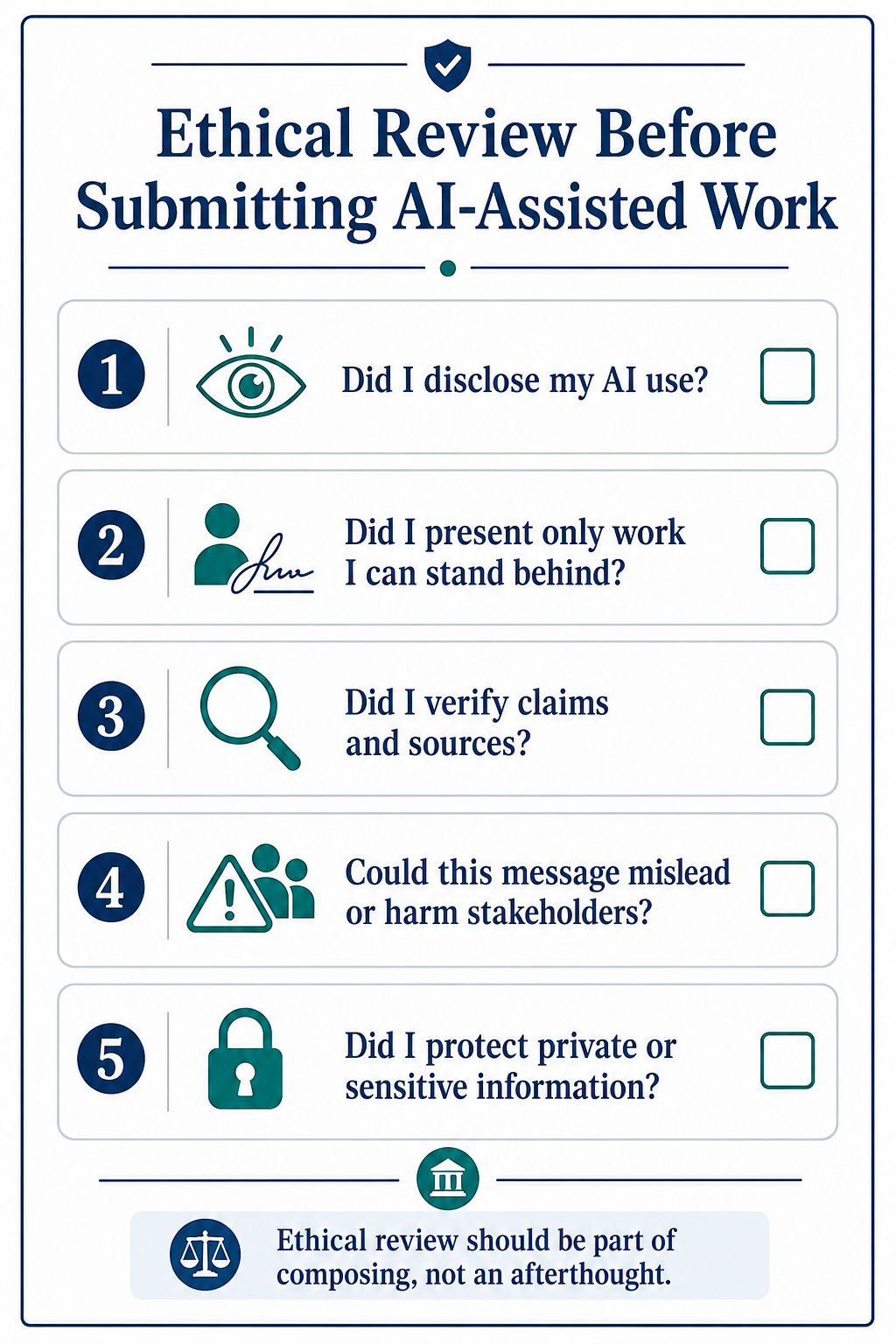
For example, before students submit an AI-assisted memo or presentation outline, ask them to answer five brief questions: Did I hide my use of AI? Did I pass off borrowed language or ideas as fully my own? Did I verify claims and sources? Did I consider whether the message could mislead or harm stakeholders? Did I expose private or sensitive information? This kind of checklist is simple, but it teaches ethical review as part of composing, not as an afterthought.
2. Use structured activities to slow student decisions
Students often make poor AI choices when the tool feels fast and frictionless. Resources that slow the process down are especially effective. Bovee and Thill describe AI as a collaborative writing partner and emphasize critically evaluating its output, which gives instructors a clear classroom direction: build activities around comparison, verification, and revision.
Recommended activity: output verification log
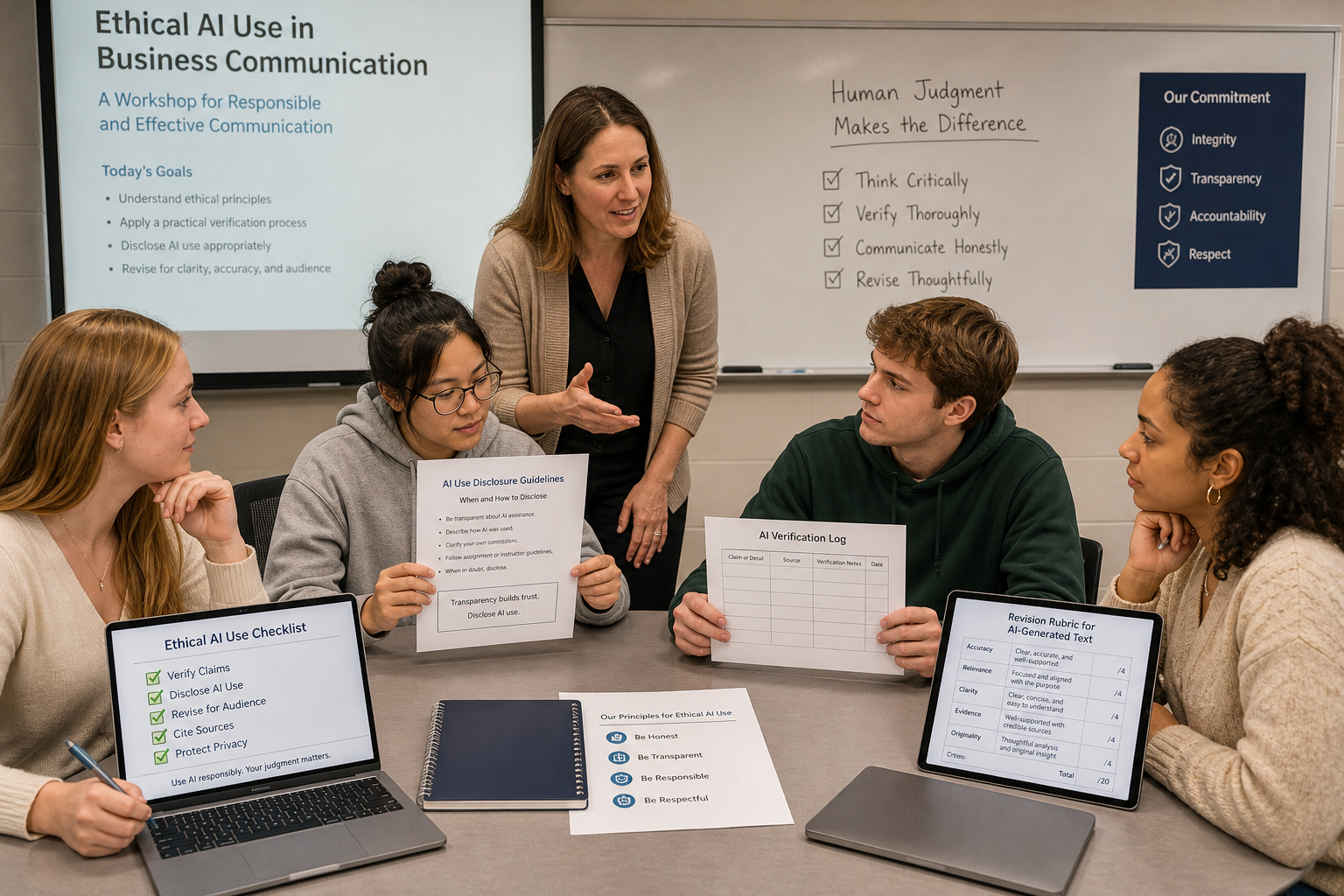
Create a one-page verification log that students complete whenever they use AI for planning, drafting, summarizing, or editing. Ask them to record the prompt, the output’s strongest idea, one possible bias or weakness, one fact they checked independently, and one revision they made to improve audience fit. This reinforces digital information fluency and critical thinking, both of which the chapter summary connects to professional communication.
Recommended activity: real-source audit
The manuscript includes an activity asking students to prompt AI for a summary and check whether the cited sources are real and relevant. You do not need to copy that exercise directly to benefit from the idea. A practical adaptation is to give students a short AI-generated paragraph and ask them to verify every factual claim, identify invented or weak sourcing, and rewrite the paragraph for accuracy and credibility.
This works especially well in business communication because professional messages need to be practical, factual, concise, clear, and tailored to audience needs. Ethical AI use is not just about avoiding cheating. It is also about meeting the quality standards of workplace communication.
Recommended activity: disclosure debate
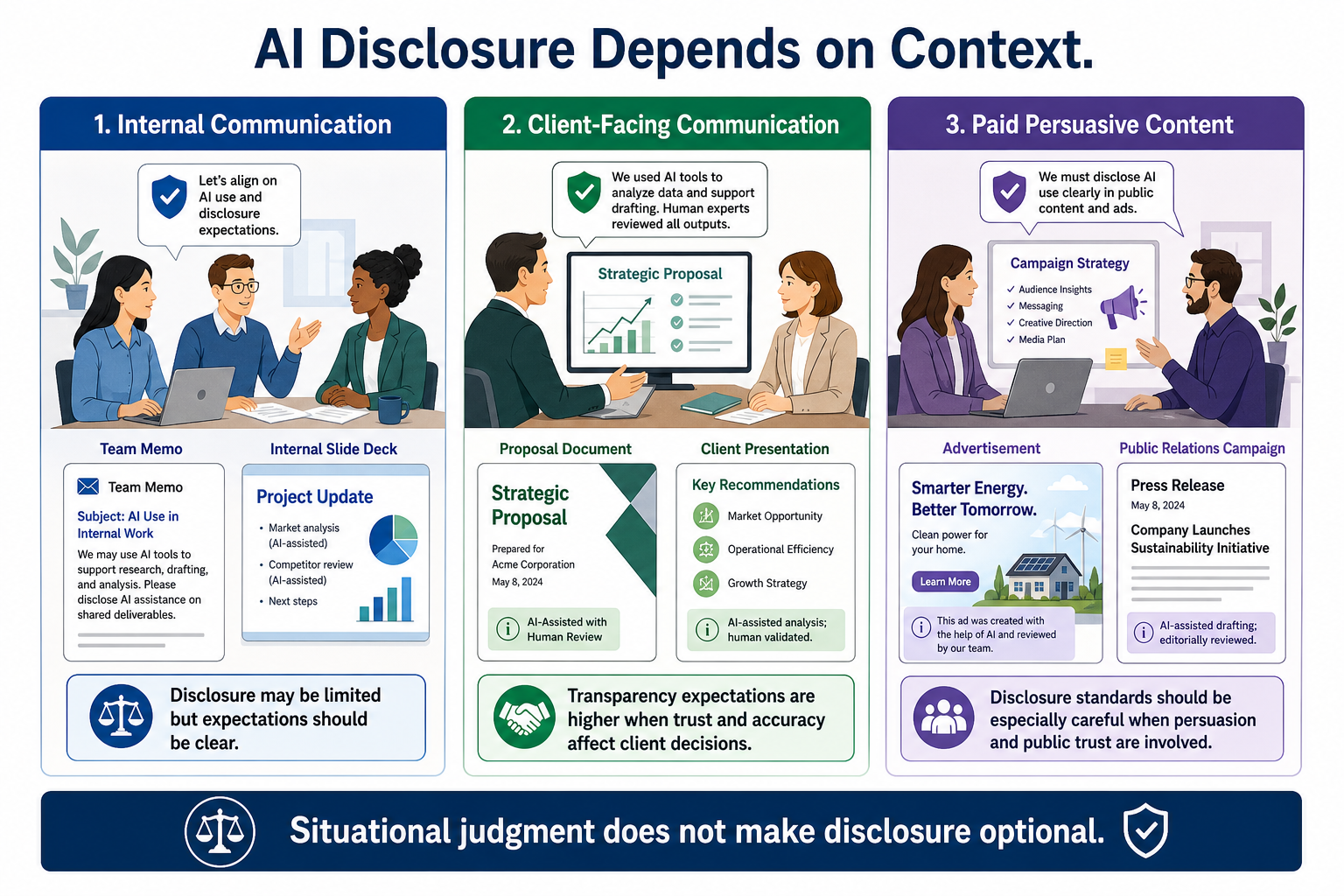
The excerpts also show discussion prompts about whether professionals should disclose AI use in reports, presentations, and externally published content. That can become a strong low-prep classroom resource. Ask teams to develop separate disclosure norms for internal communication, client-facing communication, and paid persuasive content such as advertising or public relations.
Students usually discover that ethical disclosure is situational, but not optional in all cases. That insight helps them move beyond a simplistic yes-or-no view of AI and toward more professional judgment.
3. Build a small resource set students can reuse
Instructors do not need a large library of AI materials to teach this topic well. A small, repeatable resource set is often more effective. I recommend building your course around four reusable resources.
1. An AI use policy for your course
State what kinds of AI use are allowed, restricted, or prohibited for different assignments. Include expectations for disclosure, source checking, and protection of confidential information. If students can use AI as a brainstorming or revision aid, say so plainly, and explain where human authorship and accountability remain essential.
2. An ethical review checklist
Base the checklist on the ethical risks named in the text: misinformation, bias, transparency, plagiarism, privacy, and harmful consequences. Keep it short enough that students will actually use it before submission.
3. A prompt-and-revision record
Have students save the prompt, the original output, and the final revised version. This makes the writing process visible and gives you a practical way to assess judgment rather than just the polished final draft.
4. A curated resource hub
If you want students to keep learning beyond one assignment, point them to a few dependable course resources rather than a long unsorted list. For instructors who want supplemental teaching materials from Bovee and Thill, their resource collection at Business Communication Network can be a useful starting point, particularly the materials gathered at blog.businesscommunicationnetwork.com/resources and files.businesscommunicationnetwork.com/tools/. As always, review any outside resource yourself before assigning it so it fits your course level, learning goals, and institutional AI guidelines.
Finally, keep one broad pedagogical goal in view. Bovee and Thill’s framing of AI repeatedly returns to human communication, empathy, authenticity, and careful judgment. That is a strong reminder that the best resource for teaching ethical AI use is not the tool itself. It is a course design that asks students to think before, during, and after they use the tool.
Key Takeaways
- Teach communication principles first, then place AI within those principles as a tool that requires judgment.
- Use short, repeatable resources such as disclosure rules, verification logs, and ethical checklists.
- Design activities that make students verify facts, inspect sources, and revise AI output for audience needs.
- Frame AI ethics as professional responsibility, not only as an academic integrity issue.
Glossary of Key Terms
- Ethics: Principles of right and wrong that guide behavior and decision-making.
- Generative AI (GenAI): Artificial intelligence that can produce text, images, audio, video, code, or other content.
- Hallucination: Fabricated or false content produced by an AI system.
- Plagiarism: Presenting someone else’s words or creative work as your own.
- Transparency: Openness about information or processes so audiences can interpret messages accurately.
Related Questions
- Question: Should students always disclose AI use in business communication assignments?
Answer: Not every minor use requires the same kind of disclosure, but instructors should set clear expectations for when AI assistance must be acknowledged. Disclosure is especially important when AI shapes ideas, wording, analysis, or externally oriented communication. - Question: What is the biggest ethical risk when students use AI for writing?
Answer: The biggest risk is often uncritical reliance on output that is inaccurate, biased, generic, or misleading. Students may also overlook plagiarism, privacy concerns, or the consequences of sharing unchecked claims. - Question: How can I assess ethical AI use without banning AI completely?
Answer: Assess the process as well as the final document. Require prompt records, verification notes, revision explanations, or short reflections that show how students evaluated and improved AI-generated material. - Question: Are company AI policies useful classroom resources?
Answer: Yes, if you use them as discussion texts rather than as universal models. They help students compare how organizations handle disclosure, privacy, bias, and accountability in real workplace settings. - Question: How do I connect AI ethics to core business communication outcomes?
Answer: Tie AI use to accuracy, audience awareness, clarity, professionalism, and relationship-building. Ethical AI instruction is strongest when students see that responsible tool use supports better communication rather than sitting outside it.
References
Bovee, C. L., & Thill, J. V. (2026). Business Communication Today (16th ed.). Pearson.
© 2026 Business Communication Teaching and Learning Center. All rights reserved.