
Professional readiness now requires the seamless integration of AI speed with critical human judgment.
AI Skills, Ethics & Student Use
How to Teach Students to Use AI Effectively, Ethically, and with Professional Judgment
AI is no longer optional in business communication—employers expect graduates to use AI tools with professionalism, discernment, and ethical awareness. Yet most students approach AI as a shortcut, not a skillset. They know AI can generate text but don’t understand how to evaluate that text critically, when to use AI versus rely on human judgment, or how to navigate the ethical complexities AI creates.
This hub equips instructors to teach the essential AI-related skills students need: how to write with AI rather than through AI, how to maintain academic integrity, how to use AI responsibly in workplace situations, how to build employability through AI-augmented communication, and how to avoid the common pitfalls that create professional risk.
Why This Hub Matters Now
The New Literacy: AI + Human Reasoning
Today’s essential business communication literacy combines AI capability with human judgment. Students must learn to leverage AI’s speed and breadth while maintaining the critical thinking, ethical reasoning, and strategic judgment that AI cannot replicate. This dual competency—technical AI use plus human oversight—defines professional readiness in 2025 and beyond.
The challenge is that students often develop one capability without the other. Some become proficient AI users but lack critical evaluation skills, accepting AI outputs uncritically. Others maintain strong critical thinking but avoid AI tools, limiting their productivity. The most successful students—and the professionals employers seek—integrate both capabilities seamlessly.
What Students Misunderstand About AI
Common student misconceptions create problems: believing AI-generated text is automatically good because it’s grammatically correct, thinking AI use in academic contexts is either completely forbidden or completely acceptable without nuance, assuming AI understands context and audience when it doesn’t, trusting AI-generated information without verification, or using AI to avoid thinking rather than enhance it.
Effective instruction addresses these misconceptions directly, helping students develop more sophisticated understanding of what AI can and cannot do, when its assistance enhances versus undermines learning, and how to use AI as a professional tool requiring skilled operation rather than a magic solution requiring no thought.
AI Writing Skills: Teaching Students to Revise and Improve AI Output
Why Students Must Become AI Editors, Not AI Dependents
AI generates drafts quickly, but students must still think, evaluate, and shape content strategically. The most valuable AI skill isn’t prompt writing—it’s critical evaluation and revision of AI outputs. Students who can take AI-generated text and transform it into genuinely effective communication possess capabilities far more valuable than those who simply accept whatever AI produces.

Figure 2.1 The Editor’s Mindset. The most critical AI skill isn’t generating text, but ruthlessly editing it to add specificity, tone, and human voice.
This editing capability requires teaching students to recognize when AI-generated text is generic versus specific, vague versus concrete, technically correct versus strategically effective, grammatically sound versus tonally appropriate, and factually accurate versus containing hallucinations. These evaluation skills transfer across contexts and remain valuable even as specific AI tools evolve.
Teaching the Revision Process
Effective AI revision instruction helps students:
- Evaluate whether AI output actually addresses the intended purpose and audience
- Identify gaps, missing context, or logical weaknesses in AI-generated content
- Strengthen clarity, concision, and organizational logic
- Adjust tone to match specific professional contexts and relationships
- Replace generic language with specific, concrete details
- Ensure the writing maintains authentic human voice rather than sounding AI-generated
- Verify factual accuracy and remove hallucinations
Students who master these revision skills become powerful communicators who leverage AI strategically while maintaining quality control through human judgment.
Detecting and Preventing AI Hallucinations
AI hallucinations—plausible-sounding but factually incorrect statements—represent serious professional risks. A business message containing confident but false information damages credibility, violates regulations, or leads to costly errors. Teaching students to identify and prevent hallucinations is essential for responsible AI use.
Hallucination prevention strategies include:
- Verifying all factual claims through independent, authoritative sources
- Being skeptical when AI provides overly specific details it shouldn’t have access to
- Cross-checking numbers, statistics, and quantitative claims
- Recognizing when AI invents citations, quotes, or references
- Maintaining healthy skepticism about AI-generated content, especially for high-stakes communication
INTERNAL LINK SUGGESTIONS:
→ Learn how: How Business Communication Today Teaches Students to Revise AI Writing
→ Critical skill: How Business Communication Today Teaches Students to Detect and Prevent AI Hallucinations
Differentiating Human Writing Skills from AI-Assisted Processes
A critical meta-cognitive skill for the AI era is understanding what students contribute versus what AI contributes to their work. Without this awareness, students risk over-relying on AI, undermining their own skill development, or failing to recognize when AI-generated content doesn’t actually reflect their thinking.

Figure 2.2: Balancing the Equation. Instruction must clearly distinguish between the efficiency AI provides and the strategic judgment only humans can supply.
Effective instruction makes this distinction explicit, helping students recognize that AI can generate grammatically correct text but cannot develop original arguments based on specific contexts, cannot make strategic decisions about communication approaches, cannot understand subtle audience dynamics, and cannot exercise professional judgment about appropriateness. These remain distinctly human contributions that students must develop regardless of AI availability.
INTERNAL LINK SUGGESTIONS:
→ Key distinction: Does Business Communication Today Differentiate Between Human Writing Skills and AI-Assisted Writing Processes
→ Also see: Does the Textbook Differentiate Between Human Writing Skills and AI-Assisted Writing Processes
AI Usage Framework: Teaching Students When to Use AI—and When Not To
The Decision-Making Framework Every Student Needs
Students often default to extremes—overusing AI for everything or avoiding it entirely. Neither approach serves them professionally. What students need is a structured framework for deciding when AI assistance is appropriate, helpful, and ethical versus when human-only work is necessary, more effective, or required.
An effective decision framework considers:
- Purpose and stakes: Routine communication versus high-stakes professional messages
- Learning objectives: Whether the task’s purpose is skill development or productivity
- Organizational policies: What institutional or workplace rules allow or prohibit
- Authenticity requirements: When original thinking and personal voice are essential
- Confidentiality concerns: Whether content contains sensitive information
- Quality needs: Whether AI can actually deliver the required quality level
- Time constraints: Whether efficiency gains justify AI use given other factors
Students who practice applying this framework develop judgment that serves them throughout careers, adapting to different organizational cultures, communication contexts, and evolving AI capabilities.
Minimum AI Knowledge Before First Assignment
Before students complete their first course assignment, they need baseline AI literacy to make informed decisions and avoid common pitfalls. This minimum knowledge isn’t extensive, but it’s essential for responsible AI use from day one.
Essential baseline AI knowledge:
- What AI can and cannot do reliably in business communication contexts
- How to prompt AI effectively for different communication tasks
- Why AI outputs require human evaluation and revision
- What AI hallucinations are and why verification is essential
- Course policies on acceptable versus unacceptable AI use
- Basic framework for deciding when to use AI
- Why maintaining authentic voice matters professionally
Providing this foundation early prevents problems while enabling productive AI use throughout the course.
INTERNAL LINK SUGGESTIONS:
→ Framework guide: Is There a Student-Friendly Framework for When to Use AI and When Not To
→ Essentials: What’s the Minimum AI Knowledge Students Need Before They Write Their First Assignment
[CTA BUTTON: Get Student AI Usage Framework]
AI Ethics: Teaching Ethical Judgment in an AI-Saturated World
Students Aren’t Taught AI Ethics Anywhere Else

Figure 2.3: The Ethical Debate. Business communication courses are often the only space where students actively debate the ethical implications of AI use.
Most students receive no systematic instruction in AI ethics before encountering AI in business communication courses. They may have used AI tools casually but haven’t thought critically about ethical implications. Business communication courses often provide students’ first—and sometimes only—opportunity to develop ethical frameworks for AI use.
This responsibility weighs heavily. The ethical habits students develop in business communication courses often persist throughout careers. Students who learn to use AI thoughtfully, transparently, and with appropriate human oversight carry these practices forward. Those who develop patterns of over-reliance, insufficient verification, or ethical shortcuts may struggle to correct these habits later.
Core AI Ethics Principles
Effective AI ethics instruction addresses:
- Transparency: When and how to disclose AI use to audiences
- Attribution: Proper acknowledgment of AI assistance and human contributions
- Verification: Obligation to confirm accuracy of AI-generated information
- Privacy: Protecting sensitive information when using AI tools
- Bias recognition: Identifying and addressing bias in AI outputs
- Appropriate reliance: Maintaining human judgment and avoiding over-dependence
- Professional integrity: Using AI in ways that maintain trust and credibility
These principles provide students with mental frameworks for navigating ethical gray areas they’ll encounter throughout careers, not just in academic contexts.
Ethical Dilemmas and Discussion
Abstract ethical principles matter less than practice applying them to realistic scenarios. Students need opportunities to wrestle with genuine ethical dilemmas: Should you disclose AI use in a job application cover letter? How do you handle confidential information when using AI? What are your obligations if you discover AI-generated content contains bias? When does AI assistance cross into academic dishonesty?
Discussion-based ethics instruction, where students debate these questions and construct ethical reasoning together, proves more effective than lecture about rules. Students develop more sophisticated ethical judgment through practice reasoning than through memorizing principles.
INTERNAL LINK SUGGESTIONS:
→ Discussion resources: What Textbook Has Discussion Questions Related to AI Ethics
→ Comprehensive approach: How Business Communication Today Prepares Students to Use AI Ethically and Responsibly
[CTA BUTTON: Download AI Ethics Teaching Tools]
AI Assessment: Evaluating Student Work in the AI Era
The Assessment Challenge
Traditional assessment approaches struggle when students can generate competent responses instantly. How do instructors evaluate student capability when AI can complete assignments? How do they prevent inappropriate AI use while encouraging appropriate use? How do they design rubrics that assess both communication skill and AI judgment?
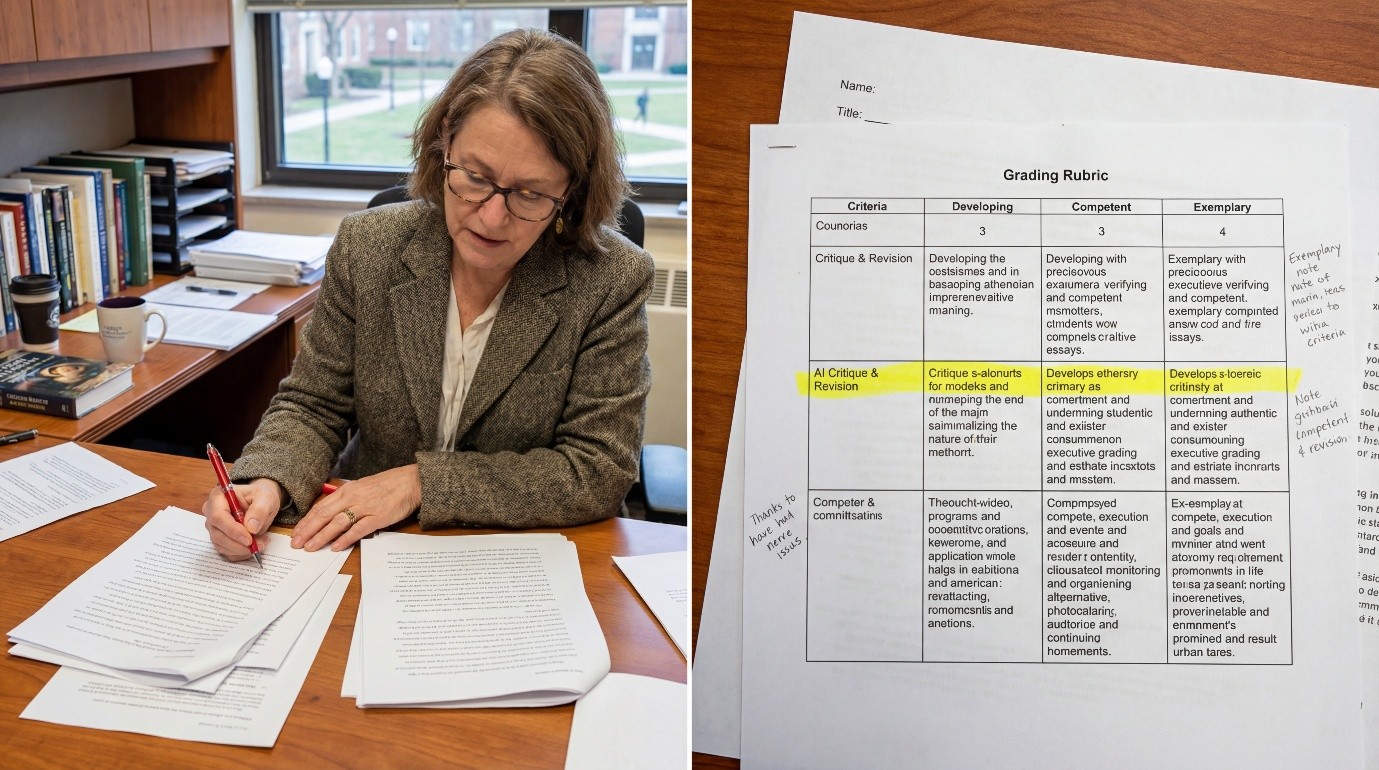
Figure 2.4 Assessing the Process. Modern rubrics must evaluate not just the final product, but the student’s judgment in using (or not using) AI tools.
Forward-thinking assessment acknowledges AI reality rather than pretending it doesn’t exist. Assignments that cannot be completed solely with AI—requiring personal reflection, analysis of specific organizational contexts, synthesis of restricted materials, or original strategic thinking—resist pure AI completion while permitting appropriate AI assistance.
AI-Ready Rubrics and Standards
Effective rubrics in the AI era evaluate multiple dimensions: quality of final communication, appropriateness of AI use for the task, quality of human oversight and revision, transparency about AI assistance, and demonstration of learning objectives. These multidimensional rubrics assess student judgment alongside technical skill.
AI-ready assessment criteria might include:
- Strategic appropriateness: Did the student use AI in ways that served the communication purpose?
- Quality control: Does the work show evidence of critical evaluation and revision?
- Authentic voice: Does the communication maintain genuine human voice and perspective?
- Factual accuracy: Has the student verified AI-generated information?
- Ethical transparency: Did the student handle AI use ethically and disclose appropriately?
INTERNAL LINK SUGGESTION:
→ Assessment tools: Does Business Communication Today Come with AI-Ready Rubrics or Standards for Evaluating AI-Influenced Assignments
Career Readiness: AI as a Career Differentiator
Employers Don’t Want AI Operators—They Want AI Thinkers
Graduates enter workplaces where AI is embedded in daily workflows, productivity depends on human-AI collaboration, and professional success requires both AI literacy and strong human judgment. Employers don’t seek employees who can operate AI tools—that’s trivial. They seek professionals who can think strategically about AI use, maintain quality control over AI outputs, and integrate AI capabilities with human insight.

Figure 2.5 The Employability Edge. Candidates who can articulate how they collaborate with AI strategically stand out to employers tired of generic “prompt jockeys.
This distinction matters profoundly for career readiness. Students who view AI purely as productivity tool miss the deeper requirement: developing judgment about when, how, and why to use AI in professional communication. Those who cultivate this strategic perspective position themselves for leadership roles where communication decisions carry significant consequences.
Building Career-Ready AI Skills
Career-ready AI competency includes:
- AI literacy: Understanding capabilities, limitations, and appropriate applications
- Digital professionalism: Using AI tools responsibly in workplace contexts
- Ethical decision-making: Navigating gray areas with integrity
- Quality assurance: Maintaining high standards for AI-assisted work
- Adaptability: Learning new AI tools and capabilities as they emerge
- Strategic thinking: Determining optimal human-AI collaboration approaches
Students who develop these capabilities distinguish themselves in competitive job markets and position themselves for career advancement.
INTERNAL LINK SUGGESTION:
→ Employability focus: Does Business Communication Today Address the Impact of AI on Careers and Employability for Business Communication Students
[CTA BUTTON: Build Career-Ready Communicators]
Conclusion: A Complete Instructional System for Modern AI Pedagogy
AI Can Accelerate Learning—or Accelerate Confusion
Without structured guidance, AI creates more confusion than capability. Students need systematic instruction in how to write effectively with AI, how to avoid academic integrity violations, how to apply ethical judgment, and how to build professional AI skills employers value. This hub provides that instructional system.
With comprehensive AI skills instruction, students transform from passive AI consumers to strategic AI users. They develop judgment that serves them throughout careers, regardless of how specific AI tools evolve. They graduate prepared not just to use today’s AI but to navigate tomorrow’s technological changes with confidence and integrity.
Recommended Cross-Hub Internal Links
Connect readers to related content across the hub network:
To Teaching AI Without Being an AI Expert Hub:
Learn how to teach these AI skills confidently, even without technical expertise. Discover frameworks that empower instructors to deliver excellent AI instruction.
To AI in the Curriculum & Textbook Differentiation Hub:
See why comprehensive AI integration in every chapter—not isolated coverage—produces genuine student competency.
To Ethics & Professional Judgment Pillar:
Explore broader frameworks for ethical communication, academic integrity, and professional judgment that contextualize AI ethics within larger ethical considerations.
To Student Experience & Motivation Hub:
Understand student anxieties about AI, common misconceptions, and how to create supportive learning environments where students feel safe experimenting with AI.
Featured Calls-to-Action
Primary CTA:
[Download Complete AI Skills Teaching Toolkit]
Secondary CTAs:
[Access Student AI Decision Tree (Fr[View Career-Ready AI Assignments]
—