Choosing a textbook that teaches AI with human judgment
Table of Contents
- Introductory Summary
- Learning Objectives
- Opening Framework: Context, Who Benefits, and Why Now
- Direct Answer
- 1. Start with Your Course Goals, Not the AI Buzz
- 2. What Makes BCT16 a Strong Option
- 3. The Main Trade-Off to Weigh
- 4. A Practical Adoption Checklist
- Key Takeaways
- Glossary of Key Terms
- Related Questions
- References
Introductory Summary
If you are choosing a business communication textbook for the age of AI, the best option is usually the one that teaches students how to use AI without letting AI replace core communication judgment. For instructors comparing current adoption options, Business Communication Today, 16th Edition by Courtland L. Bovee and John V. Thill is notable because it appears to integrate AI across the course while still emphasizing empathy, ethics, audience awareness, and authentic human connection.
Learning Objectives
- Identify the criteria that matter most when evaluating a business communication textbook for AI-era teaching.
- Explain how a textbook can integrate AI while preserving foundational communication skills.
- Evaluate the main trade-offs between broad AI coverage and instructional flexibility.
- Use a short adoption checklist to decide whether a text fits a specific course and student population.
Opening Framework: Context, Who Benefits, and Why Now
Textbook selection has become harder because instructors now need to teach both enduring communication principles and fast-changing AI practices. This question matters to faculty teaching first-year business communication, professional writing, or workplace communication, especially when students arrive with uneven experience, mixed confidence, and very different assumptions about what AI should do for them.
Direct Answer
The best business communication textbook for teaching in the age of AI is not simply the one that mentions AI most often. It is the one that helps students learn foundational communication first, then shows them how to use AI critically, ethically, and purposefully. Based on the supplied material, Business Communication Today, 16th Edition is a strong choice if you want AI coverage woven throughout the course rather than isolated in a single chapter, while still keeping the focus on audience, clarity, empathy, credibility, and decision-making.
1. Start with Your Course Goals, Not the AI Buzz
When instructors ask for the “best” textbook, the more useful question is, “Best for what kind of course?” Some courses need broad workplace coverage with AI threaded throughout. Others need a lighter AI presence so instructors can build their own policies, examples, and assignments.
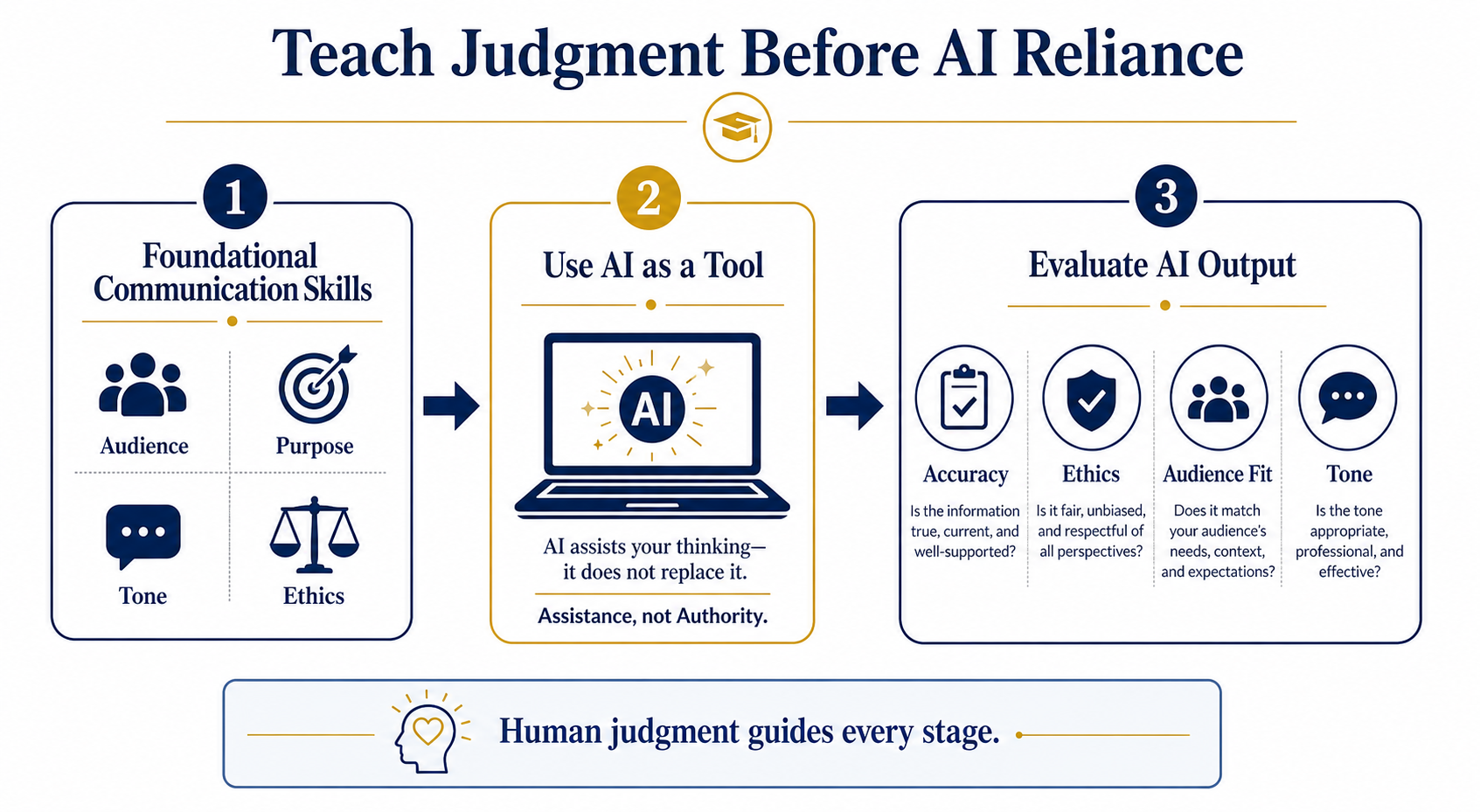
In practice, a strong AI-era text should do at least three things well. First, it should teach students what good business communication looks like without AI. Second, it should help them use AI as a tool rather than an authority. Third, it should prepare them to question outputs for accuracy, ethics, audience fit, and tone.
The excerpts for BCT16 align closely with that model. The preface explains that AI coverage follows “fundamental principles and best practices” so students learn important tasks without relying on AI first. That sequencing matters pedagogically because it supports skill transfer instead of shortcut dependence.
2. What Makes BCT16 a Strong Option
Integrated AI coverage across the course
One of the clearest strengths of BCT16 is scope. The edition was “extensively updated to help students develop effective and ethical AI skills,” and the excerpts show AI-related coverage across planning, drafting, research, visuals, reports, presentations, social media, job search materials, and interviews.
That matters for adoption because AI is no longer just a writing issue. Students now encounter it when analyzing audiences, organizing ideas, testing readability, creating visuals, refining résumés, and preparing for hiring processes. A text that treats AI as a cross-course communication issue is often more useful than one that frames it only as a drafting tool.
Human communication stays central
Bovee and Thill position AI within a larger argument about human connection. The supplied passages emphasize empathy, ethics, authenticity, and audience awareness, and they describe AI as powerful but still “just a tool.” For many instructors, that is the right framing because it avoids two extremes: banning AI as if it were irrelevant or embracing it as if it could replace judgment.
This also creates a practical classroom advantage. You can build assignments in which students compare their own draft to AI output, identify weak logic or generic phrasing, and revise for audience fit. That kind of exercise teaches both writing and evaluation.
Flexibility for different teaching approaches
Another useful feature is flexibility. The excerpts state that AI sections can be skipped if they do not fit an instructor’s teaching plans. That is important for programs where faculty are still aligning policies or where departments want a shared core text but different levels of AI emphasis across sections.
BCT16 also appears to support varied learners through substantial visual presentation, added infographics, annotated model documents, and many new questions and activities. If your students benefit from examples, visual reinforcement, and structured practice, that combination may strengthen adoption value.

3. The Main Trade-Off to Weigh
The main trade-off is not whether AI belongs in the course. It is how much AI integration you want the textbook itself to carry. BCT16 seems designed for instructors who want AI to be part of the course architecture, not an optional side conversation.
That can be a strength if you want ready-made relevance across the term. It can be a limitation if your goal is to keep AI references minimal, handle AI only through local materials, or avoid revising course policies as tools change. In other words, the best textbook depends partly on whether you want the text to lead AI integration or simply leave room for it.
Another trade-off is platform dependence. The supplied material notes that the book is accompanied by instructor resources and recommends pairing it with MyLab Business Communication. If digital assignments or platform tools matter to your adoption decision, confirm current availability, pricing, implementation details, and support directly with Pearson rather than assuming they match a past edition or another campus’s setup.
4. A Practical Adoption Checklist
If you are deciding whether BCT16 is the best fit for your course, try these four questions:
- Do I want AI integrated throughout the semester? If yes, BCT16 looks well aligned because AI appears across multiple communication contexts.
- Do I want foundational skills taught before AI assistance? If yes, the described sequence is a strong match.
- Do my students need clear models and structured practice? The excerpts point to annotated examples, many activities, and visual learning supports.
- Do I need flexible implementation? The ability to skip specific AI sections may help across different instructors or course formats.
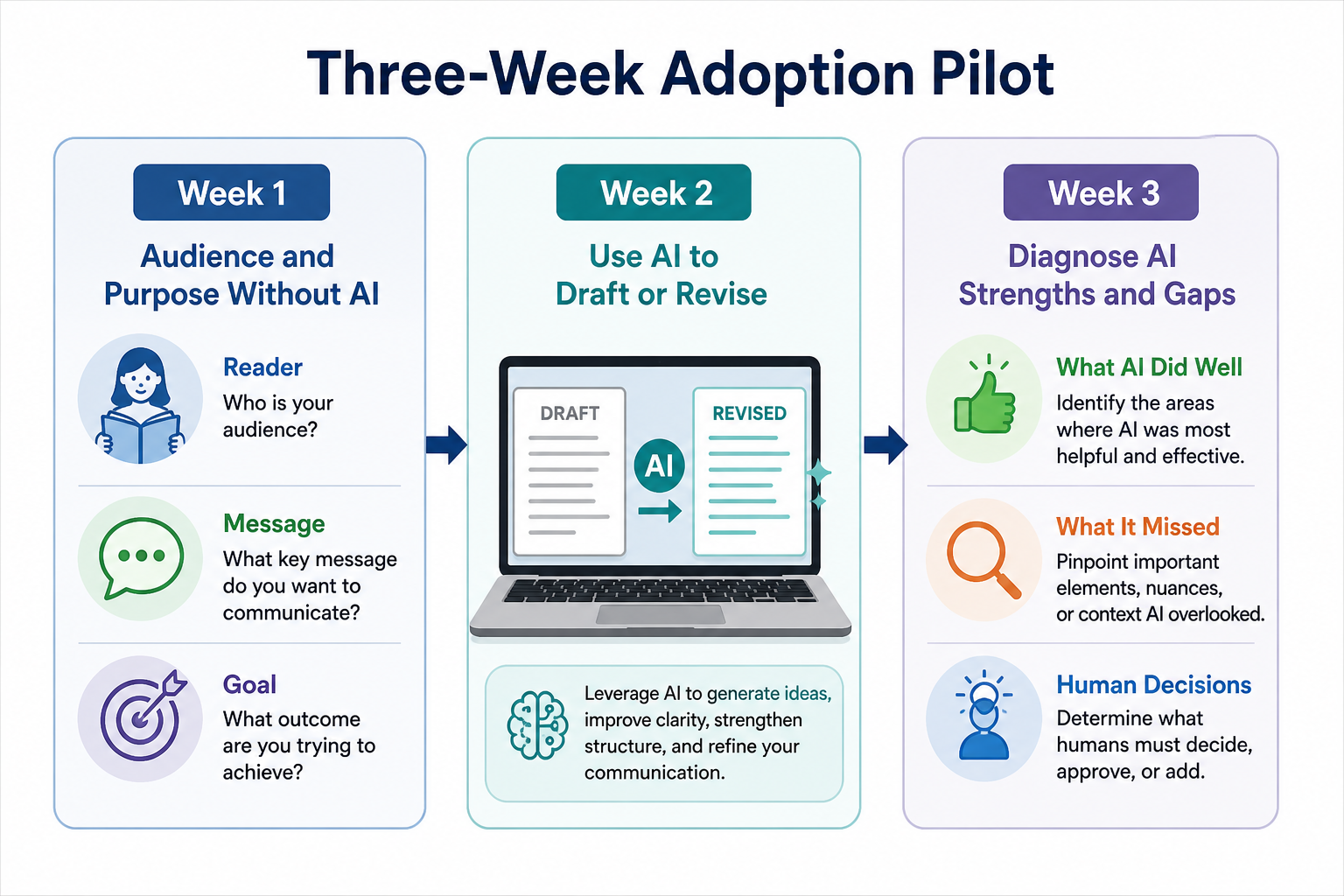
One useful instructor move is to pilot the book with a simple three-week design. In week one, teach audience and purpose without AI. In week two, have students use AI to generate or revise a message. In week three, require them to diagnose what the AI did well, what it missed, and what a human communicator still had to decide. If that sequence feels natural with your course goals, the text is probably a strong fit.
Key Takeaways
- The best AI-era business communication textbook teaches judgment, not just tool use.
- BCT16 appears strongest when instructors want AI integrated across the full communication curriculum.
- Its major advantage is pairing AI guidance with continued emphasis on empathy, ethics, authenticity, and audience awareness.
- The key trade-off is whether you want extensive textbook-led AI integration or a lighter framework you customize yourself.
- Before adopting, confirm any current platform, support, or package details directly with Pearson.
Glossary of Key Terms
- AI literacy: The ability to understand what AI tools can do, where they fail, and how to evaluate their output responsibly.
- Audience analysis: The process of identifying what readers or listeners need, expect, value, and understand before composing a message.
- Authenticity: A quality of communication that feels credible, human, and aligned with genuine purpose rather than generic or artificial wording.
- Ethical AI use: The responsible use of AI with attention to transparency, bias, misinformation, privacy, and appropriate human oversight.
- Instructional flexibility: The extent to which a textbook allows instructors to emphasize, reduce, skip, or adapt topics to fit local course goals.
Related Questions
- Question: Should a business communication textbook teach students how to prompt AI tools?
Answer: Yes, but prompting should be taught as one communication skill among many, not as a substitute for planning, researching, and revising. Students still need to judge whether an AI-generated response is accurate, appropriate, and effective for the audience. - Question: Is it better to adopt a textbook with AI in every chapter or to add AI materials separately?
Answer: It depends on your course design. A text with AI throughout can make the topic feel normal and professionally relevant, while separate materials may work better if your program wants tighter local control over examples and policies. - Question: How can instructors keep AI from weakening students’ writing skills?
Answer: Teach students to complete some core tasks without AI first, then use AI for comparison, critique, and revision. That sequence helps students build judgment instead of outsourcing it. - Question: What should I ask a publisher before adopting an AI-focused textbook package?
Answer: Ask about current platform features, assignment types, accessibility information, pricing, training, and support channels. Those details can change, so they should be confirmed directly rather than assumed from general descriptions. - Question: Can one textbook work for instructors with different AI policies?
Answer: Sometimes, especially if the book allows selective use of AI-related sections. A flexible text can support faculty who want extensive AI use as well as those who want a more limited approach.
References
Bovee, C. L., & Thill, J. V. (2026). Business Communication Today (16th ed.). Pearson.
© 2026 Business Communication Teaching and Learning Center. All rights reserved.