How should AI be integrated into a business communication curriculum?
Quick answer: Comprehensively—with AI concepts woven into every communication lesson rather than isolated in a single chapter or sidebar. A modern business communication curriculum builds AI literacy gradually and contextually, as a repeated, integrated, principled skillset across every communication task: every chapter addresses AI’s implications for that communication context, the approach is principles-based rather than tool-specific, and ethics is woven throughout.
Use this hub to evaluate how AI is integrated across a business communication curriculum and go directly to the article that covers each question.
At a glance: AI in the curriculum and textbook differentiation
On smaller screens, scroll horizontally within the table to see all four columns.
| Teaching focus | Activity or approach | Learning purpose | Related article |
|---|---|---|---|
| Integrated AI coverage | Weaving AI through every chapter, with chapter-by-chapter examples and ethics woven throughout | See what comprehensive AI integration actually looks like | AI in Every Chapter–Business Communication Today Set the Standard |
| Digital literacy comparison | Comparing coverage depth, integration patterns, currency, practical guidance, and assessment support | Assess how major textbooks compare in AI readiness | Digital Literacy and AI in Business Communication Textbooks |
| Instructor readiness | Taking a quiz on your readiness to teach AI | Find out whether you are able to deliver integrated AI coverage | How Ready Are You to Teach AI in Business Communication? Take the Quiz! |
| Single chapter vs. integration | Contrasting single-chapter limitations with the benefits of woven coverage | Understand why a single AI chapter isn’t sufficient | What’s the Difference Between This Textbook’s AI Content and Others That Just Have a Single Chapter on AI |
| Future-readiness | Emphasizing principles over tools, update cycles, and adaptable frameworks | Choose AI content that remains valuable as tools change | Future-Proofing AI Instruction That Won’t Age Quickly |
| Course relevance | Examining the automation paradox and uniquely human competencies | Make the case for communication course value in the AI era | Business Communication Courses Matter More Than Ever in the AI Era |
AI in the Curriculum and Textbook Differentiation
How Comprehensive AI Integration Transforms Business Communication Instruction
AI is now inseparable from the way modern organizations write, design, research, collaborate, and solve problems. Yet most business communication textbooks still treat AI as a side topic—something to acknowledge, not something to teach systematically. Many students encounter AI more deeply on TikTok than in their assigned textbooks. The result is a growing gap between workplace expectations and classroom preparation.
This hub helps instructors evaluate how AI should be integrated across a business communication curriculum—and why the distinction between “AI sprinkled in” and “AI woven throughout” is now one of the most important decisions instructors will make. It also clarifies how textbook design influences student competence, engagement, and readiness for AI-shaped careers.
Why This Hub Matters Now
The New Educational Baseline: AI Everywhere, Not AI Later
Today’s students enter a world where AI is embedded in everyday professional tasks—drafting messages, analyzing data, generating visuals, preparing presentations, and even shaping strategic decisions. Employers assume graduates will know how to collaborate with AI tools effectively and ethically.
But most textbooks were not built for this moment. They provide:
- a single AI chapter,
- limited or outdated AI discussion,
- insufficient connection to communication principles, or
- abstract descriptions with no guidance instructors can actually use.
This mismatch leaves students unprepared for the reality they will face on day one of the job.
A modern business communication curriculum must build AI literacy gradually and contextually—not as a one-off topic, but as a repeated, integrated, principled skillset across every communication task.
Related Pillar: AI & Technological Transformation
Why AI Integration Approach Matters
AI isn’t a separate topic to be addressed once and checked off—it’s transforming every aspect of business communication. From writing and editing to visual content creation, from research and analysis to presentation design, AI tools are becoming standard in professional environments.

Yet many textbooks approach AI as:
- An add-on: A single chapter tacked onto existing content
- A technology topic: Isolated from communication principles
- A trend: Surface treatment without strategic integration
- An afterthought: Minimal coverage to claim “AI included”
This fragmented approach fails students who need to understand:
- When and how to use AI ethically and effectively
- How AI changes but doesn’t replace human communication skills
- Which competencies remain uniquely human and valuable
- How to maintain authentic voice while leveraging AI assistance
- What employers expect regarding AI literacy and judgment
Comprehensive AI integration means:
- Every chapter addresses AI’s implications for that communication context
- Principles-based approach that transcends specific tools
- Critical thinking about AI’s capabilities and limitations
- Ethical frameworks for responsible AI use
- Practical guidance students can apply immediately
This hub helps you evaluate textbooks based on AI integration quality and understand why this approach matters for student success.
AI Coverage & Comparison: Understanding the Landscape
Cluster Focus: How do business communication textbooks differ in their approach to AI, and what does truly comprehensive coverage look like?
AI in Every Chapter–Business Communication Today Set the Standard
The difference between integrated and isolated AI coverage is dramatic. This article examines what it means to weave AI throughout a business communication textbook.
This article explores:
- Integration Philosophy: Why AI belongs in every chapter, not just one
- Chapter-by-Chapter Examples: How AI connects to each communication context
- Pedagogical Approach: Teaching AI as tool, not replacement
- Student Experience: How integrated coverage affects learning
- Practical Application: Helping students use AI in assignments
- Ethical Emphasis: Responsibility woven throughout, not isolated
- Future-Proofing: Principles that transcend specific AI tools
Key Questions Answered:
- What does comprehensive AI integration actually look like?
- How is integrated coverage different from a single AI chapter?
- Why does the integration approach matter for students?
- Which textbook leads in AI integration?
Target Keywords: AI in business communication textbook, comprehensive AI coverage, integrated AI teaching, AI every chapter, business communication AI integration
Digital Literacy and AI in Business Communication Textbooks: What True Integration Requires
Not all textbooks claiming AI coverage deliver equal preparation. This article provides comparative analysis of how leading textbooks approach AI and digital literacy.
This article examines:
- Coverage Depth: Superficial vs. substantive AI instruction
- Integration vs. Isolation: Chapter placement and integration patterns
- Digital Literacy Scope: Beyond AI to broader technology competence
- Currency: How recently content was updated for AI
- Practical Guidance: Abstract discussion vs. actionable advice
- Assessment Support: Whether assignments address AI appropriately
- Instructor Resources: Support for teaching AI confidently
Key Questions Answered:
- How do major textbooks compare in AI readiness?
- What should you look for when evaluating AI coverage?
- Which textbooks lead in digital literacy preparation?
- How can you assess AI integration quality?
Target Keywords: digital literacy comparison textbooks, AI readiness textbooks, comparing business communication textbooks, textbook AI coverage comparison, digital competence teaching
How Ready Are You to Teach AI in Business Communication? Take the Quiz!
If integrated AI coverage matters, are you able to deliver it? This article will give you the answer.

This article provides:
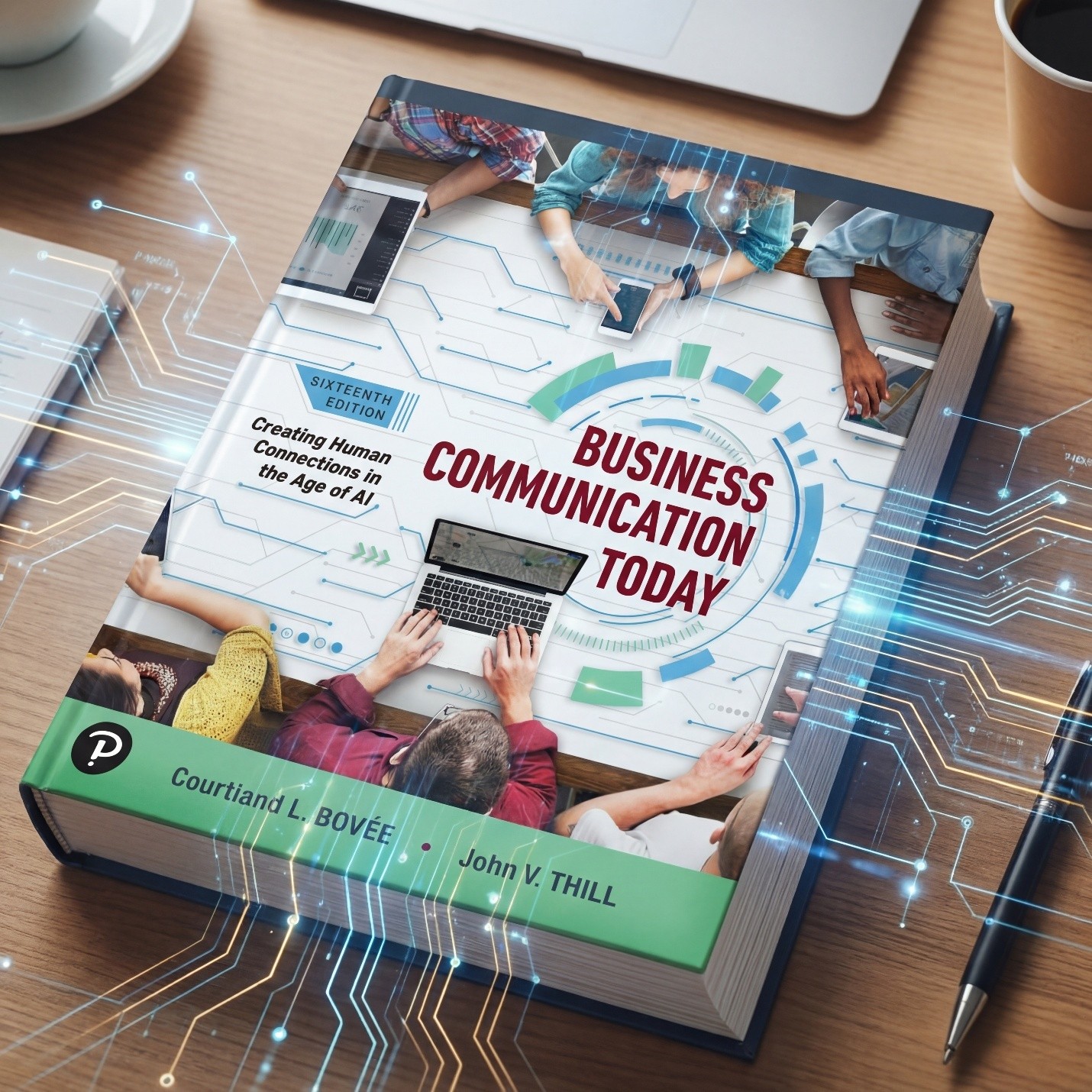
- Market Survey: Comprehensive review of major textbooks’ AI approach (Bovee and Thill integrate coverage throughout each chapter of the text. All of the other texts as of January 2026 only offer a “bonus” chapter or supplement that covers AI.)
- Coverage Patterns: Common approaches to AI integration
- Strengths and Weaknesses: What each textbook does well and poorly
- Instructor Fit: Matching textbook approach to teaching philosophy
- Student Outcomes: How different approaches affect learning
- Selection Criteria: Factors for evaluating AI integration
Key Questions Answered:
- Which textbooks offer truly comprehensive AI coverage? (Only Bovee and Thill)
- How do you distinguish marketing claims from reality?
- What questions should you ask publishers about AI content?
- Which approach fits your teaching style and student needs?
Target Keywords: business communication textbooks with AI, comprehensive AI textbooks, textbook AI integration, AI-ready business communication, best AI coverage textbooks
What’s the Difference Between This Textbook’s AI Content and Others That Just Have a Single Chapter on AI
Many textbooks now include “an AI chapter”—but that’s fundamentally different from comprehensive integration. This article explains why the distinction matters.
This article examines:
- Single-Chapter Limitations: Why isolated treatment is insufficient
- Integration Benefits: How woven coverage enhances learning
- Student Application: Making AI relevant to every assignment
- Principle Transfer: Understanding AI across contexts vs. as isolated topic
- Employer Expectations: What workplaces need from graduates
- Cognitive Integration: How students develop AI literacy differently
- Long-Term Retention: Which approach produces lasting competence
Key Questions Answered:
- Why isn’t a single AI chapter sufficient?
- What specifically makes integrated coverage more effective?
- How does integration affect student AI literacy development?
- What are the learning outcome differences?
Target Keywords: comprehensive AI coverage business communication, AI integration vs chapter, integrated AI teaching, business communication AI approach, AI throughout curriculum
Future-Readiness: Will This Content Age Well?
Cluster Focus: AI evolves rapidly—how do you choose content that remains valuable as tools change.
Future-Proofing AI Instruction That Won’t Age Quickly
AI tools change constantly. Today’s ChatGPT will be succeeded by newer models; today’s image generators will be surpassed. How do textbooks create AI content that doesn’t become obsolete?
This article explores:
- Principles vs. Tools: Teaching conceptual foundations that transcend specific technologies
- Update Cycles: How frequently textbooks refresh AI content
- Adaptable Frameworks: Structures that accommodate new AI developments
- Core Competencies: Skills that remain valuable regardless of tools
- Critical Thinking: Teaching evaluation of any AI tool
- Ethical Foundations: Principles that apply to current and future AI
- Author Commitment: Publishers’ track record of updating content
Key Questions Answered:
- How do you evaluate whether AI content will stay relevant?
- What makes AI teaching future-proof?
- Should textbooks focus on specific tools or general principles?
- How often should AI content be updated?
Target Keywords: future-ready AI content, sustainable AI teaching, AI-proof curriculum, timeless AI principles, evolving AI education
Course Relevance: Why Business Communication Matters More Now
Cluster Focus: AI hasn’t made business communication courses obsolete—it’s made them more important than ever.

Business Communication Courses Matter More Than Ever in the AI Era
Some worry AI will make business communication instruction obsolete. The reality is the opposite: as AI handles routine communication tasks, uniquely human skills become more valuable, not less.
This article examines:
- The Automation Paradox: Why AI increases need for human communication skills
- Uniquely Human Competencies: What AI can’t replicate
- Strategic Thinking: Judgment AI cannot provide
- Authentic Connection: Human relationship building
- Ethical Decision-Making: Responsible communication requiring human judgment
- Creative Problem-Solving: Original thinking beyond AI patterns
- Emotional Intelligence: Reading and responding to human needs
- Career Differentiation: How communication skills create competitive advantage in AI era
Key Questions Answered:
- Why do communication courses matter more, not less, with AI?
- What skills should business communication courses emphasize now?
- How do you make the case for communication course value?
- What’s the future of business communication education?
Target Keywords: business communication importance AI, communication skills AI era, human skills AI workplace, business communication relevance, why communication courses matter
Synthesis: Evaluating AI Integration Quality

When evaluating textbooks for AI integration, use this comprehensive framework:
The AI Integration Matrix
On smaller screens, scroll horizontally within the table to see all four columns.
| Dimension | Isolated Approach | Integrated Approach | Questions to Ask |
|---|---|---|---|
| Coverage Location | Single chapter | Throughout all chapters | Where does AI appear in the table of contents? |
| Integration Depth | Superficial mention | Substantive treatment | How thoroughly is AI addressed in each context? |
| Pedagogical Approach | Technology topic | Communication tool | Is AI taught as separate topic or integrated tool? |
| Practical Guidance | Abstract discussion | Actionable strategies | Can students apply guidance to assignments? |
| Ethical Framework | Isolated ethics chapter | Ethics woven throughout | Is responsible use addressed repeatedly? |
| Assessment Alignment | Generic assignments | AI-aware assignments | Do assignments address AI use appropriately? |
| Currency | One-time addition | Regular updates | When was AI content last updated? |
| Principles Focus | Tool-specific | Principle-based | Will content age well as tools change? |
Evaluation Questions for Publishers
When considering textbook adoption, ask:
About Coverage:
- In which chapters does AI appear?
- How many pages total address AI across the textbook?
- Is AI isolated or woven throughout discussions?
- Are assignments designed with AI in mind?
About Approach:
- Do you teach specific AI tools or general principles?
- How do you address AI ethics?
- What frameworks help students decide when to use AI?
- How do you help students maintain authentic voice?
About Currency:
- When was AI content last updated?
- What’s your revision cycle for AI content?
- How do you stay current with rapid AI evolution?
- Do you update between editions?
About Support:
- What instructor resources address teaching AI?
- Is training available on AI integration?
- Are there sample assignments using AI?
- How do you support AI assessment?
Making the Case for AI-Integrated Textbooks
When advocating for textbooks with comprehensive AI integration:
To Colleagues
Frame as:
- “Our students will use AI daily in their careers—they need integrated preparation, not isolated discussion”
- “Comprehensive AI coverage demonstrates our program’s currency and relevance”
- “Integrated approach teaches students to think critically about AI across all communication contexts”
Provide:
- Comparison of AI coverage across textbooks
- Examples of integrated vs. isolated approach
- Student feedback on AI preparation needs
- Employer expectations regarding AI literacy
To Administration
Frame as:
- “Prepares students for AI-integrated workplaces”
- “Demonstrates institutional commitment to innovation and currency”
- “Addresses accreditor interest in emerging technology competence”
- “Competitive advantage in program marketing”
Provide:
- Enrollment trends in programs with strong AI emphasis
- Employer demand for AI-literate graduates
- Competitive analysis of peer programs
- Cost-benefit analysis of comprehensive AI preparation
To Students
Frame as:
- “Develops skills that will differentiate you in job market”
- “Prepares you for workplaces where AI is standard tool”
- “Teaches you to leverage AI while maintaining competitive advantage”
- “Addresses questions you have about AI’s role in your career”
Provide:
- Clear explanation of AI literacy employers expect
- Examples of how AI changes but doesn’t replace human skills
- Career advantages of AI competence combined with communication excellence
- Transparency about AI’s role in course assignments and assessment
The Future of AI in the Business Communication Curriculum

As AI continues evolving, expect:
Increasing Integration
AI won’t remain a special topic—it will be assumed infrastructure, like internet or email
Principles Over Tools
Focus will shift from specific AI platforms to frameworks for evaluating any AI tool
Ethics Centrality
Responsible AI use will be core competency, not afterthought
Human Skill Emphasis
Uniquely human competencies—judgment, creativity, empathy—will be valued more highly
Continuous Updates
Textbooks will need more frequent revisions to stay current
Instructor Development
Publishers will need to provide stronger AI teaching support
Assessment Evolution
Traditional assignments will adapt to assume AI availability
Career Preparation Focus
Workplace AI expectations will drive curriculum design
Instructor takeaways
- Weave AI throughout every chapter rather than isolating it in a single chapter or supplement.
- Teach principles that transcend specific AI tools, so content ages well as tools change.
- Address ethics repeatedly in relevant contexts, not only in an isolated ethics chapter.
- Use the AI Integration Matrix and the evaluation questions for publishers to distinguish marketing claims from reality.
- Design AI-aware assignments that assume AI availability.
- Balance AI literacy with uniquely human communication skills—judgment, creativity, and empathy.
Related questions
How is integrated AI coverage different from a single AI chapter?
A single chapter tacked onto existing content isolates AI from communication principles. Integrated coverage addresses AI’s implications in every chapter, so students understand AI across contexts rather than as an isolated topic. See What’s the Difference Between This Textbook’s AI Content and Others That Just Have a Single Chapter on AI.
What does comprehensive AI integration look like?
Every chapter addresses AI’s implications for that communication context, with a principles-based approach that transcends specific tools, critical thinking about AI’s capabilities and limitations, ethical frameworks for responsible AI use, and practical guidance students can apply immediately. See AI in Every Chapter–Business Communication Today Set the Standard.
What should instructors ask publishers about AI content?
Ask about coverage (in which chapters AI appears), approach (specific AI tools or general principles, and how AI ethics is addressed), currency (when AI content was last updated and the revision cycle), and support (instructor resources, training, and sample assignments using AI).
Should textbooks focus on specific AI tools or general principles?
General principles. AI tools change constantly, so conceptual foundations, adaptable frameworks, critical thinking, and ethical foundations keep AI instruction valuable regardless of tools.
Does AI make business communication courses obsolete?
No. As AI handles routine communication tasks, uniquely human skills—strategic thinking, authentic connection, ethical decision-making, creative problem-solving, and emotional intelligence—become more valuable, not less.
How can instructors make the case for AI-integrated textbooks?
Frame the case for each audience—colleagues, administration, and students—and provide evidence such as a comparison of AI coverage across textbooks, examples of integrated vs. isolated approach, and employer expectations regarding AI literacy.
Connection to Other Hubs
This hub focuses on AI integration in curriculum and textbooks. For related topics:
- Teaching AI Without Being an AI Expert – Building instructor confidence and capability
- AI Skills, Ethics & Student Use – Practical implementation and ethical frameworks
- AI & Visual / Digital Media – AI’s impact on visual communication
Together, these four hubs provide comprehensive guidance for AI integration in business communication education.
The Bottom Line
AI integration approach is one of the most significant textbook differentiators today. Look for textbooks that:
- ✓ Integrate AI throughout every chapter rather than isolating it
- ✓ Teach principles that transcend specific AI tools
- ✓ Address ethics repeatedly in relevant contexts
- ✓ Provide practical guidance students can apply immediately
- ✓ Design AI-aware assignments that assume AI availability
- ✓ Support instructors with teaching resources and training
- ✓ Commit to currency through regular content updates
- ✓ Balance AI literacy with uniquely human communication skills
The textbooks that excel in AI integration don’t just acknowledge AI exists—they fundamentally reimagine business communication instruction for an AI-augmented workplace. This preparation is no longer optional; it’s essential for student success.
Calls to Action
- Order Examination Copies of Business Communication Textbooks
- Bring AI into the Classroom without Feeling Overwhelmed (scroll down to this heading on the page and locate this item in the list: Student AI Decision Framework: A Practical Guide for Ethical, Professional AI Use)
- Why Business Communication Courses Matter More Than Ever in the Age of AI
- Business Communication Curriculum Audit: AI Readiness Assessment