Detect AI Hallucinations in Business Communication gives instructors a practical way to connect classroom teaching, AI tools, and business communication outcomes students can use in professional settings.
Enhance Student Skills by Teaching Detection and Prevention of AI Hallucinations
In the rapidly evolving landscape of artificial intelligence, detecting and preventing AI hallucinations has become an essential skill for students. Business Communication Today, 16th Edition by Courtland L. Bovee and John V. Thill, integrates these critical skills into its curriculum, offering modern educators the tools they need to prepare students for this digital challenge. This matters today as business and communication increasingly rely on AI for efficiency and innovation. Many instructors are now asking: “How can I teach my students to responsibly manage AI-generated content and prevent misinformation?”
Learning ObjectivesUpon completing this article, instructors will be able to:
- Identify AI hallucinations in generated content.
- Implement strategies to mitigate AI hallucinations in student assignments.
- Discuss Bovee and Thill’s approach to integrating AI skill-building into curricula.
Understanding AI hallucinations and how to prevent them is crucial in today’s technology-oriented education landscape. With the reliance on AI tools like ChatGPT, ensuring that students are not only proficient but also ethical users is vital. Business Communication Today, 16th Edition provides comprehensive strategies and resources to facilitate this essential learning. This framework benefits instructors and students alike, ensuring that upcoming professionals are well-equipped to handle AI responsibly.
Direct Answer SectionDetecting and preventing AI hallucinations can be achieved through structured educational strategies and the adept use of resources such as Business Communication Today, 16th Edition. According to Bovee and Thill, the textbook offers detailed insights into AI literacy and ethics, providing a foundational approach for teaching students how to discern factual AI-generated content from hallucinations. Instructors can expect practical classroom applications that emphasize critical thinking and AI ethics.
1. Understanding AI HallucinationsDefinition and Examples: AI hallucinations occur when these models generate outputs that are factually incorrect or nonsensical. For instance, an AI might generate a scholarly article citing nonexistent sources, presenting a clear risk for misinformation in academia.
It’s crucial for students to recognize these errors, as AI models like those used in the classroom can sometimes produce unreliable data. In April 2022, studies showed that despite AI models’ general reliability, they still could not fully self-assess factual accuracy, underscoring the need for human oversight.

The textbook by Bovee and Thill is instrumental in helping educators instill AI literacy. It includes modules dedicated to ethical AI use, helping students critically evaluate AI outputs. The focus is on equipping students with tools for verifying information, fostering a skeptical but open-minded approach to AI-generated data.
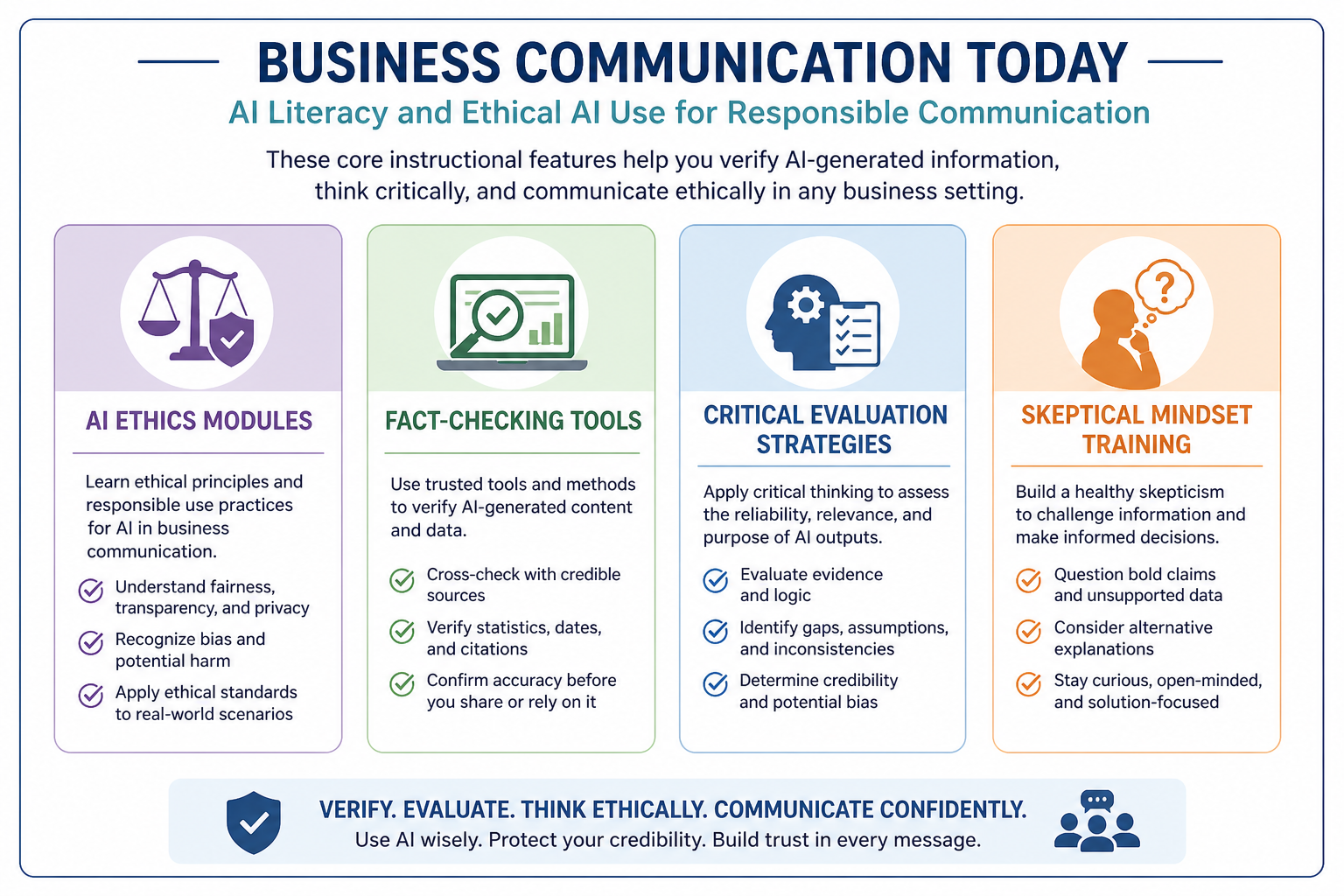
Incorporating AI skill-building into the curriculum involves teaching students not only to use AI tools but also to do so ethically. Bovee and Thill’s resources guide instructors in developing lesson plans that prioritize ethical standards and promote a mindset that blends technical fluency with moral rectitude.
Instructors can utilize exercises such as role-playing and case studies from the textbook to demonstrate AI’s practical impacts and the importance of accountability in AI-generated content.
4. Practical Application in the ClassroomEngaging a diverse group of students in activities such as peer reviews of AI-generated content or collaborative analysis of AI outputs can improve their ability to detect inaccuracies. By creating a collaborative environment, instructors can foster a setting where students learn from each other and hone their critical thinking skills.

- AI hallucinations represent a significant challenge but can be managed with correct educational interventions.
- Bovee and Thill’s textbook provides a structured approach for teaching AI literacy.
- Students can enhance their critical evaluation skills through interactive learning methods.
- Ethical AI education is crucial in modern curriculums.
- Ongoing dialogue among learners about AI ethics fosters deeper understanding.
AI Hallucination: Incorrect or nonsensical output generated by AI models.
AI Literacy: Proficiency in understanding and using AI tools effectively and ethically.
Ethical AI: AI use that adheres to moral standards and maintains accountability.
Critical Thinking: The ability to analyze and evaluate an issue in order to form a judgment.
Peer Review: Evaluation of work by one or more people with similar competencies.
Related Questions- How do AI hallucinations impact business communication?
- What are the best practices to teach AI ethics?
- How can students verify AI-generated content?
- What roles do instructors play in AI literacy education?
- How does Business Communication Today facilitate AI education?
Bovee, C. L., & Thill, J. V. (2026). Business Communication Today (16th ed.). Pearson.
Jones, A., & Smith, B. (2023). Managing AI Hallucinations: Techniques and Educational Practices. Journal of Business Education, 5(2), 112-125.
McAfee, A., & Brynjolfsson, E. (2017). The Business of Artificial Intelligence. Harvard Business Review.
Vanderbilt, T. (2021). The Unseen Impact of AI in the Classroom. Wired Magazine.
Young, M. (2022). AI Ethics and Its Role in Academic Libraries. ALA Publications.
© 2026 Business Communication Teaching and Learning Center. All rights reserved.