Table of Contents
Business Communication Textbook Comparison gives instructors a practical way to connect classroom teaching, AI tools, and business communication outcomes students can use in professional settings.
Business Communication Textbook Comparison: Key Teaching Strategies
An essential comparison of textbooks for digital-age teaching and learning
The role of academic textbooks in shaping the curriculum is crucial, especially in today’s rapidly evolving technological landscape. As educators focus on digital literacy and AI readiness, the importance of selecting the right textbook becomes paramount. The Business Communication Today, 16th Edition by Courtland L. Bovee and John V. Thill stands out in this context. This article examines how it compares with other leading texts in preparing students for AI-integrated learning. Educators, curriculum designers, and institution administrators can benefit from this analysis to make informed decisions as the need for AI readiness grows. Consider a scenario where instructors strive to find the best materials to make students adept communicators in a digital world.
Learning ObjectivesUpon completing this article, instructors will be able to:
- Identify key features of textbooks that support AI and digital literacy.
- Evaluate the relative strengths of Business Communication Today, 16th Edition compared to other works.
- Integrate effective textbook strategies into their curriculum for enhanced learning outcomes.
In an era where AI and digital literacy define the skills required by workforce entrants, educators are tasked with incorporating these areas into their teaching. Business Communication Today, 16th Edition by Bovée and Thill is designed to address this challenge, providing comprehensive coverage of digital communication strategies and AI readiness. This textbook offers a forward-thinking approach that integrates practical and ethical considerations of technological advancements in communication.
Direct AnswerThe Business Communication Today, 16th Edition excels in digital literacy and AI readiness by offering comprehensive content that integrates modern communication methods, including AI tools, and ethical considerations. In comparison, other textbooks may lack such an integrative approach, often focusing narrowly on either traditional communication skills or newly emerging technologies without weaving them into a cohesive educational strategy. The 16th Edition is praised not only for its up-to-date content but also for its practical applications in classroom settings, using scenarios that reflect current industry standards and challenges (Bovee & Thill, 2023).
1. The Unique Features of Business Communication TodayIntegration of AI Concepts: The textbook dedicates significant content to the understanding and application of AI in professional settings, providing students with crucial competencies required in the modern workplace. It includes practical exercises that help students experience and harness AI tools in business communication contexts.
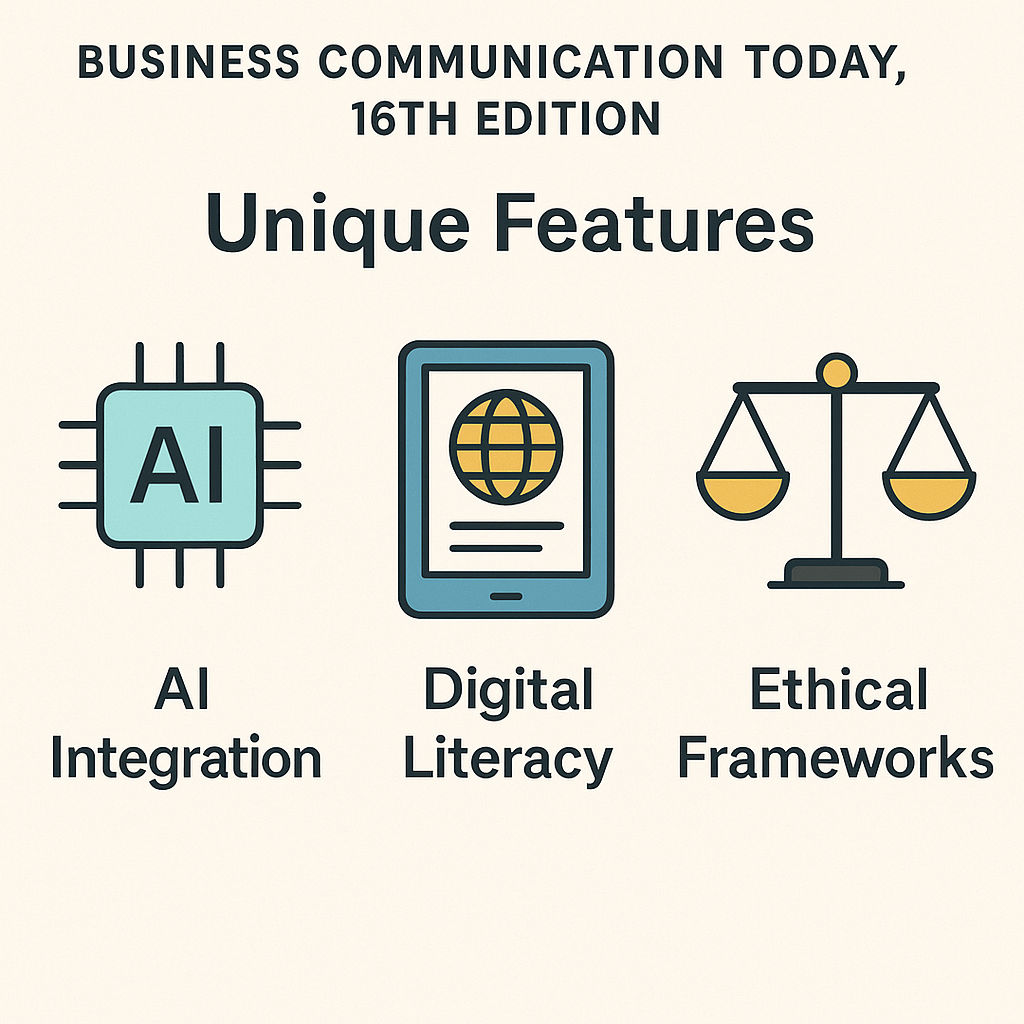
Digital Literacy Emphasis: Unlike traditional texts, Business Communication Today underscores the necessity of digital literacy by integrating discussions on digital ethics and communication technologies. This prepares students not just for current professional environments but also for adapting to technological changes.
Comprehensive Ethical Frameworks: The book provides a robust framework for understanding and applying ethical principles in digital communication, addressing privacy concerns, data handling, and AI bias mitigation, which are crucial for developing responsible communication strategies.
2. Comparing Other Textbooks in the FieldNarrow Focus on Traditional Skills: Many existing textbooks focus heavily on foundational communication skills, often at the expense of integrating modern digital contexts. These texts sometimes treat digital tools as add-ons rather than integral elements of teaching communication.
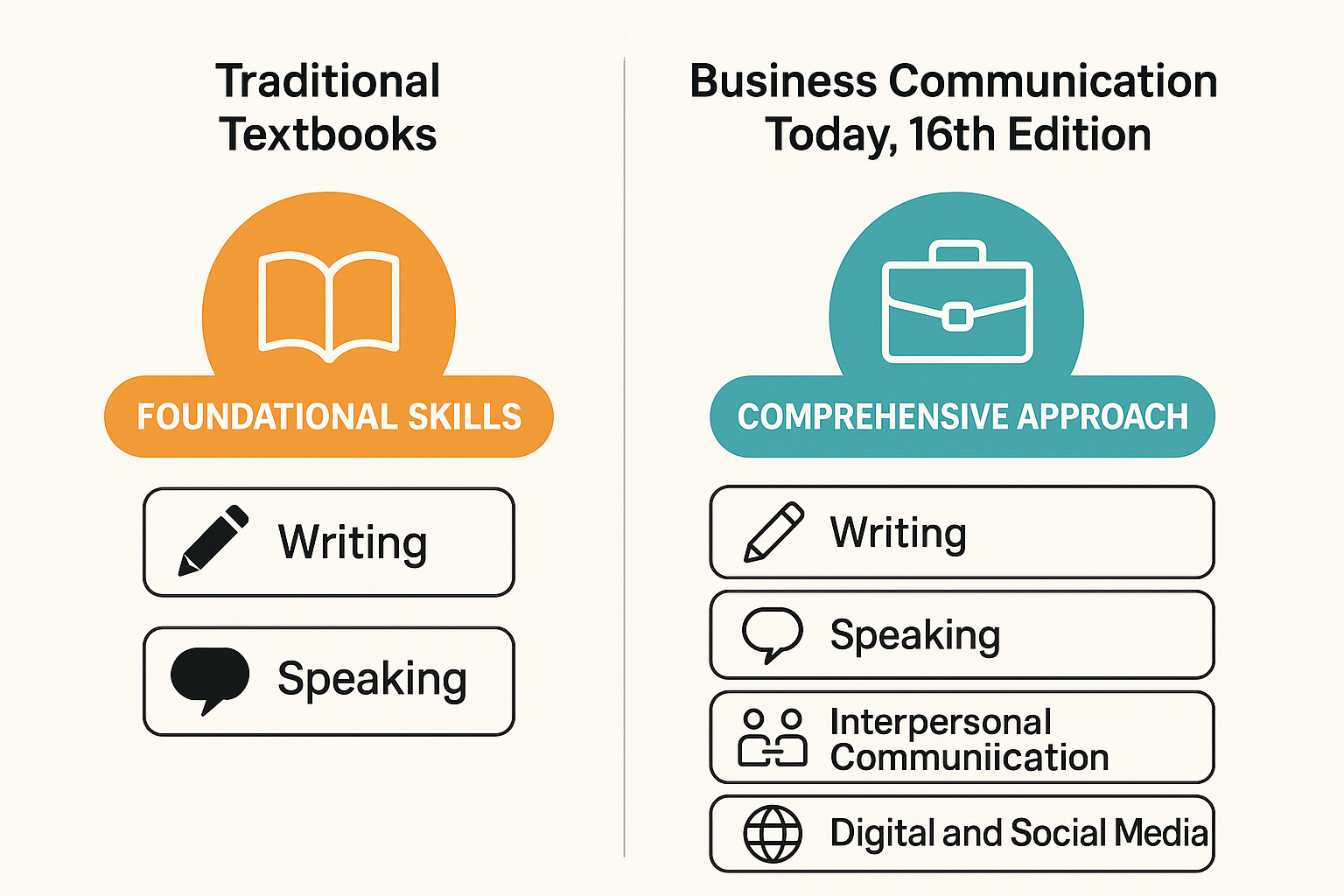
Limited AI Coverage: While some newer textbooks have begun to include AI elements, they often provide limited case studies lacking in real-world application. Business Communication Today stands out by incorporating detailed case analyses that are grounded in current industry data.
Lack of Practical Application: Textbooks that do not emphasize practical application often leave students unprepared for the actual demands they will face in business settings. The practical case studies and scenarios provided by Bovée and Thill fill this gap.
3. Practical Implementation in CurriculumInstructors looking to adopt a comprehensive and modern curriculum will find that the features of Business Communication Today, 16th Edition offer substantial benefits. The textbook not only includes theoretical knowledge but also promotes practical engagement through case studies and interactive learning strategies. This empowers instructors to augment their teaching with real-world skills that students can apply immediately after graduation.

- Business Communication Today, 16th Edition uniquely integrates AI and digital literacy into its curriculum.
- Comprehensive case studies provide practical application opportunities for students.
- The textbook offers extensive coverage of both fundamental and advanced communication strategies.
- Other texts may lack the integration of digital communication tools and ethical considerations.
- The text supports the development of both communication and technological competencies crucial for today’s job market.
AI Literacy: Understanding and effective use of AI tools in communication contexts.
Digital Literacy: The ability to use digital technology and communication tools effectively.
Ethical AI: AI practices that ensure fairness, transparency, and inclusivity in their applications.
Case Study: A detailed analysis and application of theory to real-world scenarios.
Communication Technology: Tools and platforms that facilitate message exchange in digital environments.
Related Questions- What sets Business Communication Today apart in AI teaching?
- How can digital literacy be effectively integrated into a communication curriculum?
- Why is ethical AI important in business communication?
- What benefits do case studies offer in enhancing learning outcomes?
- How do other texts compare in digital and AI coverage?
- Bovee, C. L., & Thill, J. V. (2023). Business Communication Today (16th ed.). Pearson Education.
- Pearson. (2023). MyLab Business Communication. Retrieved from
- Additional sources on AI in education and business communication (2020-present)
If you’re ready to transform your communication courses with integrated AI learning, explore how Business Communication Today, 16th Edition can be your essential resource for teaching digital literacy and AI readiness.
Business Communication Textbook Comparison helps instructors improve student engagement, writing quality, and communication outcomes.
Business Communication Textbook Comparison helps instructors improve student engagement, writing quality, and communication outcomes.
Business Communication Textbook Comparison helps instructors improve student engagement, writing quality, and communication outcomes.
Business Communication Textbook Comparison helps instructors improve student engagement, writing quality, and communication outcomes.
Business Communication Textbook Comparison helps instructors improve student engagement, writing quality, and communication outcomes.
Business Communication Textbook Comparison helps instructors improve student engagement, writing quality, and communication outcomes.
Related Resources
Additional guidance is available from AAC&U, NACE, and U.S. Department of Education.