
Fresh ways to use curated business communication content
Table of Contents
- Introductory Summary
- Learning Objectives
- Opening Framework: Context, Who Benefits, and Why Now
- Direct Answer
- 1. What Instructors Will Find
- 2. How to Turn Magazines into Teaching Activities
- 3. How to Keep the Work Manageable
- Key Takeaways
- Glossary of Key Terms
- Related Questions
- References
Introductory Summary
If you teach business communication and want current, low-prep examples for class discussion, Bovée and Thill’s online business communication magazines can give you a steady stream of timely material. Instructors using Business Communication Today, 16th Edition by Courtland L. Bovee and John V. Thill, can treat these magazines as a practical extension of course themes by bringing real-world messages, trends, and cases into class more often.
Learning Objectives
- Identify useful types of curated online content for business communication instruction.
- Design short class activities that connect current examples to communication concepts.
- Evaluate online articles for classroom relevance, credibility, and accessibility.
- Plan a manageable routine for using digital resources without overloading students.
Opening Framework: Context, Who Benefits, and Why Now
Students often understand communication principles more quickly when they can see them at work in current business settings. Curated online magazines are especially helpful for instructors who want fresh examples, support different student backgrounds and interests, and keep discussion grounded in what organizations are actually doing now.
Direct Answer
Bovée and Thill’s 11 online business communication magazines are most useful as a curated source of current teaching examples, discussion starters, and short analysis assignments. Instead of replacing your core text, they can help you update lessons with recent articles, compare strong and weak communication choices, and give students more practice applying course concepts to contemporary workplace situations. You can explore them at the Courtland L. Bovée Scoop.it page.
1. What Instructors Will Find
The main value of these online magazines is curation. Rather than asking instructors to search broadly for usable business communication content, the collection brings together articles and resources that can support topics such as workplace writing, presentations, visual communication, digital professionalism, social media, interpersonal communication, and message strategy.
Because the collection is curated in magazine format, it also helps with classroom efficiency. You can scan recent items quickly, spot content that fits a lesson already on your schedule, and choose one example instead of building an entire supplemental reading list from scratch.
Why curated magazines work well in business communication courses
Business communication courses benefit from materials that are both current and teachable. A curated magazine can narrow the gap between theory and practice by giving students concrete artifacts to analyze, discuss, and revise. That makes it easier to move from “What does this principle mean?” to “How well did this organization apply it?”
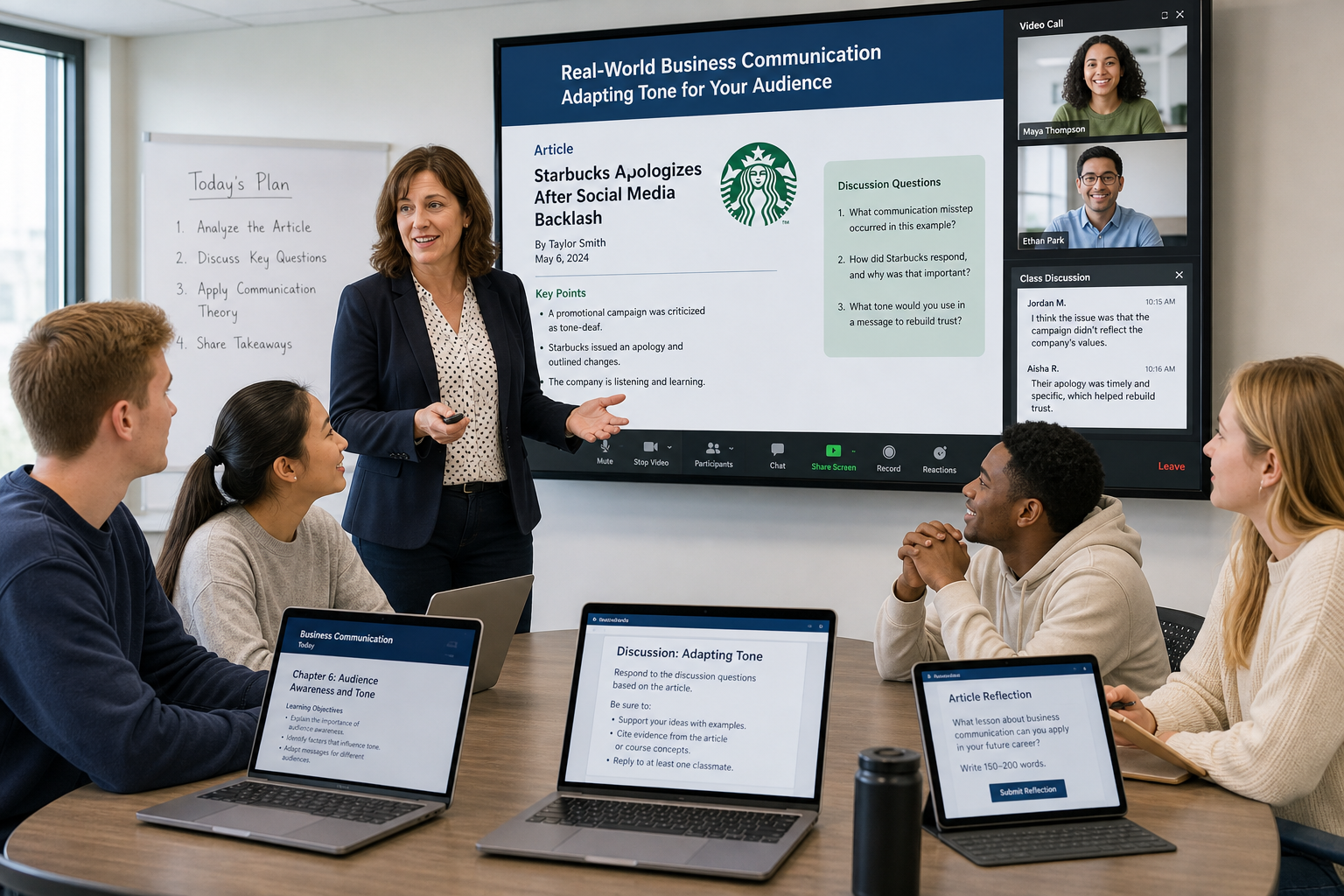
These magazines are also flexible across course formats. In face-to-face classes, you can use them for warm-up discussion or small-group analysis. In online or hybrid sections, they work well for discussion boards, short response posts, or low-stakes annotation activities.
2. How to Turn Magazines into Teaching Activities
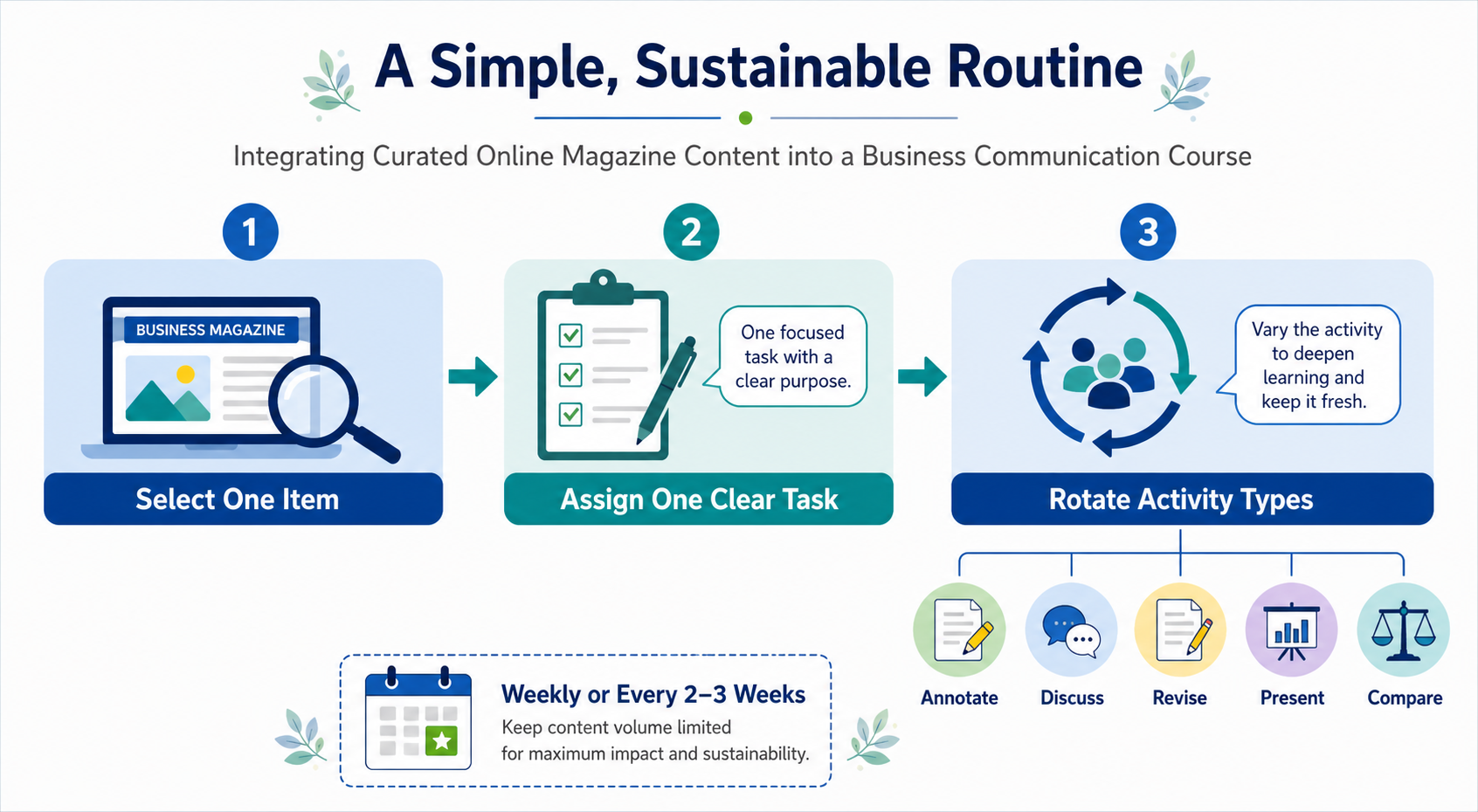
The best use of online magazines is not assigning large amounts of reading. It is selecting one focused item and pairing it with a clear task. Students usually learn more from a short, guided analysis than from a long list of links with no framework.
Use one article to teach one communication decision
Pick a single article or example and ask students to identify one key communication choice: audience focus, tone, organization, evidence, design, channel selection, or credibility. This keeps the task manageable and helps students connect a general concept to a visible real-world case.
You can also ask students to explain what they would change and why. That revision mindset turns passive reading into applied business communication practice.
Build short recurring activities
Many instructors get better results by making current-content work brief and consistent. For example, you might open each week with a five-minute “communication in the news” item from one of the magazines, followed by two questions: What is working here, and what could be improved?
Another option is a rotating student role. One student or team selects an item, summarizes it in one minute, and leads a short class discussion focused on a course concept. This approach increases engagement without adding much grading time.
Support writing, speaking, and critical thinking
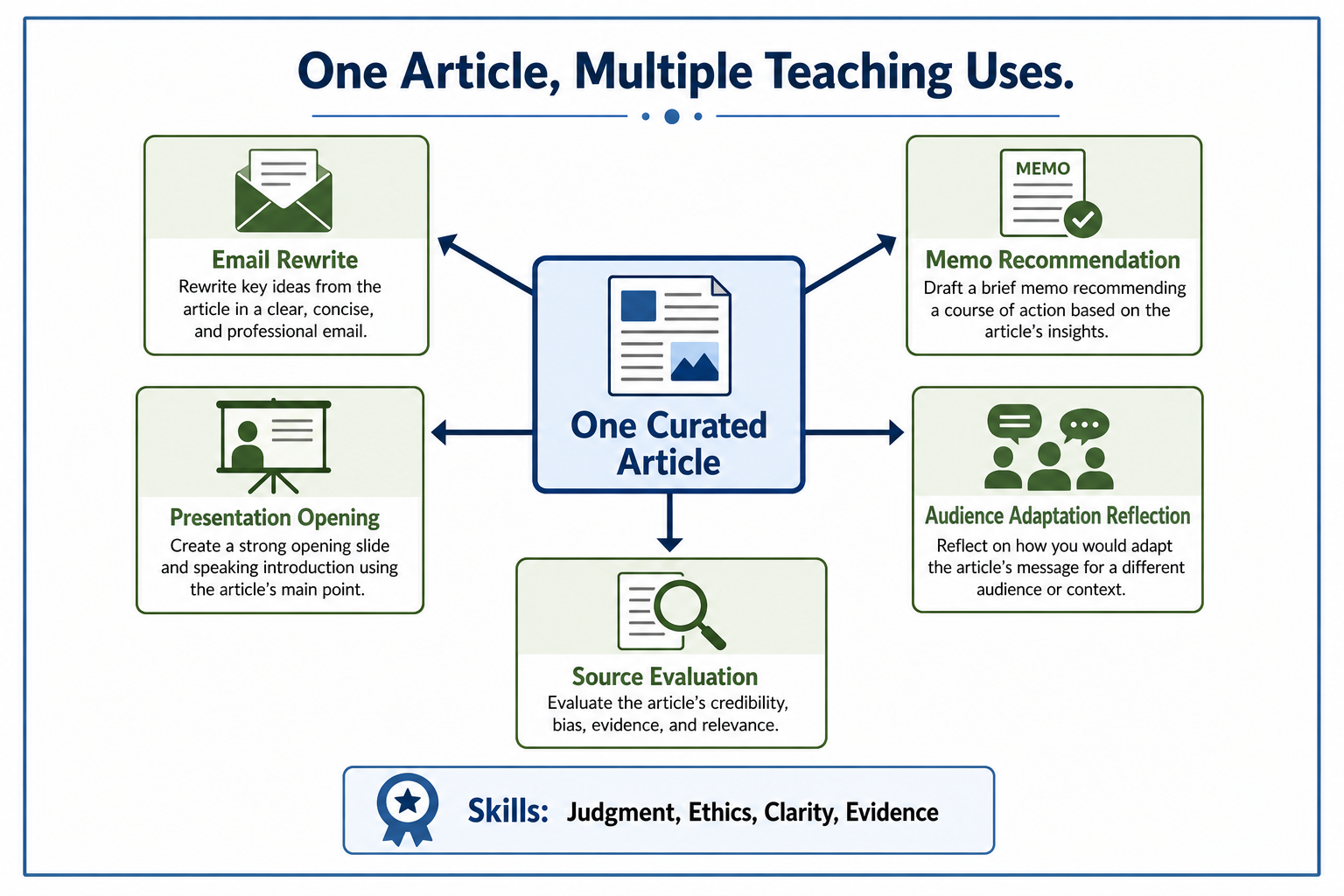
Curated content can support multiple assignment types. A short article can become the basis for an email rewrite, a memo recommendation, a presentation opening, or a reflection on audience adaptation. It can also help students practice evaluating sources and distinguishing useful evidence from unsupported claims.
That range matters because business communication instruction is rarely only about writing mechanics. It also involves judgment, ethics, clarity, and the ability to respond appropriately to different workplace situations.
3. How to Keep the Work Manageable
Fresh content is valuable, but too much of it can distract from the course structure. The simplest solution is to use the magazines as a supplement with a clear purpose, not as an additional stream of required content that students must constantly monitor.
Choose selection criteria before assigning anything
Before you bring in an article, decide what makes it worth class time. Good criteria might include relevance to that week’s learning goal, readability, discussion potential, and whether students can analyze it without needing extensive background knowledge.
It also helps to preview whether the item will work for all students in your class context. If an article depends heavily on jargon, paywalled material, or unexplained industry assumptions, it may need framing or a different choice.
Connect digital resources to your core teaching materials
When you use a core text such as Business Communication Today, the most effective approach is usually pairing textbook concepts with current examples. Bovee and Thill’s broader resource ecosystem can also help instructors who want additional teaching materials, including items available through the Business Communication Network resources page and tools page, when those resources fit the course goal.
The key is alignment. Students should be able to see why the supplemental item matters, what concept it illustrates, and what they are expected to do with it.
Keep the assignment load realistic
One curated item per week is often enough. In many courses, even one item every two or three weeks can make class feel more current without creating content fatigue. If you want deeper engagement, vary the task rather than increasing the reading volume.
That might mean alternating among annotation, discussion, revision, brief presentations, and comparison exercises. Variety helps students stay attentive while keeping prep and grading under control.
Key Takeaways
- Use Bovée and Thill’s online magazines as a curated source of current teaching examples, not as a replacement for your course structure.
- Select one item at a time and pair it with a specific communication concept or skill.
- Short, repeatable activities usually work better than large open-ended reading assignments.
- Connect curated digital content to your core text and learning outcomes so the purpose is clear.
- Prioritize relevance, clarity, and accessibility when choosing items for students.
Glossary of Key Terms
- Curated Content: Materials selected and organized by someone else to help users find relevant, high-value information efficiently.
- Low-stakes Assignment: A brief activity with limited grading weight that helps students practice skills without major performance pressure.
- Source Evaluation: The process of judging whether a source is credible, relevant, clear, and appropriate for a specific purpose.
- Supplemental Resource: Any teaching material used alongside a primary textbook or course framework to extend learning.
- Transfer of Learning: A student’s ability to apply a concept learned in one setting to a new and different context.
Related Questions
- Question: How often should I use online magazine content in a business communication course?
Answer: In most courses, one carefully chosen item every one to three weeks is enough to keep content current without overwhelming students. The better measure is whether each item clearly supports a learning objective. - Question: What types of assignments work best with curated online articles?
Answer: Short analysis tasks, discussion prompts, revision exercises, source-evaluation activities, and brief presentations usually work well. These formats keep the focus on communication choices rather than on content coverage alone. - Question: Can curated magazines help in online or hybrid teaching?
Answer: Yes. They are especially useful in online and hybrid courses because they can anchor asynchronous discussions, short reflections, and collaborative annotation without requiring lengthy new course modules. - Question: Should students browse the full magazine collection on their own?
Answer: Usually, it is better to guide them toward selected items first. Once students understand your evaluation criteria, you can invite them to find and justify additional pieces that fit the course goals. - Question: How do I connect current digital content to a textbook-based course?
Answer: Start with the course concept you are already teaching, then choose one current item that illustrates or complicates it. Ask students to apply the concept to the example so the textbook and the digital resource reinforce each other.
References
Bovee, C. L., & Thill, J. V. (2026). Business Communication Today (16th ed.). Pearson.
- What Kind of Instructor Support Materials Are Provided with Business Communication Today?
- Can I Get a Desk Copy or Trial Access to the Digital Platform for Business Communication Today to Review It Thoroughly?
© 2026 Business Communication Teaching and Learning Center. All rights reserved.