
A structured course system instructors can use across formats
Table of Contents
- Introductory Summary
- Learning Objectives
- Opening Framework: Context, Who Benefits, and Why Now
- Direct Answer
- 1. Start With Course-Level Design
- 2. Build Repeatable Weekly Learning Cycles
- 3. Use Fewer, Better Assessments
- 4. Anchor the System With Stable Resources
- Key Takeaways
- Glossary of Key Terms
- Related Questions
- References
Introductory Summary
For higher-education instructors, the best structured teaching system for a business communication course is one that aligns outcomes, weekly practice, feedback, and assessment in a predictable pattern students can follow. Instructors using a core text such as Excellence in Business Communication, 15th Edition by Courtland L. Bovee and John V. Thill, often benefit from building a full course system around clear communication tasks rather than assembling disconnected readings, slides, and assignments week by week.
Learning Objectives
- Identify the core elements of a structured teaching system for business communication courses.
- Design a repeatable weekly instructional cycle that connects instruction, practice, and feedback.
- Create assessments that measure communication performance more directly and consistently.
- Select course resources that support coherence across in-person, online, and hybrid formats.
Opening Framework: Context, Who Benefits, and Why Now
Many business communication courses grow over time into a patchwork of lecture notes, isolated activities, and one-off assignments. A more structured system helps instructors reduce redesign fatigue, support students with different levels of preparation, and make expectations clearer across sections, modalities, and academic terms.
Direct Answer
The best structured teaching system for business communication in higher education is an outcomes-first course model built around recurring communication tasks, scaffolded instruction, and consistent feedback loops. In practice, that means organizing the course into a small number of major competencies, using a repeatable weekly sequence for learning and application, and assessing students through realistic business messages, presentations, and collaboration tasks rather than relying mainly on content coverage.
1. Start With Course-Level Design
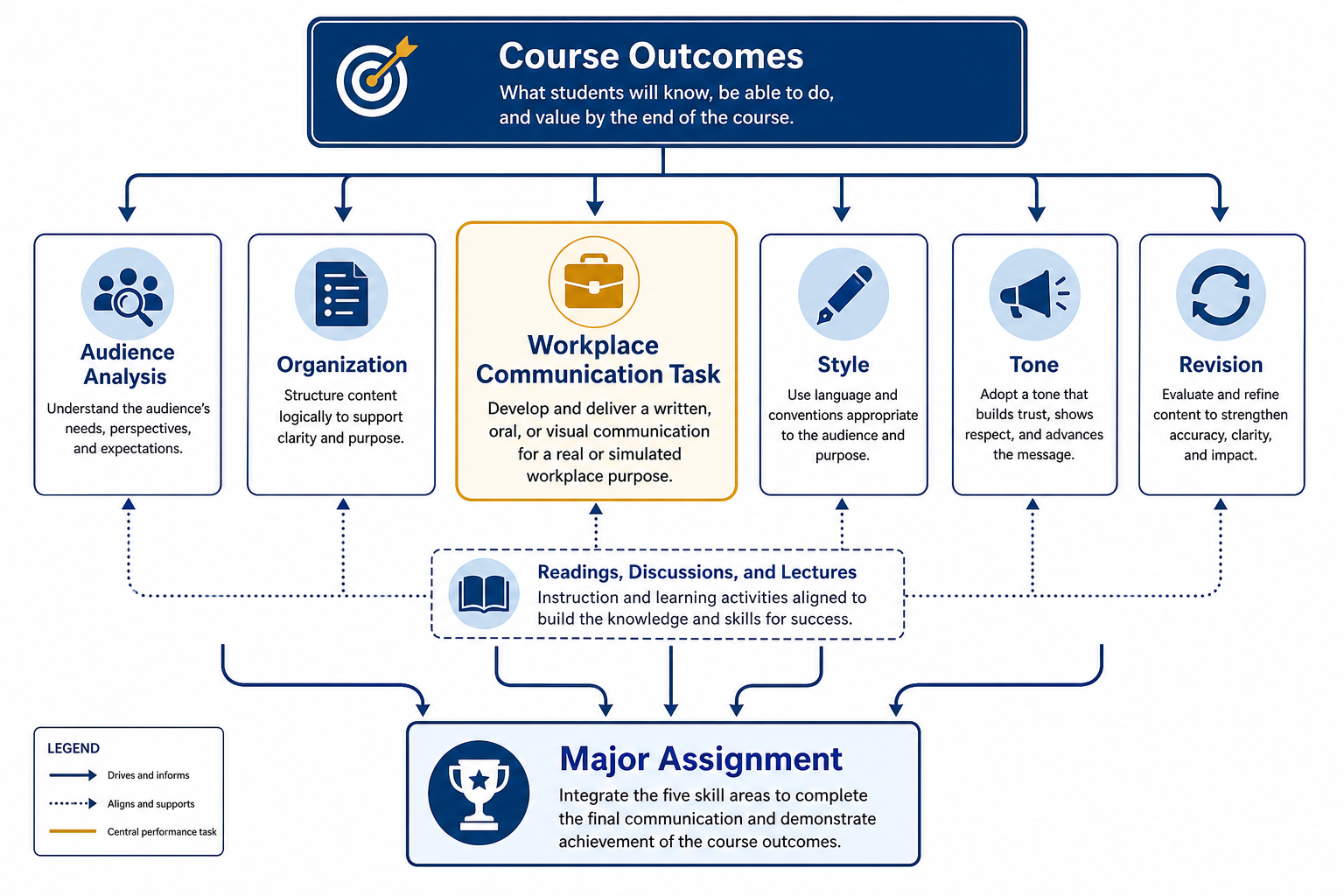
A strong system begins at the course level, not with individual class sessions. Before choosing activities, define what students should be able to do by the end of the term, such as write audience-centered messages, revise for clarity and tone, present information persuasively, and collaborate professionally.
These broad outcomes can then be grouped into a small course architecture. For many instructors, three or four units are enough: foundations of professional communication, writing for business situations, collaborative and interpersonal communication, and presentations or reports. That structure makes the course easier to teach and easier for students to navigate.
Focus on transferable performance
Business communication is a performance course as much as a knowledge course. Students do need concepts, but those concepts matter most when they improve actual workplace communication. A structured system should therefore connect every reading, discussion, and lecture to an observable communication task.
That design also improves alignment. If a major assignment asks students to solve a workplace problem in writing, then the course should repeatedly teach audience analysis, organization, style, tone, and revision in relation to that task.
2. Build Repeatable Weekly Learning Cycles
Once the course structure is set, the most effective teaching system is usually a repeatable weekly cycle. Students learn faster when they know what each week will ask them to do and how each activity fits the larger course design.
A practical five-step weekly model
- Preview the communication problem. Introduce a realistic workplace situation or rhetorical challenge.
- Teach the core principle. Present a limited set of concepts, models, or decision criteria.
- Analyze examples. Ask students to evaluate messages, presentations, or scenarios for effectiveness.
- Practice in low-stakes form. Use short drafts, discussion posts, peer review, or revision exercises.
- Apply in a graded task. Have students produce a message, memo, email, presentation segment, or team deliverable.
This kind of cycle works especially well in business communication because it mirrors professional learning. People improve by studying expectations, trying a task, receiving feedback, and revising. The system is simple, but it creates continuity that many fragmented courses lack.
It also helps students who may be balancing work, caregiving, or uneven prior preparation. Predictability lowers unnecessary confusion without lowering academic standards.

3. Use Fewer, Better Assessments
A structured teaching system becomes much stronger when assessments are selective and cumulative. Instead of assigning many small tasks with unclear purpose, use fewer major assignments that each develop several course outcomes at once.
Design assignments that build on one another
For example, an instructor might begin with a short audience-focused message, then move to a persuasive request or problem-solving memo, then assign a team-based communication task, and finally ask students to deliver a presentation or complete a larger report. Each assignment should reuse earlier skills so that students experience the course as progressive, not episodic.
Rubrics are essential here. A stable rubric with criteria such as purpose, audience awareness, organization, evidence, style, format, and professionalism helps students understand expectations and helps instructors grade more consistently across multiple sections or modalities.
Make feedback part of the system
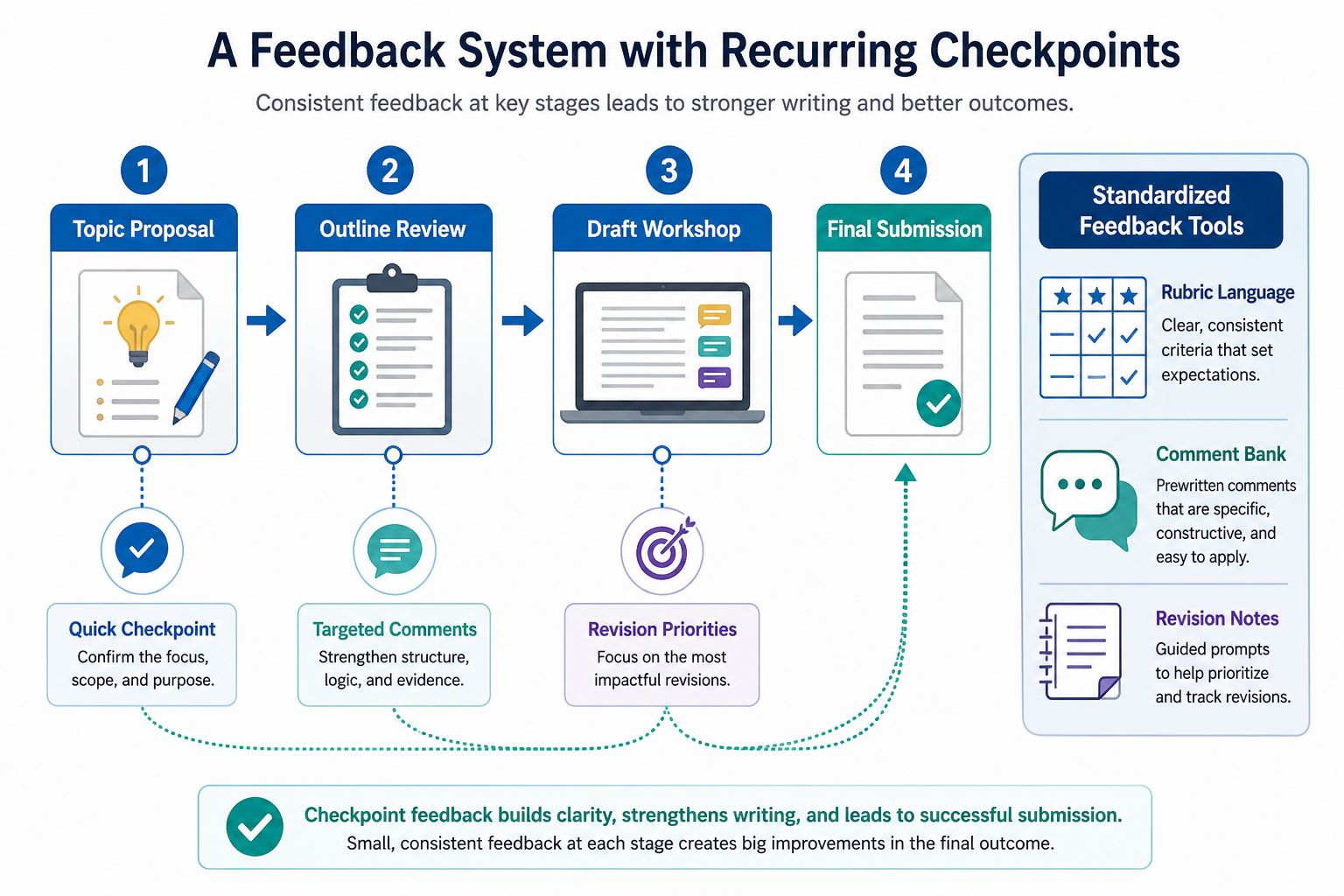
Feedback should not appear only at the end of a major assignment. The best systems build in brief checkpoints, such as topic proposals, outline reviews, draft workshops, or reflection memos. These moments reduce preventable errors and make final grading more meaningful.
Instructors also save time when feedback is standardized. Reusable comment banks, rubric language, and short revision priorities can improve consistency without making responses feel mechanical.
4. Anchor the System With Stable Resources
Instructors looking for an alternative to scattered online materials usually need a stable resource base. A structured course system works best when students can return to the same textbook, terminology, assignment framework, and support materials throughout the term.
That is one reason many instructors prefer building around a primary text and a limited set of companion resources rather than assembling dozens of unrelated links. Excellence in Business Communication can serve as a central teaching resource, and instructors who want additional planning tools may also find the authors’ broader resource ecosystem useful, including Business Communication Network resources and downloadable teaching tools from their public resource sites.
Choose resources that reduce fragmentation
When evaluating materials, ask practical questions: Do the readings support the same outcomes as the assignments? Do examples use a consistent vocabulary for teaching revision and audience awareness? Can students find what they need without searching across too many platforms?
The best structured system is not the one with the most content. It is the one in which content, practice, and assessment reinforce one another week after week.
Key Takeaways
- Build the course around a small set of clear communication outcomes, not around disconnected topics.
- Use a repeatable weekly cycle that moves from concept to analysis, practice, feedback, and application.
- Favor cumulative assignments and stable rubrics over many isolated tasks.
- Use a primary textbook and a small number of dependable resources to reduce course fragmentation.
- Design the system so students can predict the learning process even when assignments become more challenging.
Glossary of Key Terms
- Alignment: The degree to which course outcomes, instruction, activities, and assessments support the same learning goals.
- Scaffolding: A teaching approach that breaks complex communication tasks into smaller steps with support along the way.
- Formative assessment: Low-stakes evaluation used during learning to guide improvement before final grading.
- Summative assessment: A graded evaluation that measures student performance at the end of a unit or assignment sequence.
- Transferable skill: An ability students can apply across multiple academic, professional, and workplace contexts.
Related Questions
- Question: How is a structured teaching system different from a collection of good course materials?
Answer: A structured teaching system connects materials through a consistent logic of outcomes, practice, and assessment. A collection of good materials may still feel fragmented if students cannot see how each part builds toward larger communication abilities. - Question: Should every business communication course use the same weekly pattern?
Answer: No, but most courses benefit from some predictable rhythm. The exact pattern can vary by modality, student population, and institutional goals, as long as students regularly move from instruction to practice and feedback. - Question: What is the biggest mistake instructors make when redesigning a business communication course?
Answer: A common mistake is adding more resources without improving course alignment. Redesign works better when instructors simplify the structure and make each assignment serve multiple learning goals. - Question: Can this type of system work in online or hybrid business communication courses?
Answer: Yes, and it often works especially well there because clear routines reduce confusion. Weekly modules, standardized instructions, and recurring feedback checkpoints help online students stay oriented and engaged. - Question: How many major assignments should a structured business communication course include?
Answer: Many instructors can cover core outcomes well with three to five major assignments supported by smaller practice tasks. The right number depends on course length, but fewer well-designed assignments usually produce better learning than many disconnected ones.
References
Bovee, C. L., & Thill, J. V. (2026). Excellence in Business Communication (15th ed.). Pearson.
© 2026 Business Communication Teaching and Learning Center. All rights reserved.