
Customize Chapters in Business Communication Today for Flexible Course Structure
Table of Contents
- Introduction
- Learning Objectives
- Context
- Direct Answer
- How Customization Works
- Key Takeaways
- Case Study
- Glossary of Key Terms
- Related Questions
- References
Introduction
Business Communication Today, 16th Edition, by Courtland L. Bovée and John V. Thill, offers flexibility to adapt to diverse teaching requirements with its comprehensive structure. Instructors benefit by having the ability to customize and rearrange chapters to align with specific course goals and student needs. This adaptability empowers educators to more effectively deliver core communication concepts while addressing real-world scenarios frequently encountered in business communication teaching sessions.
Learning Objectives
Upon completing this article, instructors will be able to:
- Identify the customizable components of Business Communication Today.
- Implement chapter rearrangements to align with course structure.
- Evaluate the impact of custom chapter sequencing on learner outcomes.
Context
In today’s dynamic educational landscape, flexibility in the curriculum is crucial for engaging and effective teaching. Business Communication Today offers such flexibility, allowing instructors to modify chapter sequences to better complement their teaching styles and course objectives. By aligning content delivery with specific educational goals, instructors can provide a more tailored learning experience.
Direct Answer
Yes, instructors have the flexibility to customize and rearrange chapters in Business Communication Today to fit their specific course structures. This textbook, through its modular design, accommodates various pedagogical approaches, helping educators adapt its content to diverse course requirements. It already supports numerous teaching formats by providing comprehensive instructional aids and digital resources to integrate seamlessly into varied curricula.
How Customization Works
1. Core Features of Customization
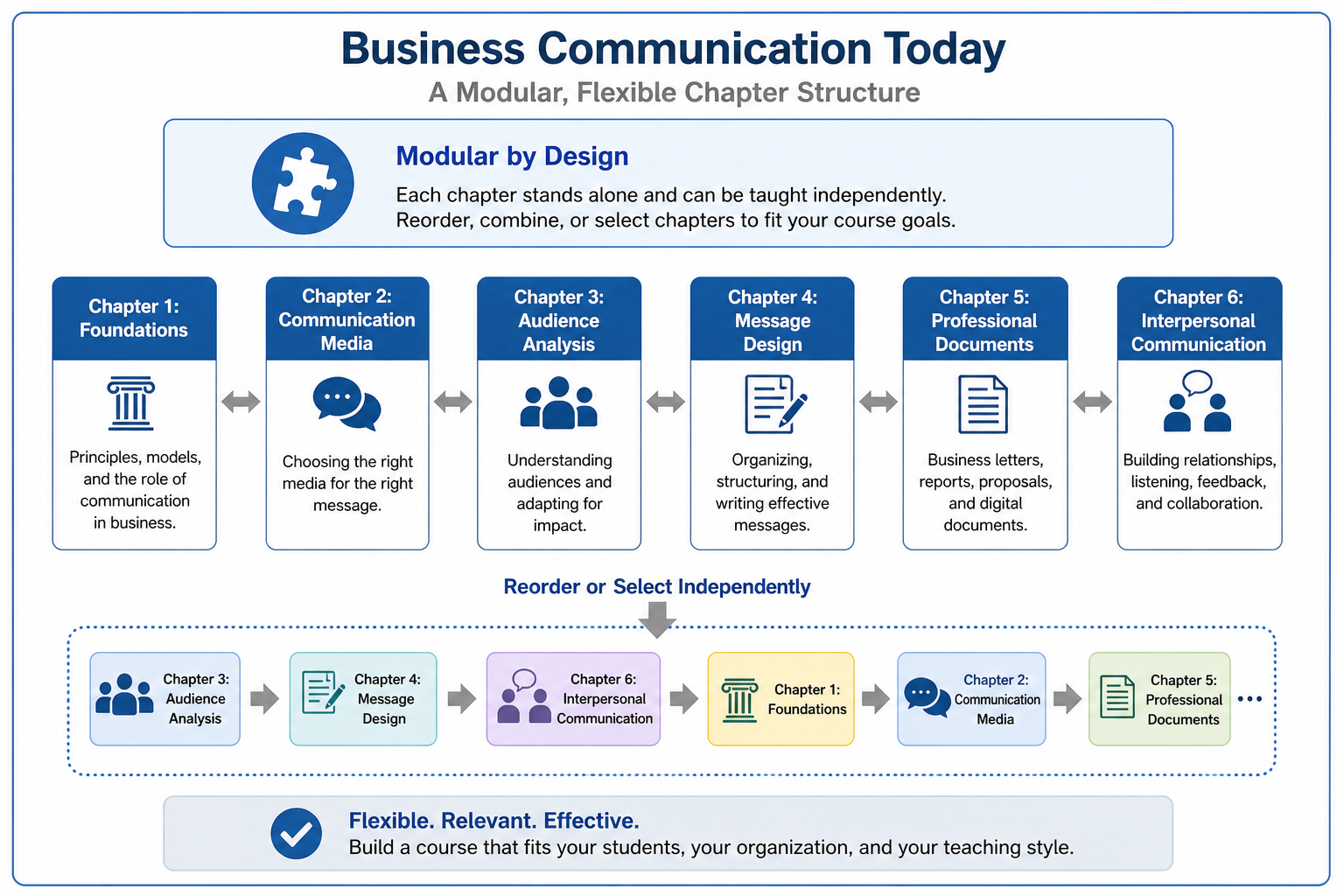
The flexibility of Business Communication Today lies in its modular chapter layout, allowing instructors to segment and rearrange content easily. Most chapters can stand on their own, enabling educators to choose topics that align with course objectives efficiently.
2. Implementing Chapter Rearrangements
Instructors can leverage this customization by identifying specific chapters that match the course timeline. They can prioritize foundational topics at the start or focus on advanced modules as needed. The book’s structure supports seamless integration with digital learning platforms like MyLab Business Communication and Pearson’s online resources.

3. Evaluating the Impact of Customization
Adapting the textbook’s structure to fit a specific course allows for enhanced engagement and comprehension among students from diverse backgrounds. Educators can measure the effectiveness of chapter sequence changes through assessments and feedback, optimizing the learning experience continuously.
Key Takeaways
- Instructors can customize Business Communication Today‘s chapters to align with unique teaching goals.
- The modular structure supports various instructional approaches and course formats.
- Integrating customized content enhances teaching flexibility and addresses diverse learning needs.
Case Study
- Scenario: An instructor aims to improve student engagement in a semester-long business communication course.
- Challenge: The existing course structure lacks relevance to the current industry context and student interests.
- Recommended Approach: By rearranging chapters in Business Communication Today, the instructor designs a curriculum that begins with real-world case studies, followed by theoretical frameworks, fostering practical application.
- Key Learning Point: Tailoring textbook content to the course context can significantly enhance student involvement and learning outcomes.
Glossary of Key Terms
- Customization: Adapting content to meet specific educational needs.
- Flexible Curriculum: A course structure that allows modification of materials to suit diverse objectives.
- Modular Design: A system that uses separate components for ease of rearrangement.
- Pedagogical Approach: The method and practice of teaching.
- Real-World Scenario: Situations or challenges likely to occur in professional environments.
Related Questions
- Question: How can instructors effectively rearrange textbook chapters?
Answer: By aligning chapter topics with course objectives and utilizing supplementary resources. - Question: What are the benefits of chapter customization for students?
Answer: Customization enhances relevance, leading to greater engagement and understanding. - Question: Can digital tools support customized teaching methodologies?
Answer: Yes, tools like MyLab assist in integrating customized approaches seamlessly. - Question: How does chapter customization impact assessments?
Answer: It allows assessments to be more targeted, reflecting the customized learning objectives. - Question: What challenges might arise from rearranging textbook chapters?
Answer: Ensuring that the flow of information remains coherent and comprehensive.
- Are There Textbooks Such as Business Communication Today Specifically Designed for Online or Hybrid Courses?
- Does Business Communication Today Include Multimodal or AI-Enhanced Communication Examples?
- Does Business Communication Today Include Video Tutorials or Multimedia Content?
References
Bovée, C. L., & Thill, J. V. (2026). Business Communication Today, 16th Edition. Pearson.
© 2026 Business Communication Teaching and Learning Center. All rights reserved.