TEXTBOOK COMPARISON
BCOM vs. Business Communication Today
A course-selection comparison for business communication instructors.
 |
Figure 1. Business Communication Today, 16th Edition, prepares students to solve workplace communication challenges through audience analysis, the Three-Step Writing Process, digital fluency, visual communication, and responsible AI use.
Textbooks Compared
| Textbook | Edition, Author(s), and Publisher |
| BCOM | 11th Edition, Carol M. Lehman, Debbie D. DuFrene, and Robyn Walker, Cengage |
| Business Communication Today | 16th Edition, Courtland L. Bovée and John V. Thill, Pearson |
At a Glance
Both textbooks teach the central competencies of workplace communication: audience awareness, ethics, interpersonal and group communication, planning, clear writing, electronic communication, positive and negative messages, persuasion, research, reports, graphics, presentations, résumés, interviewing, grammar, and mechanics. BCOM is distinguished by a concise (one of the briefest, visually driven, communication-strategy-focused design built around 14 short chapters and MindTap support. Business Communication Today is distinguished by a broader 19-chapter modular curriculum, the Three-Step Writing Process, Human-First AI in every chapter, and the exclusive Teaching and Learning Accelerator™.
Cengage’s official materials emphasize BCOM’s direct tone, practical business application, updated model documents, chapter-level Learn It and Apply It assessments, and an Aplia-powered grammar diagnostic. Business Communication Today also supports a concise course through selective assignment while preserving more separately assignable coverage of digital media, social media, visual communication, research, reports, presentations, career communication, and artificial intelligence.
Who Should Read This Comparison?
This comparison is designed for instructors, department chairs, curriculum committees, and program leaders choosing a textbook for undergraduate business communication, managerial communication, professional writing, workplace communication, or a related course. It focuses on instructional architecture, recurring learning frameworks, artificial intelligence, digital support, and course-design flexibility rather than on price or ancillary adoption incentives.
How This Comparison Was Prepared
Descriptions of BCOM, 11th Edition, are based on Cengage’s official product page, table of contents, feature descriptions, MindTap information, and publicly available bibliographic records. Descriptions of Business Communication Today, 16th Edition, are based on the complete published manuscript and official teaching and learning materials. Because the full BCOM manuscript was not available, this comparison avoids claims that cannot be verified from public sources and distinguishes documented facts from editorial interpretation.
Learning Objectives
- Identify the common professional communication competencies taught by both textbooks.
- Explain BCOM’s signature contribution as a concise, visually driven, communication-strategy-focused course design.
- Compare BCOM’s planning and delivery-strategy emphasis with the Three-Step Writing Process in Business Communication Today.
- Evaluate differences in chapter modularity, digital and visual communication, artificial intelligence, and career preparation.
- Compare MindTap, MyLab Business Communication, and the Teaching and Learning Accelerator™.
- Match each textbook’s architecture to specific course outcomes and instructor priorities.
Table of Contents
Why Compare These Textbooks?
Executive Comparison
What Do Both Textbooks Teach?
How Do the Textbooks’ Signature Contributions Differ?
How Do the Textbooks Differ in Instructional Philosophy?
How Does BCOM’s Communication-Strategy Focus Compare with the Three-Step Writing Process?
How Do the Textbooks Compare in Scope and Course Flexibility?
Do Grammar, Mechanics, and Writing Control Distinguish the Textbooks?
How Do the Textbooks Teach Electronic, Digital, Social, and Visual Communication
How Does Each Textbook Integrate Artificial Intelligence?
What Does Human-First AI Mean in Business Communication Today?
How Does Each Textbook Prepare Students for the Workplace?
What Is New in Business Communication Today, 16th Edition?
How Do MindTap, MyLab, and the Teaching and Learning Accelerator™ Differ?
Which Textbook Matches Each Instructional Priority?
Which Textbook Best Fits Your Course?
Key Takeaways
Glossary of Key Terms
Related Questions
References
About the Authors
Why Compare These Textbooks?
Quick Answer: Both books prepare students for the core demands of professional communication, but they package that preparation differently. BCOM offers a defined 14-chapter pathway with short, visually driven chapters and an explicit focus on communication delivery strategy and practical application. Business Communication Today teaches the same fundamentals within a larger 19-chapter modular architecture connected by the Three-Step Writing Process, AI instruction in every chapter, and a larger teaching and coaching ecosystem.
The decision is not practical versus strategic. Both textbooks are practical, audience centered, and oriented toward workplace performance. The meaningful contrast is predefined concision versus modular flexibility, together with differences in the visibility of a recurring process, the documented treatment of generative AI, and the surrounding digital resources.
Instructor Takeaway: BCOM gives instructors an efficient, visually accessible route through the core curriculum. Business Communication Today supports the same focused course design through selective assignment while preserving broader options for strategic communication, media, research, presentations, career preparation, and Human-First AI.
Executive Comparison
The clearest distinction is not whether either book teaches fundamentals. Both do. BCOM defines a compact, communication-strategy-focused course with short chapters and MindTap-based practice. Business Communication Today provides a more granular modular curriculum, a named ten-task writing process, systematic AI integration, and an additional teaching and learning system.
Table 1. Executive comparison of the two textbooks.
| Comparison Area | BCOM | Business Communication Today |
| Signature educational contribution | A concise, visually driven, communication-strategy-focused pathway through essential business communication | A broader modular curriculum connected by the Three-Step Writing Process, Human-First AI, and integrated teaching support |
| Instructional philosophy | Direct, succinct, practical instruction focused on communication delivery strategy and application | Strategic communication decisions connected to purpose, audience, evidence, media, ethics, organizational goals, and consequences |
| Course architecture | 14 somewhat short chapters plus a Grammar and Usage Appendix | 19 chapters in seven modular parts with more topics separated for independent assignment |
| Artificial intelligence | Official public materials reviewed do not document an edition-wide or chapter-by-chapter AI program | AI integrated in every chapter, with more than 100 AI-related questions, exercises, and activities |
| Writing and correctness | Planning, decision making, written-message preparation, model documents, an Aplia grammar diagnostic, and a Grammar and Usage Appendix | Planning, writing, completing, grammar handbook support, extensive exercises, and MyLab practice |
| Digital and visual organization | Dedicated chapters on electronic communication, data and graphics, and business presentations | Separate chapters on digital media, social media, visual communication, presentation planning, and presentation visuals and delivery |
| Digital course support | MindTap with eBook, organized course materials, multimedia, assignments, quizzes, Learn It and Apply It assessments, and grammar diagnostics | MyLab Business Communication plus the exclusive Teaching and Learning Accelerator™ |
Instructor Takeaway: BCOM offers a defined, efficient course with substantial digital reinforcement. Business Communication Today addresses the same core outcomes while adding greater chapter modularity, a repeatable ten-task process, more extensive documented AI instruction, and an additional integrated teaching and coaching system.
What Do Both Textbooks Teach?
Quick Answer: Both textbooks cover the essential foundations of professional communication, including communication strategy, audience analysis, ethics, interpersonal and group communication, planning, clear writing, electronic communication, routine and positive messages, bad-news messages, persuasion, research, reports, graphics, presentations, résumés, interviewing, grammar, and mechanics, although Business Communication Today’s coverage is more in-depth.
Both books use workplace examples and model documents to show how principles become professional messages. Both require students to make choices about purpose, audience, tone, organization, evidence, media, design, and delivery rather than merely memorize rules.
Fundamental topic coverage therefore does not distinguish the textbooks except for depth of coverage. The are differences in how the content is organized, how often a named framework is reinforced, how AI is distributed through the curriculum, and how digital resources support practice and feedback.
Instructor Takeaway: Both books cover the core curriculum, although Business Communication Today to a much greater degree. Adopters should also consider course architecture, recurring process, artificial intelligence, media depth, and the teaching ecosystem.
How Do the Textbooks’ Signature Contributions Differ?
Quick Answer: BCOM’s signature contribution is a very efficient, visually driven, communication-strategy-focused course design that condenses the core curriculum into 14 short comprehensive chapters. Business Communication Today’s signature contribution is a much broader modular curriculum connected by the Three-Step Writing Process, with Human-First AI in every chapter and the exclusive Teaching and Learning Accelerator™.
Cengage describes BCOM as direct, succinct, and broadly focused on communication delivery strategy and practical business application. Its shorter chapter design, updated model documents, and Learn It and Apply It assessments are intended to help students read, understand, and apply the material.
Business Communication Today also emphasizes practical application, but its distinctive mechanism is curricular transfer. Students repeatedly use the same Plan-Write-Complete framework across interpersonal, written, digital, social, visual, research, presentation, employment, and AI-assisted communication.
Instructor Takeaway: BCOM creates focus by defining a compact course and reinforcing it through concise chapters and MindTap practice. Business Communication Today creates focus through selective assignment within a broader curriculum and reinforces transfer through one recurring process and Human-First AI.
How Do the Textbooks Differ in Instructional Philosophy?
Quick Answer: Both textbooks are practical, audience centered, and designed to develop workplace competence. BCOM emphasizes very efficient presentation, communication delivery strategy, model documents, chapter-level application, and mastery-oriented MindTap support. Business Communication Today emphasizes strategic decision making across the full communication process, with explicit attention to organizational goals, evidence, media, ethics, relationships, technology, and consequences.
BCOM’s design begins with a framework for business communication, interpersonal and group communication, and planning and decision making before moving into message preparation and common workplace documents. The sequence creates a direct route from foundational principles to business application.
Business Communication Today begins with professional communication in the age of AI, collaboration and interpersonal communication, and communication challenges in a diverse global marketplace. The Three-Step Writing Process then provides a stable architecture for messages, media, reports, presentations, and career communication.
Instructor Takeaway: BCOM is built for efficient progression through a defined core. Business Communication Today uses a broader strategic architecture that instructors narrow for a concise course or expand when programs require more media, research, AI, presentation, and career depth.
How Does BCOM’s Communication-Strategy Focus Compare with the Three-Step Writing Process?
Quick Answer: BCOM’s public materials foreground communication delivery strategy, planning, decision making, and practical application. Its table of contents moves from Planning and Decision Making to Preparing Written Messages. Business Communication Today makes a named ten-task framework explicit: Plan, Write, and Complete. The distinction is a broad strategy-focused course design versus a recurring process that carries decisions from analysis through final distribution.
The public evidence for BCOM supports a strong emphasis on strategic planning and message preparation but does not establish a single named, ten-task process used throughout every chapter. Its instructional continuity comes from the course’s strategy focus, short chapter design, model documents, and recurring Learn It and Apply It assessments.
Business Communication Today groups ten tasks into three phases. Planning includes analyzing the situation, gathering information, selecting media and channels, and organizing information. Writing includes adapting to the audience and composing. Completing includes revising, producing, proofreading, and distributing.
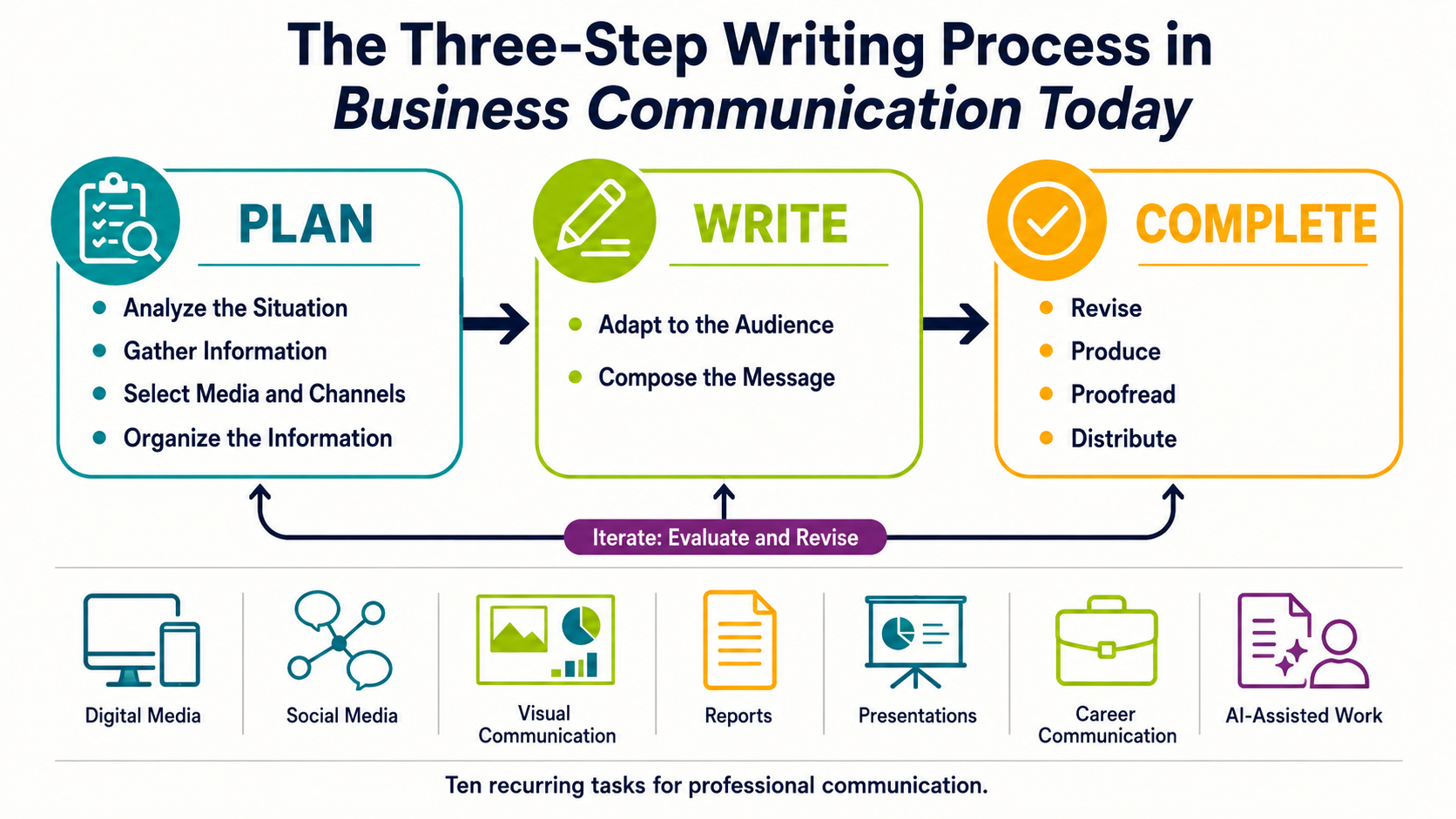
Figure 2. Business Communication Today reinforces a named ten-task process across written, digital, visual, research, presentation, career, and AI-assisted communication contexts.
Table 2. Comparison of the recurring instructional frameworks.
| Instructional Question | BCOM | Business Communication Today |
| Where does the framework begin? | With a framework for business communication, interpersonal and group communication, and planning and decision making | With analysis of the communication situation as the first task in the Three-Step Writing Process |
| What does it emphasize? | Communication delivery strategy, practical application, model documents, and efficient progression through core topics | A systematic workflow from purpose and audience through evidence, media, organization, drafting, revision, production, and distribution |
| How is it reinforced? | Through short comprehensive chapters, Learn It and Apply It assessments, model documents, and MindTap resources | Through repeated use of Plan, Write, and Complete across chapters and communication contexts |
| What is the transfer benefit? | Students connect strategy and practical application across a defined core curriculum | Students learn a stable process they reuse for nearly every professional communication task |
Instructor Takeaway: Both approaches require planning, audience awareness, judgment, and revision. BCOM offers a concise strategy-centered pathway; Business Communication Today makes the complete workflow more explicit and repeatedly transferable across independently assignable topics.
How Do the Textbooks Compare in Scope and Course Flexibility?
Quick Answer: BCOM provides a predefined, brief 14-chapter pathway through what the authors believe is the core business communication curriculum. Business Communication Today supports the same focused course design through selective assignment while preserving access to 19 chapters and more separately assignable coverage of collaboration, digital media, social media, visual communication, research, reports, presentations, résumés, interviewing, and artificial intelligence.
BCOM’s concise architecture reduces course-design complexity. Related topics are combined into broad chapters, including electronic communication, report research and preparation, data and graphics, presentations, and employment communication. The structure is especially attractive when instructors want a direct route through a one-semester course.
Business Communication Today divides comparable territory into more independent modules. Digital media, social media, and visual communication receive separate chapters; research and reports span three chapters; presentations span two chapters; and career communication spans two chapters. Its modular design lets instructors omit modules without losing the Three-Step Writing Process that connects the course.
 |
Figure 3. Business Communication Today organizes 19 chapters into seven modular parts that instructors configure for focused or expanded course designs.
Instructor Takeaway: BCOM builds concision into the textbook’s boundaries. Business Communication Today supports a concise course through selective assignment while retaining greater room to expand, sequence, or reconfigure the curriculum.
Do Grammar, Mechanics, and Writing Control Distinguish the Textbooks?
Quick Answer: No. Both textbooks provide substantial support for clear writing, revision, grammar, mechanics, and correctness. BCOM includes an Aplia-powered grammar diagnostic, a Grammar and Usage Appendix, model documents, and chapter-level practice. Business Communication Today includes writing and completing chapters, a grammar handbook, extensive end-of-chapter exercises, and MyLab practice.
Cengage gives grammar support especially visible digital treatment by helping students identify competencies, review tutorials, and complete check-up activities in MindTap. Business Communication Today likewise teaches clarity, conciseness, tone, paragraph development, revision, proofreading, production, and correctness throughout the text and digital course.
The placement and digital tools differ, but both programs treat writing control as essential. It is misleading to present grammar, editing, or mechanics as an exclusive advantage for either textbook.
Instructor Takeaway: Both textbooks provide strong writing and correctness support. The more meaningful adoption differences are course architecture, recurring instructional framework, media modularity, artificial intelligence, and teaching support.
How Do the Textbooks Teach Electronic, Digital, Social, and Visual Communication?
Quick Answer: Both textbooks prepare students to select appropriate channels and communicate with text, data, graphics, and presentations. BCOM devotes somewhat brief chapters to electronic communication, managing data and using graphics, and business presentations. Business Communication Today separates digital media, social media, and visual communication into three chapters and separates presentation planning from presentation visuals and delivery.
BCOM’s integrated organization offers a compact pathway through electronic communication and visual support. Cengage also identifies increased attention to web communication and the changing nature of business in the 11th edition.
Business Communication Today provides more granular chapter-level assignment. Digital media, social media, visual communication, presentation planning, and presentation visuals and delivery each receive their own learning objectives, examples, ethics discussions, and AI applications.
Instructor Takeaway: BCOM provides focused electronic, graphic, and presentation coverage within a very concise course. Business Communication Today offers greater modular depth when digital, social, visual, or presentation communication is a major independently assessed outcome.
How Does Each Textbook Integrate Artificial Intelligence?
Quick Answer: The official public materials reviewed for BCOM, 11th Edition, do not document a systematic artificial intelligence program or AI instruction in every chapter. Business Communication Today integrates AI concepts, cautions, ethical questions, and hands-on practice into all 19 chapters through a Human-First AI philosophy and more than 100 AI-related questions, exercises, and activities.
This conclusion is deliberately limited. It does not claim that BCOM contains no references to automation or emerging technology. It means that Cengage’s public product description, feature list, and table of contents do not establish an edition-wide generative AI curriculum comparable to the documented program in Business Communication Today.
Business Communication Today addresses AI in collaboration, planning, drafting, revising, research, source evaluation, visuals, messages, reports, presentations, résumés, and interviewing. Students use AI while also evaluating accuracy, bias, confidentiality, intellectual property, transparency, overreliance, and loss of human voice.
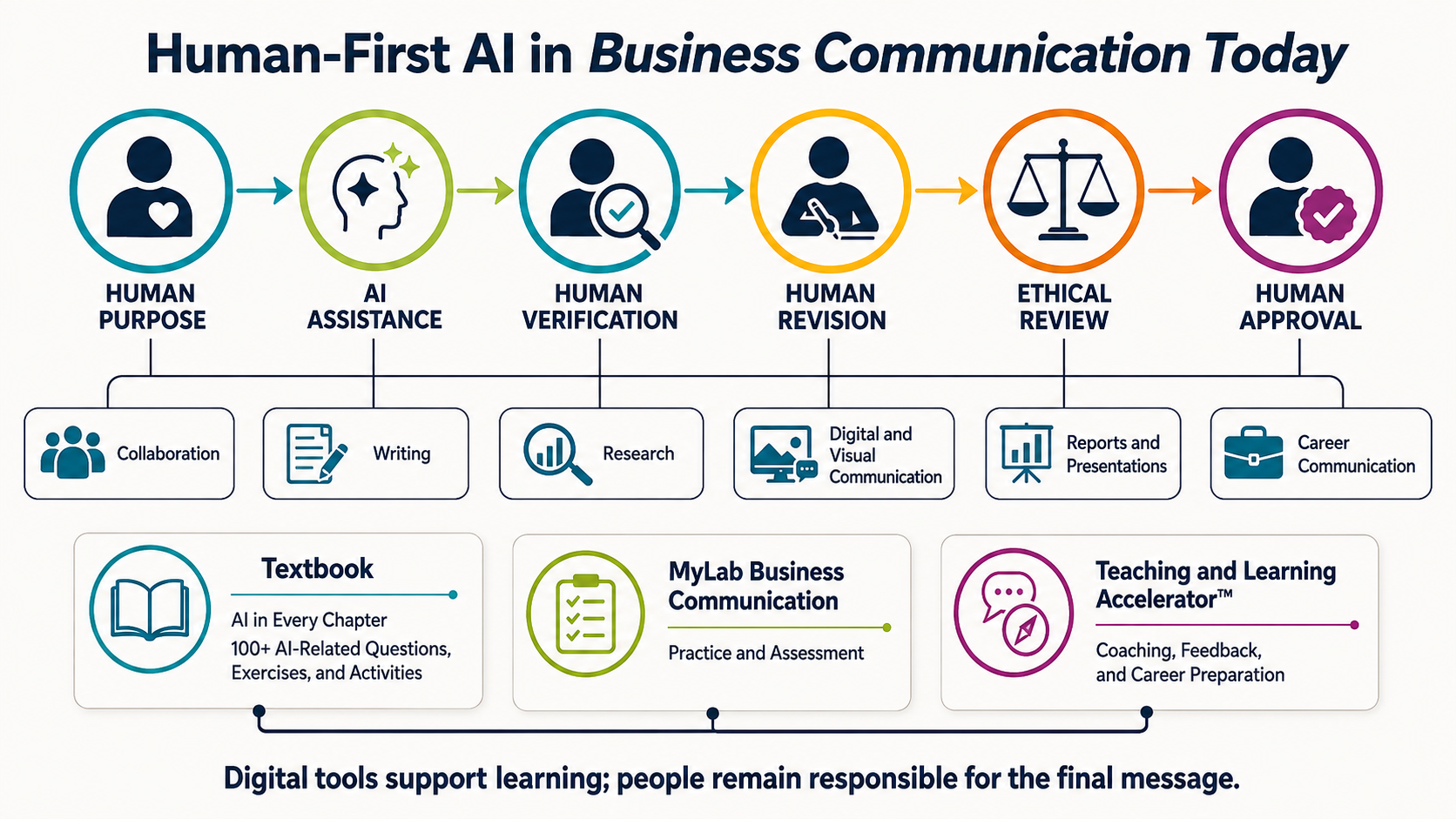 |
Figure 4. Business Communication Today integrates Human-First AI instruction and practice across every chapter, supported by MyLab Business Communication and the Teaching and Learning Accelerator™.
Instructor Takeaway: Both programs use digital learning to build communication competence. Instructors who want AI repeatedly embedded in textbook instruction and assignments have more extensive documented coverage in Business Communication Today.
What Does Human-First AI Mean in Business Communication Today?
Quick Answer: In Business Communication Today, Human-First AI treats artificial intelligence as a support for human communication rather than a replacement for human judgment. Students begin with purpose, audience, evidence, ethics, and voice; use AI selectively; verify and revise the output; and retain responsibility for the final message.
The philosophy is integrated with the Three-Step Writing Process. AI assists with brainstorming, research, drafting, revision, visuals, presentations, and career communication, but students must protect confidentiality, check facts and sources, look for bias, preserve authenticity, and disclose or document AI use when required.
Instructor Takeaway: Human-First AI gives instructors a repeatable way to teach both capability and restraint. The objective is not simply to make students faster with AI; it is to make them more responsible, critical, and effective communicators while using it.
How Does Each Textbook Prepare Students for the Workplace?
Quick Answer: Both textbooks prepare students to collaborate, plan messages, communicate electronically, write common workplace messages, conduct research, use data and graphics, prepare reports, present ideas, and compete for employment. BCOM emphasizes concise practical application and model documents. Business Communication Today adds more separately assignable media, research, presentation, career, and AI modules.
BCOM’s chapter sequence moves from foundational communication and group interaction through planning, written and electronic messages, reports, graphics, presentations, résumés, interviewing, and employment messages. Updated model documents and Apply It assessments support practical transfer.
Business Communication Today uses workplace vignettes and applications across 19 chapters. Career preparation spans two chapters, presentations span two chapters, and AI guidance is integrated throughout research, messages, reports, visuals, presentations, résumés, and interviewing.
Instructor Takeaway: BCOM provides a direct, practical route through a brief core workplace curriculum. Business Communication Today offers the stronger fit when media fluency, research, presentation design, career preparation, and AI competence are extensive separately assessed outcomes.
What Is New in Business Communication Today, 16th Edition?
Quick Answer: Business Communication Today, 16th Edition, integrates artificial intelligence throughout all 19 chapters, adds more than 100 AI-related questions, exercises, and activities, updates chapter-opening workplace vignettes, and expands instruction in digital, social, visual, research, presentation, and career communication for an AI-influenced workplace.
The edition presents AI as a collaborative tool that assists with brainstorming, drafting, revising, research, visuals, presentations, and employment communication while also creating risks involving accuracy, bias, confidentiality, intellectual property, transparency, overreliance, and loss of human voice.
The Human-First AI philosophy requires students to begin with human purpose and judgment, evaluate AI output critically, verify evidence, revise for audience and context, and retain responsibility for the final message. This philosophy is integrated with the Three-Step Writing Process rather than treated as a detached technology unit.
Instructor Takeaway: The edition’s primary contribution is not simply more AI content. It is the systematic integration of AI literacy, ethical judgment, and human accountability across the full business communication curriculum.
How Do MindTap, MyLab, and the Teaching and Learning Accelerator™ Differ?
Quick Answer: MindTap and MyLab Business Communication are full digital course platforms that support eBooks, assignments, assessment, analytics, and instructor resources. BCOM’s MindTap course adds Learn It and Apply It assessments and an Aplia-powered grammar diagnostic. The distinguishing difference for Business Communication Today is the exclusive Teaching and Learning Accelerator™, which adds an integrated layer of teaching, coaching, feedback, assessment, and career-preparation resources beyond the digital course platform.
Cengage describes MindTap for BCOM as a mobile-ready textbook with organized course materials, interactive multimedia, assignments, quizzes, customizable syllabi, and tools designed to move students from memorization to mastery. Its grammar and mechanics folder helps students diagnose competencies, review tutorials, and complete check-up activities.
MyLab Business Communication provides digital course delivery, assignments, practice, assessment, and analytics for Business Communication Today. The Teaching and Learning Accelerator™ extends the program with resources such as the Elevator Pitch Studio™, Listening & Nonverbal Analyzer™, Job Application Package Reviewer,™ AI Interview & Presentation Coach™, Visual Storytelling Coach™, Communication Risk Radar™, and Case Transformation Tool™.
Instructor Takeaway: MindTap provides established digital course support for BCOM, while MyLab Business Communication supports Business Communication Today. The exclusive Teaching and Learning Accelerator™ adds a separate integrated layer of teaching, coaching, individualized feedback, assessment, and career preparation to the Business Communication Today experience.
Which Textbook Matches Each Instructional Priority?
Quick Answer: Both textbooks support multiple course designs, but they serve priorities differently. BCOM provides a defined 14-chapter pathway with short visually driven chapters, communication-strategy emphasis, MindTap, Learn It and Apply It assessments, and grammar diagnostics. Business Communication Today supports the same focused course design through selective assignment while adding a named ten-task writing process, broader chapter modularity, AI integration in every chapter, and the exclusive Teaching and Learning Accelerator™.
Table 3. Matching textbook architecture to instructional priorities.
| Instructional Priority | BCOM | Business Communication Today |
| Teach a concise, predefined course | Direct fit: 14 short comprehensive chapters plus a Grammar and Usage Appendix | Supports a concise course through selective chapter and activity assignment |
| Emphasize communication delivery strategy and practical application | Direct fit: the publisher identifies this as the book’s central approach | Strong fit: strategic choices are integrated through the Three-Step Writing Process |
| Use one named repeatable process across assignments | Public materials emphasize planning and strategy but do not document one named ten-task process | Direct fit: the Three-Step Writing Process recurs across communication contexts |
| Emphasize writing, grammar, and correctness | Strong fit through planning and writing chapters, model documents, Aplia diagnostic, and appendix | Strong fit through writing and completing chapters, grammar handbook, exercises, and MyLab practice |
| Emphasize electronic, digital, social, and visual communication | Strong focused coverage through electronic communication, data and graphics, and presentation chapters | Stronger modular fit through separate digital, social, visual, and two presentation chapters |
| Integrate AI repeatedly across the textbook | An edition-wide AI program is not documented in the public product materials reviewed | Direct fit: AI in every chapter and more than 100 AI-related questions, exercises, and activities |
| Expand reports, presentations, and career communication | Core coverage in report, graphics, presentation, résumé, and interviewing chapters | Greater modularity through three research/report chapters, two presentation chapters, and two career chapters |
| Add an extensive teaching and coaching ecosystem | MindTap with course delivery, multimedia, assessment, Learn It and Apply It, and grammar diagnostics | MyLab plus the exclusive Teaching and Learning Accelerator™ |
Instructor Takeaway: BCOM offers a distinctive concise, visually driven, strategy-focused course supported by MindTap. Business Communication Today addresses the same core outcomes while offering greater chapter modularity, a more extensive documented AI program, a repeatable ten-task process, and an additional integrated teaching and coaching system.
Which Textbook Best Fits Your Course?
Quick Answer: BCOM is well suited to instructors who want a very concise 14-chapter course, short visually driven chapters, direct practical application, MindTap, chapter-level Learn It and Apply It assessments, and an Aplia grammar diagnostic. Business Communication Today supports the same focused course design through selective assignment while adding broader modular coverage, the Three-Step Writing Process, AI integration in every chapter, and the exclusive Teaching and Learning Accelerator™.
The central distinction is not concise versus comprehensive. It is predefined concision versus modular flexibility. BCOM establishes the boundaries of a focused course. Business Communication Today allows instructors to build either a concise or expanded course while preserving access to more independently assignable topics and resources.
For instructors who want a concise course without limiting future instructional options, Business Communication Today offers the stronger fit. Course outcomes should still guide adoption, especially when a program places exceptional value on BCOM’s short-chapter visual design, MindTap workflow, and grammar diagnostics.
Instructor Takeaway: Both textbooks support a focused introductory course. Business Communication Today provides the broader long-term platform when instructors also want curriculum-wide AI, more modular media, and career and workplace readiness coverage, a named transferable process, and an additional integrated teaching system.
Key Takeaways
- Both textbooks teach the essential competencies of professional business communication; fundamental topic coverage is common ground rather than the deciding factor.
- BCOM provides concision through 14 short comprehensive chapters, a visually driven design, communication-strategy emphasis, MindTap, Learn It and Apply It assessments, and an Aplia grammar diagnostic; Business Communication Today supports the same focused course design through selective assignment while preserving a broader modular curriculum.
- BCOM’s public materials emphasize communication delivery strategy, planning, decision making, and practical application; Business Communication Today adds a named ten-task Three-Step Writing Process that recurs across communication contexts.
- Both textbooks provide substantial support for writing, grammar, mechanics, revision, and correctness; these areas are not meaningful adoption differentiators.
- BCOM provides focused coverage of electronic communication, data and graphics, presentations, and career communication; Business Communication Today separates more of these topics into independently assignable chapters.
- The public materials reviewed do not document an edition-wide AI program in BCOM; Business Communication Today integrates Human-First AI into every chapter and includes more than 100 AI-related questions, exercises, and activities.
- MindTap provides established digital support for BCOM; MyLab supports Business Communication Today, and the exclusive Teaching and Learning Accelerator™ adds a separate integrated layer of teaching, coaching, feedback, assessment, and career preparation.
Glossary of Key Terms
Aplia-powered grammar diagnostic: A MindTap resource that helps students identify grammar and mechanics competencies, review tutorials, and complete check-up activities.
Communication delivery strategy: The set of choices used to determine how a professional message should be planned, structured, delivered, and applied in a business situation.
Human-First AI: The Business Communication Today philosophy that keeps human purpose, evidence, judgment, ethics, voice, verification, and final responsibility at the center of AI-assisted communication.
Learn It and Apply It: Chapter-level BCOM assessments designed to build understanding and then require practical application.
MindTap: Cengage’s digital course platform for eBooks, organized course materials, multimedia, assignments, quizzes, customization, and analytics.
Modular curriculum: A course architecture in which topics are separated into units or chapters that instructors assign independently.
MyLab Business Communication: Pearson’s digital course platform for Business Communication Today, including assignments, practice, assessment, analytics, and instructor resources.
Predefined concision: A textbook design in which the boundaries and sequence of a focused course are built into the book’s chapter structure.
Teaching and Learning Accelerator™: The exclusive Business Communication Today system of teaching, coaching, feedback, assessment, and career-preparation resources that extends beyond the digital course platform.
Three-Step Writing Process: The ten-task Plan-Write-Complete framework used throughout Business Communication Today.
Related Questions
- Do BCOM and Business Communication Today both support a one-semester course?
- How do BCOM’s short chapters compare with the modular structure of Business Communication Today?
- Which textbook provides more extensive documented artificial intelligence instruction?
- How do MindTap and MyLab Business Communication differ?
- What does the Teaching and Learning Accelerator™ add beyond a digital course platform?
References
Cengage. BCOM, 11th Edition, by Carol M. Lehman, Debbie D. DuFrene, and Robyn Walker. Official product page, feature list, table of contents, and pricing information. Accessed August 4, 2026.
Cengage. MindTap for Lehman, DuFrene, and Walker’s BCOM, 11th Edition. Official product description and digital-resource information. Accessed August 4, 2026.
Bovée, Courtland L., and John V. Thill. Business Communication Today, 16th Edition.
Pearson. MyLab Business Communication for Business Communication Today, 16th Edition. Official program information.
Bovée & Thill LLC. Teaching and Learning Accelerator™ documentation and resource descriptions provided by the Business Communication Teaching and Learning Center.
About the Authors
Courtland L. Bovée and John V. Thill are the authors of Business Communication Today, 16th Edition. Their professional relationship with the textbook is disclosed to give readers appropriate context for evaluating the comparison. To reduce bias, the article begins with common ground, uses official public sources for BCOM, identifies source limitations, avoids unsupported claims, and ties conclusions to specific instructional priorities rather than a universal claim that one textbook is best for every program.
Pingback: Which business communication textbook is most student-friendly?