TEXTBOOK COMPARISON
Business Communication for Success vs. Business Communication Today
A course-selection comparison for business communication instructors.

Figure 1. Business Communication Today, 16th Edition, prepares students to solve workplace communication challenges through audience analysis, the Three-Step Writing Process, digital and visual fluency, and responsible AI use.
Textbooks Compared
| Textbook | Edition, Author(s), and Publisher |
| Business Communication for Success | LibreTexts edition (2019), listed on LibreTexts as Communication for Business Success and adapted by University of Minnesota Libraries Publishing from a 2010 original whose author and publisher asked not to be credited; open access under a CC BY-NC-SA 3.0 license |
| Business Communication Today | 16th Edition, Courtland L. Bovée and John V. Thill, Pearson |
At a Glance
Both textbooks teach the foundations of business communication: audience analysis, clear writing, revision, routine and negative messages, reports and proposals, presentations, résumés, interpersonal and intercultural communication, and teamwork. Business Communication for Success is an open educational resource (OER): a free, openly licensed LibreTexts text with 19 chapters that give unusual space to oral presentations. Its own text history says the adaptation has not significantly updated the original 2010 text.
Business Communication Today, 16th Edition, offers a current, 19-chapter modular curriculum organized around the Three-Step Writing Process, with separate chapters on digital, social, and visual media, AI integrated in every chapter, MyLab Business Communication, and the exclusive Teaching and Learning Accelerator™. The clearest differences are currency, AI integration, chapter allocation, and the teaching support that surrounds each text.
Who Should Read This Comparison?
This comparison is designed for instructors, department chairs, curriculum committees, and program leaders choosing a textbook for undergraduate business communication, professional writing, or workplace communication courses.
It is especially useful when the adoption decision weighs a no-cost open textbook against a current commercial program, or when the course must address artificial intelligence, digital and social media, a substantial speaking requirement, research-based reports, or career preparation.
How This Comparison Was Prepared
Descriptions of Business Communication for Success are based on the LibreTexts edition: its table of contents, chapter and section pages, About this Book page, and licensing information. Descriptions of Business Communication Today, 16th Edition, are based on the complete published manuscript, Pearson’s official product information, the authors’ chapter-level AI coverage outline, and documented teaching and learning resources.
Factual descriptions are separated from editorial interpretation, and the authors’ professional relationship with Business Communication Today is disclosed at the end of the article.
Learning Objectives
After reading this comparison, instructors will be able to:
- Identify the business communication competencies both textbooks teach.
- Explain how an open, adaptable 2010-based text and a current modular curriculum shape course design differently.
- Compare the books’ chapter allocation for writing, digital and visual media, presentations, reports, and employment communication.
- Evaluate the documented role of artificial intelligence in each textbook.
- Distinguish the open LibreTexts platform from MyLab Business Communication and the Teaching and Learning Accelerator™.
- Match each textbook to specific course outcomes, student-cost requirements, and instructor priorities.
Table of Contents
Why Compare These Textbooks?
Executive Comparison
What Do Both Textbooks Teach?
How Do the Textbooks’ Signature Contributions Differ?
How Do the Textbooks Differ in Instructional Philosophy?
How Do the Textbooks Compare in Scope and Course Flexibility?
How Do the Writing Processes Differ?
How Current Is Each Textbook?
How Does Each Textbook Integrate Artificial Intelligence?
What Does Human-First AI Mean in Business Communication Today?
How Do the Textbooks Teach Negative Messages?
How Does Each Textbook Prepare Students for the Workplace?
What Is New in Business Communication Today, 16th Edition?
How Do Access, Cost, and Customization Compare?
What Makes the Teaching and Learning Accelerator™ Different from a Digital Course Platform?
Which Textbook Matches Each Instructional Priority?
Which Textbook Best Fits Your Course?
Key Takeaways
Glossary of Key Terms
References
About the Authors
Why Compare These Textbooks?
Quick Answer: Both books prepare students for the core demands of workplace communication, but they serve different adoption needs. Business Communication for Success gives departments a free, adaptable foundation in written and oral communication. Business Communication Today provides a current, modular curriculum with AI in every chapter, separate media chapters, and an integrated teaching and learning system.
Departments often consider an open textbook when student cost is a primary concern. That decision deserves a clear view of what the open text contains, how current it is, and how much instructor time the course will need to fill gaps.
Business Communication for Success and Business Communication Today both have 19 chapters, so the chapter count alone does not separate them. The meaningful questions are how each book allocates those chapters, how recently the content was revised, and what support surrounds the text.
Instructor Takeaway: Either textbook supports an introductory course. Business Communication for Success offers a no-cost foundation that instructors supplement and update themselves. Business Communication Today supports the same focused course through selective assignment while supplying current content, AI instruction, and teaching resources that instructors would otherwise need to build.
Executive Comparison
The clearest distinction is not whether either book teaches fundamentals. Both do. Business Communication for Success is an openly licensed adaptation of a 2010 text with a strong speaking sequence. Business Communication Today, 16th Edition, is a current curriculum that integrates AI, digital and visual media, and the Three-Step Writing Process across 19 chapters.
| Comparison Area | Business Communication for Success | Business Communication Today |
| Signature contribution | A free, openly licensed foundation in written and oral business communication | A current modular curriculum connected by the Three-Step Writing Process, Human-First AI, and integrated teaching support |
| Currency | Adapted from a 2010 text; the adaptation states it has not significantly updated the original content | 16th Edition, published in 2025 with a 2026 copyright |
| Course architecture | 19 chapters in three content categories: foundations, process and products, and contexts | 19 chapters in seven modular parts |
| Chapter allocation | Six chapters on presentations; one chapter covers email, memos, letters, proposals, reports, résumés, and sales messages | Separate chapters for digital, social, and visual media; three for research and reports; two for presentations; two for careers |
| Writing framework | Writing preparation, writing, revision, and feedback developed across Chapters 5–8 | Three-Step Writing Process: Plan, Write, Complete, with ten recurring tasks |
| Artificial intelligence | None. The text never mentions artificial intelligence or prompting AI tools | AI integrated in every chapter, with more than 100 AI-related questions, exercises, and activities |
| Teaching support | Open web text with learning objectives, exercises, and assessments; no edition-specific commercial platform | MyLab Business Communication plus the exclusive Teaching and Learning Accelerator™ |
Table 1. Executive comparison of the two textbooks.
Instructor Takeaway: Business Communication for Success offers cost-free access and the freedom to adapt an established foundation. Business Communication Today offers current content, curriculum-wide AI instruction, more separately assignable media and career chapters, and a larger documented teaching system.
What Do Both Textbooks Teach?
Quick Answer: Both textbooks teach audience analysis, verbal and written communication principles, research and source ethics, organization, style, revision, proofreading, routine business documents, negative news, proposals, reports, presentations, résumés, interpersonal communication, intercultural communication, meetings, and teamwork.
Business Communication for Success supports these topics with learning objectives, introductory exercises, practical examples, key takeaways, key terms, in-chapter assignments, and postchapter assessments linked to objectives. It is a complete teaching text, not just a collection of readings.
Business Communication Today supports the same topics with chapter-opening workplace vignettes, model documents, 5-Minute Guides, Apply Your Skills Now activities, communication cases, and extensive end-of-chapter exercises.
Fundamental topic coverage therefore does not distinguish the textbooks. The meaningful differences are currency, chapter allocation, the treatment of AI and digital media, and the resources surrounding each text.
Instructor Takeaway: Both books cover the core curriculum. Adoption should turn on how current the content needs to be, how much speaking versus written and digital work the course requires, and how much course-building time instructors can invest.
How Do the Textbooks’ Signature Contributions Differ?
Quick Answer: The signature contribution of Business Communication for Success is open access: a complete 19-chapter text that students read free and instructors may adapt under its license. The signature contribution of Business Communication Today is a current, modular curriculum connected by the Three-Step Writing Process, with Human-First AI in every chapter and the exclusive Teaching and Learning Accelerator™.
The LibreTexts edition describes each chapter as self-contained, allowing mix-and-match flexibility and course-specific design. Its open license lets departments select, reorder, and localize material, with faculty time required to maintain the resulting course.
Business Communication Today also supports selective assignment, but its distinctive mechanism is curricular transfer. Students repeatedly apply the same Plan-Write-Complete framework to interpersonal, written, digital, social, visual, research, presentation, employment, and AI-assisted communication.
Instructor Takeaway: Business Communication for Success gives departments a free foundation they shape themselves. Business Communication Today gives instructors a current, connected curriculum and ready-made resources while still supporting a focused course through selective assignment.
How Do the Textbooks Differ in Instructional Philosophy?
Quick Answer: Both textbooks are practical and audience centered. Business Communication for Success organizes communication into foundations, process and products, and contexts, with parallel sequences for writing and speaking. Business Communication Today connects communication fundamentals to strategic decisions about purpose, audience, media, ethics, organizational goals, and consequences through one recurring process.
The LibreTexts text builds two parallel sequences. Chapters 4–9 move from writing principles through preparation, revision, and feedback to business writing in action. Chapters 10–15 move from developing a presentation through delivery, organization, informative and persuasive speaking, and business presentations in action.
Business Communication Today begins with professional communication in the age of AI, collaboration and interpersonal communication, and communication challenges in a diverse, global marketplace. The Three-Step Writing Process then provides a stable architecture for messages, media, reports, presentations, and career communication.
Instructor Takeaway: Business Communication for Success gives speaking and writing parallel weight within a foundations-process-contexts design. Business Communication Today gives instructors one strategic process that carries across every major assignment and connects communication choices to business consequences.
How Do the Textbooks Compare in Scope and Course Flexibility?
Quick Answer: Both books contain 19 chapters, but they allocate them differently. Business Communication for Success devotes six chapters to presentations and covers most business documents in one chapter. Business Communication Today separates digital, social, and visual media, research, reports and proposals, presentations, and career communication into independently assignable chapters.
In Business Communication for Success, Chapter 9 brings together email and netiquette, memorandums and letters, proposals, reports, résumés, and sales messages. Chapters 10–15 address presentations, and the final chapters cover interpersonal communication, negative news and crisis communication, intercultural communication, and group communication and leadership.
Business Communication Today establishes professional, interpersonal, and intercultural foundations in Chapters 1–3 and develops planning, writing, and completing messages in Chapters 4–6. Digital, social, and visual media each receive a chapter. Research, reports, and proposals occupy Chapters 13–15; presentations occupy Chapters 16–17; and career communication occupies Chapters 18–19.

Figure 2. Business Communication Today organizes 19 chapters into seven modular parts that instructors configure for focused or expanded course designs.
Instructor Takeaway: Business Communication for Success gives an oral-communication component substantial chapter space. Business Communication Today supports a focused course through selective assignment while giving written genres, professional media, research, and careers their own units for successive workplace assignments.
How Do the Writing Processes Differ?
Quick Answer: Both textbooks treat writing as a process of preparation, drafting, and revision. Business Communication for Success develops that process across four chapters on preparation, writing, revision, and feedback. Business Communication Today organizes it into the named Three-Step Writing Process, with ten recurring tasks under Plan, Write, and Complete.
The LibreTexts sequence includes a planning checklist for business messages, research and source ethics, organization and style, general and specific revision points, proofreading and design evaluation, and a chapter on feedback. These chapters give students a workable foundation in purpose, organization, clarity, and revision.
Business Communication Today groups ten tasks into three phases. Planning includes analyzing the situation, gathering information, selecting media and channels, and organizing information. Writing includes adapting to the audience and composing. Completing includes revising, producing, proofreading, and distributing.

Figure 3. Business Communication Today reinforces a named ten-task process across written, digital, visual, research, presentation, career, and AI-assisted communication.
| Phase | Business Communication for Success | Business Communication Today: Three-Step Writing Process |
| Preparation | Chapter 5: think before writing, a planning checklist, research and investigation, ethics, plagiarism, and reliable sources | Plan: analyze the situation, gather information, select media and channels, and organize the information |
| Drafting | Chapter 6: organization, writing style, making an argument, and paraphrase versus plagiarism | Write: adapt to the audience and compose the message |
| Revision and completion | Chapters 7–8: revision, style revisions, evaluating others’ work, proofreading, design evaluation, and feedback | Complete: revise, produce, proofread, and distribute the message |
| Course-wide role | A writing sequence developed in consecutive chapters before business documents in Chapter 9 | A recurring process applied to every message type, medium, report, presentation, and career task |
Table 2. Comparison of the two writing sequences.
Instructor Takeaway: Both books give students disciplined writing guidance, and style, revision, and proofreading are common ground. Business Communication Today adds a named, repeatable process that students carry into every later chapter, along with a grammar handbook and extensive chapter-end practice.
How Current Is Each Textbook?
Quick Answer: Business Communication for Success is adapted from a 2010 text, and its LibreTexts edition states that the adaptation has not significantly altered or updated the original. Business Communication Today, 16th Edition, was published in 2025 with a 2026 copyright and treats digital, social, and visual communication and AI as distinct areas of current professional competence.
The LibreTexts text history explains that the adaptation reformatted the original and replaced some images and figures. The text was integrated into LibreTexts in 2019 and topically edited. Many of its principles remain useful, but instructors should review technology examples and supply contemporary workplace contexts where necessary.
The gap shows most in topics that have become central to workplace communication since 2010. Business Communication for Success never mentions artificial intelligence or prompting AI tools, and it does not address data storytelling, personal branding, or communication in the creator economy.
Several other current topics receive brief or dated treatment:
- Virtual-team communication: Section 19.04 discusses virtual meetings and the nonverbal cues they lose, but not how distributed teams work together.
- Digital collaboration: Section 19.04 mentions wikis, blogs, cloud computing, and Second Life, but not current collaboration platforms.
- Visual messaging: the text covers visual aids for presentations and visual emphasis in documents, but not a broader strategy for visual media.
- LinkedIn and social influence: the text briefly mentions LinkedIn and includes a short social media overview, with examples such as MySpace.
- International remote work: Chapter 18 covers intercultural communication and international assignments, but not remote work across borders and time zones.
Business Communication Today includes 19 new chapter-opening vignettes, updated examples, and new communication cases. Its structure gives channel decisions their own instruction, so students learn to choose media as well as compose effective prose.
Instructor Takeaway: Business Communication for Success offers durable principles that instructors keep current themselves. Business Communication Today delivers current examples, media coverage, and AI instruction within the textbook, which reduces the updating work that falls on instructors.
How Does Each Textbook Integrate Artificial Intelligence?
Quick Answer: Business Communication for Success contains no AI instruction at all. A search of its full text finds no mention of “artificial intelligence,” “AI,” “generative AI,” “chatbot,” or “ChatGPT,” and no guidance on writing prompts for AI tools. Business Communication Today integrates AI concepts, cautions, and hands-on practice into all 19 chapters through Human-First AI and more than 100 AI-related questions, exercises, and activities.
For a course that must prepare students to use AI responsibly, that absence is decisive. Instructors who adopt Business Communication for Success would have to create every AI lesson, prompt-writing exercise, verification guideline, and disclosure policy themselves, because none of it is in the text.
Business Communication Today begins with a user’s perspective on generative AI: its advantages, mistakes and hallucinations, overreliance, erosion of human connections, bias, misinformation, disclosure, attribution, and privacy, security, and liability concerns. Students also learn to write effective prompts, use AI as a creative partner, and evaluate AI output.
Later chapters connect AI to specific decisions: situation analysis and organization, tone and inclusive language, revision that preserves the writer’s voice, email and messaging, social media planning, visuals and video, research, reports and proposals, job searches, ethical résumé writing, and AI interviews.

Figure 4. Business Communication Today integrates Human-First AI instruction and practice across every chapter, supported by MyLab Business Communication and the Teaching and Learning Accelerator™.
Instructor Takeaway: Business Communication for Success offers nothing on AI, so every part of AI instruction falls to the instructor. Business Communication Today provides documented, repeated AI instruction and practice inside the textbook, so students evaluate AI within real communication tasks throughout the course.
What Does Human-First AI Mean in Business Communication Today?
Quick Answer: In Business Communication Today, Human-First AI treats artificial intelligence as a support for human communication, not a replacement for purpose, judgment, creativity, empathy, audience awareness, ethical reasoning, or accountability.
Students learn to use AI for brainstorming, research, organization, drafting, editing, summarizing, visual development, presentations, and productivity. They remain responsible for the accuracy, completeness, tone, ethics, and suitability of every message they produce.
Students also learn to recognize fabrication, bias, privacy risks, confidentiality concerns, intellectual-property questions, overreliance, and loss of authentic voice. They verify information, revise generated material, and decide when AI should not be used.
Instructor Takeaway: Human-First AI teaches students to use AI productively while retaining responsibility for accuracy, ethics, audience impact, professional voice, and the final communication.
How Do the Textbooks Teach Negative Messages?
Quick Answer: Both textbooks teach negative-message fundamentals with structure, examples, and practice. Business Communication for Success covers negative news in Chapter 17 alongside crisis communication and press conferences. Business Communication Today gives negative messages their own chapter and connects them to the Three-Step Writing Process and AI-assisted drafting.
Section 17.1 of Business Communication for Success lists seven goals for a negative news message and presents a four-part structure: buffer, explanation, negative news, and redirect. It includes a scenario about an employee’s repeated tardiness, a sample message, and exercises such as announcing a 20 percent reduction in hours and base pay.
Chapter 11 of Business Communication Today applies the Three-Step Writing Process to negative messages and addresses using AI to help draft them. That raises a current teaching question: whether an AI-assisted refusal or announcement is accurate, appropriately empathetic, and faithful to the organization’s actual decision.
Instructor Takeaway: Both books give students a structure, models, and practice for delivering bad news. Business Communication Today adds a dedicated chapter and an explicit connection to AI-assisted drafting within a recurring writing process.
How Does Each Textbook Prepare Students for the Workplace?
Quick Answer: Both textbooks prepare students for workplace writing, presentations, meetings, teamwork, and the job search. Business Communication for Success offers an extensive speaking sequence. Business Communication Today adds separately assignable chapters on digital, social, and visual media, a three-chapter research and report sequence, and two career chapters.
Business Communication for Success covers informative and persuasive speaking, nonverbal delivery, visual aids, meetings, media interviews, and speeches for special occasions. Its Chapter 9 includes report, proposal, and résumé sections, and Chapter 5 addresses research and reliable sources.
Business Communication Today provides a three-chapter progression from finding and evaluating information to planning, writing, and completing reports and proposals. Presentations span two chapters, and career communication spans two: one on career building and résumés and one on applying and interviewing, including AI-supported job searches and AI interviews.
Instructor Takeaway: Business Communication for Success suits courses with a substantial speaking requirement. Business Communication Today offers the stronger fit when digital media, research-based reports, and current employment communication are separately assessed outcomes.
What Is New in Business Communication Today, 16th Edition?
Quick Answer: Business Communication Today, 16th Edition, integrates artificial intelligence into every chapter, adds more than 100 AI-related questions, exercises, and activities, expands current workplace applications, and strengthens digital, social, visual, inclusive, ethical, research, presentation, and employment communication. These changes are connected through the Three-Step Writing Process and supported by the exclusive Teaching and Learning Accelerator™.
The edition treats AI as a communication partner that must be directed, questioned, verified, revised, and governed by people. Students first learn the human communication principle or skill, then consider where AI assists and what risks, biases, privacy concerns, inaccuracies, ethical issues, or losses of voice require human intervention.
The edition also includes more than 230 new questions, exercises, and activities and 19 new chapter-opening workplace vignettes. One-third of the communication cases are new.
Instructor Takeaway: The 16th Edition is not simply an update of examples. It uses Human-First AI and the Three-Step Writing Process to connect traditional communication competence with new workplace decisions, tools, risks, and responsibilities.
How Do Access, Cost, and Customization Compare?
Quick Answer: Business Communication for Success is free to read on the web and is shared under a CC BY-NC-SA 3.0 license, which lets departments adapt it within the license terms. Business Communication Today requires a paid purchase or access arrangement and includes MyLab options, registered instructor materials, and author-created teaching tools.
Departments planning to adapt Business Communication for Success should check the detailed licensing breakdown, including separately licensed images and third-party material. Open licensing creates a practical opportunity to select, reorder, and localize content, with faculty time required to maintain the course.
For Business Communication Today, actual student cost depends on the format, access period, and any institutional agreement, so departments should compare the specific ISBN and access term they plan to adopt.
Instructor Takeaway: Business Communication for Success minimizes student cost and maximizes local control, while shifting updating and assessment work to instructors. Business Communication Today carries a cost but reduces preparation work when its current content, practice, and teaching resources align with the course.
What Makes the Teaching and Learning Accelerator™ Different from a Digital Course Platform?
Quick Answer: Business Communication for Success is an open web text, and its pages do not document an edition-specific course platform. Business Communication Today is supported by MyLab Business Communication and by the exclusive Teaching and Learning Accelerator™, which adds an integrated system of teaching resources, student coaching, individualized feedback, assessment support, and career preparation.
For the 16th Edition, MyLab Business Communication adds Interactive Reading Assignments, Using AI Assignments, a Case Study Library of brief text and video cases, and updated Communication Mini Sims for practice with realistic business documents. LibreTexts as a platform offers other tools, so departments should distinguish the contents of this text from the wider platform and from materials they add themselves.
The Accelerator’s distinguishing feature is integration. Its tools support course planning, assignment design, current examples, student practice, communication coaching, individualized feedback, assessment, and workplace skill development.
Representative Accelerator Tools
Each tool builds a structured prompt that instructors or students run in their own AI chat, aimed at a specific teaching or learning goal.
- Case Transformation Tool™: Builds prompts that guide an AI chat in converting conventional cases into assignments that require authentic analysis and resist superficial AI-generated responses.
- Always Current™ Teaching System: Builds prompts that guide an AI chat in turning current business developments into classroom-ready discussions, cases, and activities.
- Listening and Nonverbal Analyzer™: Builds prompts that guide an AI chat toward structured analysis of, and feedback on, frequently neglected interpersonal skills.
- Job Application Package Reviewer™: Builds prompts that guide an AI chat toward an employer-focused review of résumés, cover letters, and related employment materials.
- AI Interview and Presentation Coach™: Builds prompts that guide an AI chat toward practice and feedback on organization, delivery, confidence, professionalism, and effectiveness.
Additional tools support visual and intercultural communication, conflict and communication risk, workplace bias, assignment development, rubric creation, syllabus design, assessment, presentations, and career preparation. The system is modular, so instructors select only the resources that fit their goals.
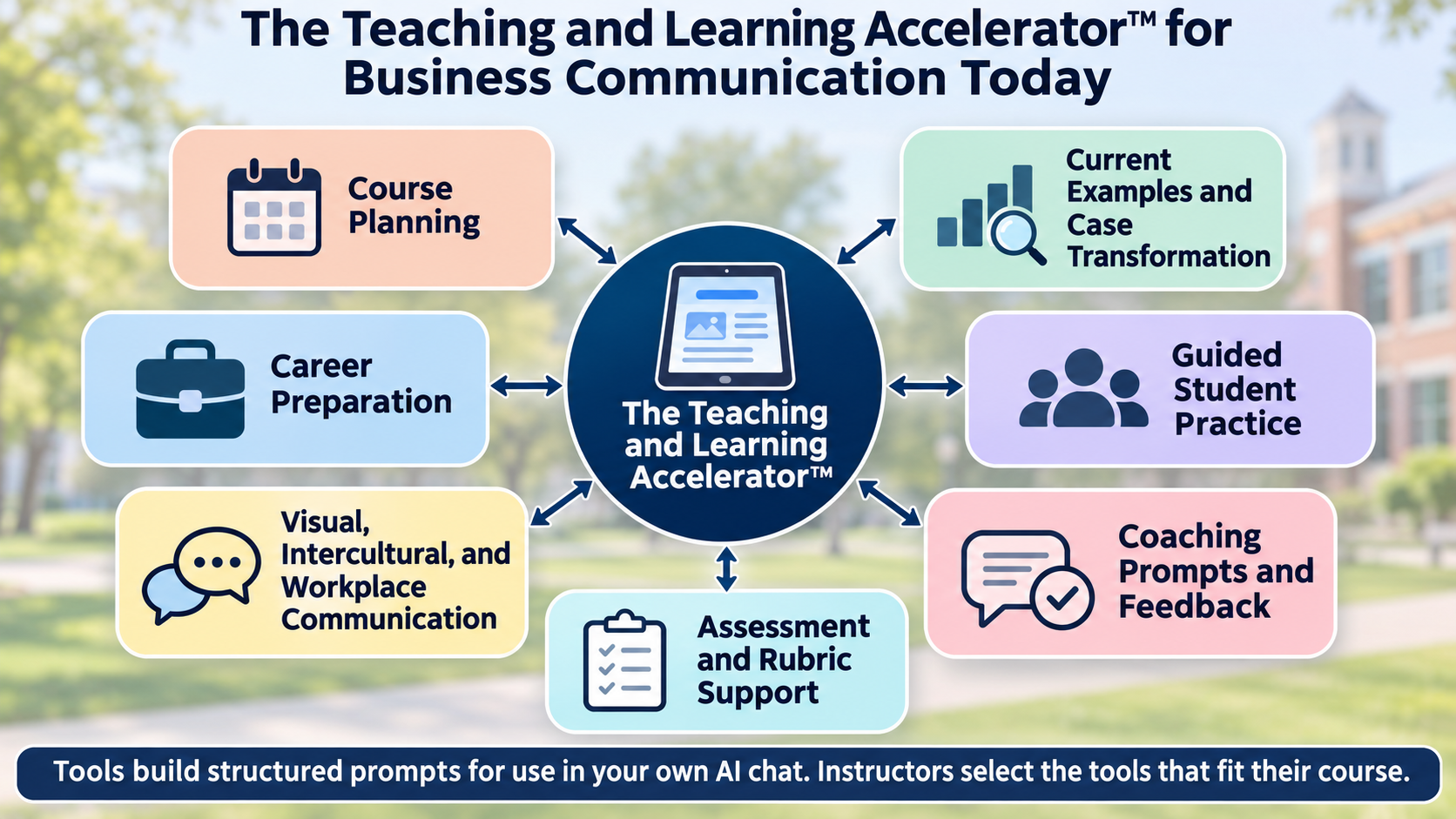
Figure 5. The Teaching and Learning Accelerator™ extends Business Communication Today with coordinated resources for course planning, instruction, practice, coaching, feedback, assessment, and career preparation.
Instructor Takeaway: Business Communication for Success gives instructors readings and exercises to build on. Business Communication Today pairs MyLab Business Communication with the exclusive Teaching and Learning Accelerator™, extending the course beyond the textbook with integrated resources for teaching, coaching, feedback, assessment, and career preparation.
Which Textbook Matches Each Instructional Priority?
Quick Answer: Business Communication for Success serves priorities centered on zero textbook cost, local adaptation, and a substantial speaking component. Business Communication Today addresses the same core outcomes while adding current content, a ten-task writing process, separate media chapters, AI integration in every chapter, and the exclusive Teaching and Learning Accelerator™.
| Instructional Priority | Business Communication for Success | Business Communication Today |
| Zero textbook cost | Free web access under a CC BY-NC-SA 3.0 license | Requires a paid purchase or access arrangement |
| Local adaptation | Open license permits selecting, reordering, and localizing content | Supports focused courses through selective chapter and activity assignment |
| Current workplace content | Original 2010 content; instructors supply current examples | 2025 publication with new vignettes, examples, and cases |
| Structured writing instruction | Preparation, writing, revision, and feedback across Chapters 5–8 | Ten-task Three-Step Writing Process applied across communication contexts |
| Oral communication | Six presentation chapters, including informative and persuasive speaking | Two presentation chapters plus a separate visual-media chapter |
| Digital, social, and visual media | Email and netiquette in Chapter 9; a brief, dated social media overview in Section 19.04; visual aids within delivery | Separate chapters on digital media, social media, and visual media |
| Artificial intelligence | None; instructors must build all AI instruction and prompting practice themselves | AI in every chapter with more than 100 AI-related questions, exercises, and activities |
| Teaching and assessment support | Learning objectives, exercises, and assessments in an open web text | MyLab Business Communication plus the exclusive Teaching and Learning Accelerator™ |
Table 3. Matching textbook design to instructional priorities.
Instructor Takeaway: Business Communication for Success offers a credible no-cost foundation, especially for speaking-intensive courses. Business Communication Today offers greater currency, chapter-level modularity, a documented AI program, and an additional integrated teaching system.
Which Textbook Best Fits Your Course?
Quick Answer: Business Communication for Success fits departments that prioritize free, adaptable readings and a substantial foundation in writing and speaking, and that can supply current examples, AI guidance, and assessment themselves. Business Communication Today offers the stronger fit for courses that treat AI judgment, digital and social channels, visual communication, research-based reports, and current employment communication as central outcomes.
For a course built around zero student cost and local control, Business Communication for Success provides a complete open text that instructors can reorder and extend. Business Communication Today supports the same focused course through selective assignment while supplying current content and resources that an open-text course must build locally.
Instructors can make the decision concrete by testing three representative assignments against each book’s readings, models, practice, and student cost: a negative message, a research-based recommendation, and an employment task.
Instructor Takeaway: Course outcomes and cost constraints should guide adoption. When the goal is current workplace communication with curriculum-wide AI practice, a repeatable ten-task process, and integrated teaching support, Business Communication Today provides the broader platform.
Key Takeaways
- Both textbooks teach the core business communication curriculum, including audience analysis, writing and revision, negative messages, reports, presentations, résumés, and teamwork; fundamental coverage is common ground.
- Business Communication for Success is free and openly licensed but adapted from a 2010 text without significant updating; Business Communication Today, 16th Edition, was published in 2025 with current examples, cases, and media coverage.
- Both books have 19 chapters: Business Communication for Success devotes six to presentations, while Business Communication Today gives digital, social, and visual media, research and reports, and careers their own chapters.
- Business Communication for Success develops writing across four consecutive chapters; Business Communication Today organizes it into the ten-task Three-Step Writing Process used throughout the book.
- Business Communication for Success contains no AI instruction and no guidance on prompting AI tools; Business Communication Today integrates Human-First AI into every chapter with more than 100 AI-related questions, exercises, and activities.
- Business Communication for Success has no course platform or instructor resource system; Business Communication Today adds MyLab Business Communication and the exclusive Teaching and Learning Accelerator™.
- For departments seeking current content, AI instruction, and integrated teaching support, Business Communication Today offers the stronger overall fit.
Glossary of Key Terms
CC BY-NC-SA license: A Creative Commons license that permits sharing and adaptation for noncommercial purposes with attribution, provided adaptations carry the same license.
Human-First AI: The Business Communication Today principle that AI may assist communication but people retain responsibility for purpose, evidence, judgment, ethics, voice, and the final message.
LibreTexts: An open-access platform that hosts free textbooks, including the LibreTexts edition of Business Communication for Success.
Modular course design: A course architecture that lets instructors assign, omit, combine, or expand relatively independent chapters and activities.
MyLab Business Communication: Pearson’s digital course platform for Business Communication Today, including assignments, practice, assessment, and instructor resources.
Negative news message: A message that delivers information the audience does not want to receive, such as a refusal, a reduction, or a change in plans.
Open educational resource: A teaching material that is free to access and openly licensed for reuse and adaptation.
Teaching and Learning Accelerator™: The exclusive Business Communication Today system of teaching, coaching, feedback, assessment, and career-preparation resources that extends beyond the digital course platform.
Three-Step Writing Process: The ten-task Plan-Write-Complete framework used throughout Business Communication Today.
References
Bovée, C. L., & Thill, J. V. (2026). Business Communication Today (16th ed.). Pearson.
Business Communication for Success. (2019). LibreTexts.
LibreTexts. Business Communication for Success book page and table of contents.
LibreTexts. About this Book, including text history and text details.
LibreTexts. Section 17.1, Delivering a Negative News Message.
LibreTexts. Chapter 9, Business Writing in Action.
LibreTexts. Licensing information.
Bovée, C. L., & Thill, J. V. Coverage of AI concepts and skills in the 16th Edition of Business Communication Today.
Pearson. Business Communication Today, 16th Edition, official overview and table of contents.
Pearson. MyLab Business Communication overview.
Descriptions of the Teaching and Learning Accelerator™ and its tools are based on materials supplied by the Business Communication Teaching and Learning Center.
About the Authors
Courtland L. Bovée and John V. Thill are the authors of Business Communication Today, Excellence in Business Communication, and Business in Action. Their work combines classroom experience, professional communication practice, textbook development, instructional design, and contemporary workplace research.
Bovée taught business communication for 22 years and held the C. Allen Paul Distinguished Chair at Grossmont College. More about Courtland Bovée is on his LinkedIn profile. Thill is a communications consultant and former corporate professional whose work has included organizations ranging from entrepreneurial firms to large multinational companies.
Business Communication for Success does not credit an author. Its LibreTexts edition explains that the 2010 original was published under a Creative Commons license by a publisher that asked that neither it nor the original author receive attribution. The adapted edition was produced by University of Minnesota Libraries Publishing.
Editorial disclosure: Because Bovée and Thill have a direct professional relationship with Business Communication Today, this comparison begins with common ground, uses the published LibreTexts edition as the source for Business Communication for Success, identifies source limitations, avoids unsupported quantitative claims, and ties conclusions to specific instructional priorities rather than universal claims.