
You don’t need to be a coder to lead the AI conversation. Your value lies in teaching the communication strategy and critical thinking that AI cannot replicate.
Teaching AI Without Being an AI Expert
How Instructors Can Lead the Future of Business Communication—Without Becoming Technologists
The rapid rise of artificial intelligence has sparked an unexpected anxiety among business communication instructors: ‘Do I have to become an AI expert just to keep up?’ The answer—resoundingly—is no.
Teaching AI effectively does not require advanced technical skills, coding literacy, or deep familiarity with machine learning. What it does require is the confidence to guide students through responsible use, critical thinking, and real-world application. The most effective instructors today aren’t technologists—they’re curators, coaches, and ethical leaders who show students how to use AI intelligently and thoughtfully.
This hub brings together the frameworks, teaching strategies, and practical tools designed to help educators integrate AI into the classroom with clarity, confidence, and purpose—regardless of technical background.
Introduction: The New Reality for Business Communication Instructors
The Expertise Misconception
Most instructors dramatically overestimate what ‘AI competence’ requires for effective teaching. Students don’t need instructors who can code neural networks or explain transformer architecture. They need communicators who understand how to prompt clearly, evaluate output critically, correct errors strategically, and preserve human voice authentically.
These skills build directly on communication expertise instructors already possess. If you can teach audience analysis, you can teach AI prompting—it’s structured communication. If you can evaluate student writing, you can evaluate AI outputs. If you can guide ethical decision-making in persuasion, you can guide ethical AI use. The pedagogical heavy lifting happens in your existing wheelhouse.
What Students Actually Need from Instructors
Students don’t struggle with operating AI tools—those interfaces are deliberately user-friendly. They struggle with knowing when to use AI versus rely on human judgment, evaluating whether AI outputs actually serve their purposes, maintaining their authentic voice when using AI assistance, navigating ethical gray areas, and avoiding over-reliance that undermines skill development.
These challenges require judgment, not technical knowledge. Business communication instructors are uniquely qualified to develop student judgment about communication effectiveness, appropriateness, and ethics. Technical AI expertise proves far less valuable than communication expertise applied to AI contexts.
Instructor Confidence: Why You Don’t Need Deep Technical Knowledge
Reframing AI Teaching as Business Communication Teaching
The confidence breakthrough happens when instructors stop viewing AI teaching as technology instruction and start viewing it as communication instruction applied to AI tools. You’re not teaching computer science—you’re teaching how to communicate effectively with AI systems and how to evaluate communication AI produces.
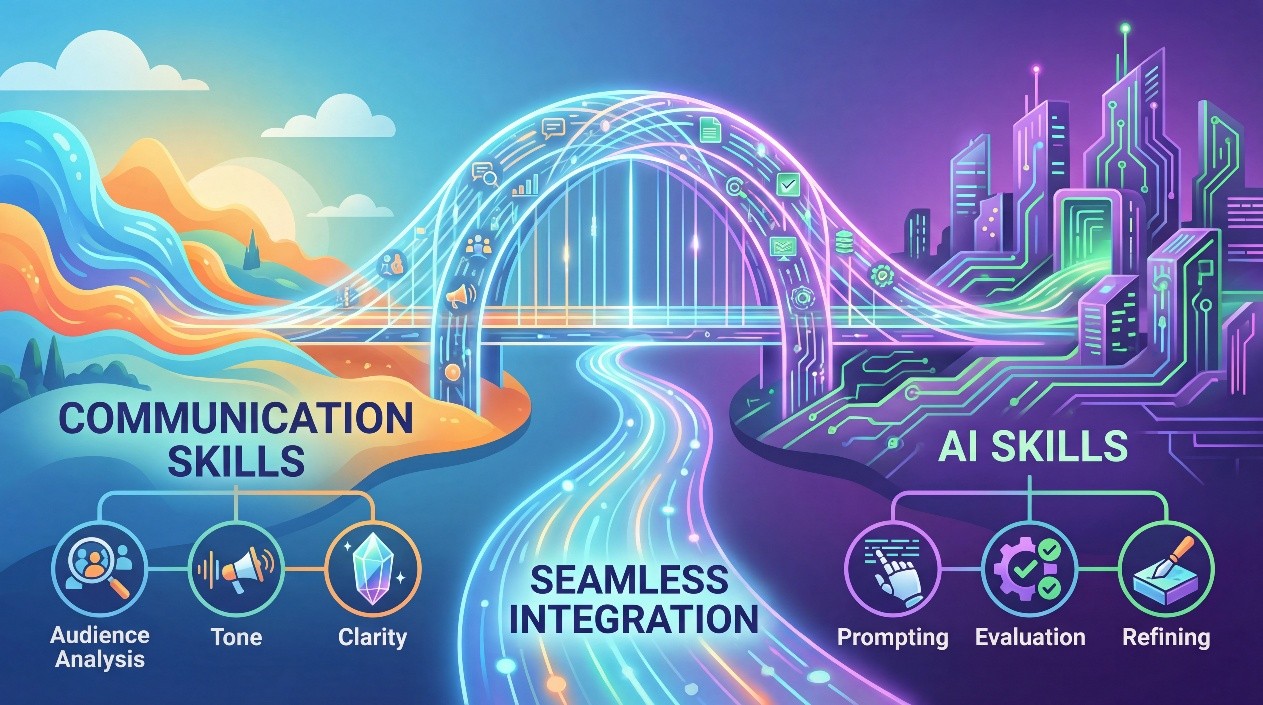
Figure 1.1 Bridging the Gap. The skills you use to teach business writing—audience analysis, tone, structure—are the exact same skills required to teach effective AI prompting.
This reframing transforms anxiety into recognition. The skills you’ve spent years developing—analyzing audiences, structuring messages, evaluating tone, assessing credibility, recognizing bias—all apply directly to AI instruction. You’re not learning an entirely new discipline; you’re extending your existing expertise to new contexts.
The Core Competencies Instructors Already Possess
Instructors who successfully teach AI without technical backgrounds leverage existing competencies:
- Clear communication: Teaching students to write clear prompts mirrors teaching clear business messages
- Critical evaluation: Assessing AI outputs requires the same critical reading skills used for student work
- Ethical reasoning: Navigating AI ethics extends existing frameworks for communication ethics
- Strategic thinking: Deciding when to use AI mirrors deciding which communication channels to use
- Quality standards: Recognizing excellent communication enables recognizing when AI meets those standards
These competencies matter more for AI instruction than understanding how large language models actually work. Technical knowledge can enhance instruction but isn’t prerequisite for effectiveness.
Building Confidence Through Experimentation
Confidence grows through hands-on experience, not theoretical study. Instructors who spend time experimenting with AI tools—trying different prompts, evaluating outputs, discovering limitations, exploring various use cases—develop practical understanding that serves teaching far better than reading about AI abstractly.
Start small: Use AI for a specific communication task yourself. Write prompts, evaluate results, refine your approach. Notice what works and what doesn’t. This experiential learning builds authentic confidence while revealing insights you can share with students. You don’t need to become an AI expert—just an informed AI user who can guide students thoughtfully.
INTERNAL LINK SUGGESTION:
→ Essential reading: How to Teach AI Without Being an AI Expert
[CTA BUTTON: Download 5-Minute AI Lesson Starters for Non-Experts]
Prompt Writing Without Overwhelm: The New Literacy You Can Already Teach
Prompt Writing Is Simply Structured Communication
Prompt engineering sounds intimidating until you recognize it’s fundamentally about clear, structured communication. If you can teach students to write concise, specific, well-organized business messages, you can teach prompt writing. The principles are identical: clarity, specificity, appropriate detail, logical structure, and audience awareness.
A good prompt exhibits the same qualities as good business writing: it states its purpose clearly, provides necessary context, specifies desired outcomes, uses concrete rather than vague language, and structures information logically. Students who struggle with prompting typically struggle with the same issues that undermine their business writing—and respond to the same pedagogical interventions.
Teaching the Fundamentals of Effective Prompting

Figure 1.2. Specificity is Key. Teaching students to write better prompts is simply teaching them to be more specific, context-aware communicators.
Effective prompt writing instruction doesn’t require technical AI knowledge. It requires helping students understand what makes communication clear and effective:
- Be specific about what you want: ‘Write a professional email declining a job offer’ beats ‘write an email’
- Provide necessary context: Include audience, purpose, tone, and relevant background information
- Specify constraints: Length limits, format requirements, style preferences, what to include or avoid
- Use examples when helpful: Show AI the kind of output you want through sample language or structures
- Iterate based on results: Refine prompts when initial outputs miss the mark, just like revising drafts
These aren’t AI-specific skills—they’re communication fundamentals. Teaching them in AI contexts reinforces broader communication competencies while developing practical AI capability.
You’re Not Teaching Prompt Engineering—You’re Teaching Communication
The pressure to teach prompt engineering as specialized technical skill creates unnecessary anxiety. Reframe it: you’re teaching students to communicate their needs clearly to AI systems, then evaluate whether those systems met the need. This is audience analysis and critical evaluation—core business communication skills applied to AI audiences.
Students who develop strong communication fundamentals naturally become effective prompt writers. Those who struggle with prompting typically reveal underlying communication weaknesses that deserve attention regardless of AI. Teaching prompting well simultaneously strengthens broader communication capabilities.
INTERNAL LINK SUGGESTION:
→ Explore: What If You’re Not Teaching AI Prompt Writing
Personal Transformation Through AI: When New Technology Rekindles Purpose
The Unexpected Renewal
Many instructors discover that engaging with AI actually unlocks creativity and renews teaching enthusiasm in unexpected ways. Rather than replacing human capability, AI often reveals human value more clearly. Rather than making teaching mechanical, AI engagement can make teaching feel more purposeful and human-centered.
Instructors report that teaching AI helps them articulate what makes human communication valuable—authentic voice, ethical judgment, strategic thinking, emotional intelligence, cultural nuance. These elements, invisible or taken for granted before AI, become visible and appreciable when contrasted with AI’s capabilities and limitations.
How AI Reignites Faith in Human Creativity
Paradoxically, many instructors find that AI deepens their appreciation for human creativity rather than undermining it. Seeing what AI can produce—competent but generic, technically correct but lacking soul—highlights what human communicators contribute: originality, authenticity, emotional resonance, strategic insight, ethical discernment.
This recognition transforms teaching. Instead of viewing business communication as teaching rules and formats—tasks AI increasingly handles—instructors can focus on developing the uniquely human capabilities that make communication powerful. This shift feels less like defending territory from AI encroachment and more like elevating teaching to its highest purpose.
The AI Lesson That Rewrites Your Own Thinking
Engaging seriously with AI often challenges instructors’ own assumptions about writing, communication, and teaching. Watching AI generate competent text forces reconsideration of what writing instruction should emphasize. Seeing students use AI productively challenges assumptions about academic integrity. Discovering AI’s limitations clarifies what human judgment contributes.
These insights reshape teaching in productive ways. Instructors often report that AI engagement has made them better teachers—more focused on higher-order thinking, more attentive to authentic assessment, more clear about learning objectives, more strategic about where to invest instructional time. The process of wrestling with AI’s implications produces pedagogical growth.
INTERNAL LINK SUGGESTIONS:
→ Personal story: How Teaching AI Reignited My Faith in Human Creativity
→ Reflection: The AI Lesson That Rewrote My Own Thinking
[CTA BUTTON: Explore Instructor Stories of AI-Driven Renewal]
Evolution of the Instructor’s Role: From Information Provider to Strategic Learning Architect
The Shifting Value Proposition
AI fundamentally shifts what students need from instructors. They no longer need professors to be information repositories—AI provides instant access to vast information. They don’t need instructors primarily for content delivery—resources abound. What they desperately need are synthesizers who help make sense of information, guides who help navigate complex choices, evaluators who help distinguish quality from mediocrity, and ethical leaders who model professional judgment.
This shift doesn’t diminish the instructor role—it elevates it. Moving from content delivery to strategic guidance positions instructors as the professionals they are: experts who don’t just know information but understand how to apply it, who have developed judgment through experience, who can help students navigate complexity rather than merely transmitting facts.
What Becomes More Important in the AI Era

Figure 1.3 The New Essentials. As technical barriers lower, the focus of instruction shifts to these higher-order human skills that AI cannot simulate.
As AI handles certain teaching functions, others grow in importance:
- Developing strategic thinking: Helping students understand when and why to use specific communication approaches
- Cultivating judgment: Teaching students to evaluate quality, appropriateness, and effectiveness
- Modeling ethics: Demonstrating how professionals navigate ethical complexity
- Building meta-cognitive awareness: Helping students understand their own communication processes
- Fostering authentic voice: Developing students’ unique communication styles and perspectives
- Creating human connection: Providing mentorship and professional role modeling AI cannot replicate
These higher-order teaching functions prove more professionally satisfying for many instructors than traditional content delivery. They leverage instructors’ professional expertise and experience rather than treating instructors as content repositories.
Redefining Business Communication Instruction
AI enables—and requires—rethinking what business communication instruction fundamentally does. Is it primarily teaching formats and mechanics that AI increasingly handles? Or is it developing communication judgment, strategic thinking, and professional identity that AI cannot replicate?
Forward-thinking instructors embrace the latter vision. They use AI to handle routine instruction about formats and mechanics, freeing time to develop students’ strategic capabilities, ethical judgment, and professional identity. This shift transforms business communication from a skills course into a professional formation experience—arguably what it should have been all along.
INTERNAL LINK SUGGESTIONS:
→ Future perspective: How Will Understanding AI Shape the Future of Business Communication Instruction
→ Role evolution: How Is AI Redefining the Business Communication Instructor’s Role
[CTA BUTTON: See How Business Communication Today Prepfor AI]
What This Hub Means for Your Teaching Practice
A Simplified, Empowering Roadmap
You don’t need to:
- Understand coding or machine learning architecture
- Become a prompt engineering expert
- Know the technical details of how LLMs work
- Master every emerging AI tool
You DO need to:
- Help students think critically about communication
- Guide them to use AI responsibly and strategically
- Model ethical approaches to AI use
- Develop their ability to evaluate AI outputs critically
- Integrate AI as one tool among many, not a replacement for thinking
If you can teach communication, you can teach AI. The skillsets are closer than anyone admits. Your communication expertise is precisely what students need to navigate AI effectively.
Recommended Cross-Hub Internal Links
Connect readers to related content across the hub network:
To AI Skills, Ethics & Student Use Hub:
Help students use AI ethically, responsibly, and effectively—with frameworks for when to use AI, how to revise AI writing, and how to detect hallucinations.
To AI in the Curriculum & Textbook Differentiation Hub:
Discover why Business Communication Today leads the field in AI coverage, with comprehensive integration in every chapter rather than isolated treatment.
To Course Design & Modernization Hub:
Explore modern frameworks for redesigning your course with AI, avoiding common mistakes, and creating 80/20 curriculum efficiency.
To Student Experience & Motivation Hub:
Understand how students actually feel about AI—their anxieties, misconceptions, and need for clear guidance—and how to support them effectively.
Featured Calls-to-Action
Primary CTA:
[Download the AI Teaching Starter Kit (Instructor Version)]
Secondary CTAs:
[Explore 40 Classroom-Ready AI Activities]
[View Sample AI Lesson Plans from Business Communication Today]
[Adopt Business Communication Today (Instant Desk Copy Access)]
[See AI Integrated Across All 19 Chapters]
—