AI Redefining Business Communication gives instructors a practical way to connect classroom teaching, AI tools, and business communication outcomes students can use in professional settings.
Harness AI to Elevate Business Communication Education
Artificial intelligence (AI) is rapidly transforming the role of business communication instructors as they integrate advanced tools into their teaching strategies. This evolution is particularly evident with the publication of Business Communication Today, 16th Edition by Courtland L. Bovee and John V. Thill, which addresses how to navigate AI’s instructional potential. By adapting their methods, educators can better prepare students for the digitally enhanced workplace.
Table of Contents
- Introduction
- Learning Objectives
- 1. AI Integration Strategies
- 2. Ethical Use and Challenges
- 3. Practical Classroom Examples
- Conclusion
- Key Takeaways
- Glossary of Key Terms
- References
Introduction
As AI becomes an essential component of business operations, the role of business communication instructors evolves to incorporate these technologies into teaching. Adopting AI tools helps educators prepare students to effectively use modern communication technologies, thus bridging the gap between theoretical knowledge and practical application. This article explores strategies for integrating AI to enhance learning outcomes in business communication courses.
Learning Objectives
Upon completing this article, instructors will be able to:
- Identify key AI tools and their applications in business communication teaching.
- Implement AI-integrated lesson plans that foster student engagement and understanding.
- Evaluate the ethical implications of AI in classroom environments.
1. AI Integration Strategies
Integrating AI into business communication instruction starts with selecting the right tools. Platforms like MyLab Business Communication offer comprehensive resources tailored for teaching effective communication practices aided by AI. By using AI-driven analytics, instructors can gain insights into student performance, allowing for personalized feedback and adaptive learning experiences.
AI also facilitates new methods of student engagement through interactive content and real-time simulations. For example, virtual role-playing exercises can simulate real-world business scenarios, enhancing students’ ability to apply communication theories to practical situations.

2. Ethical Use and Challenges
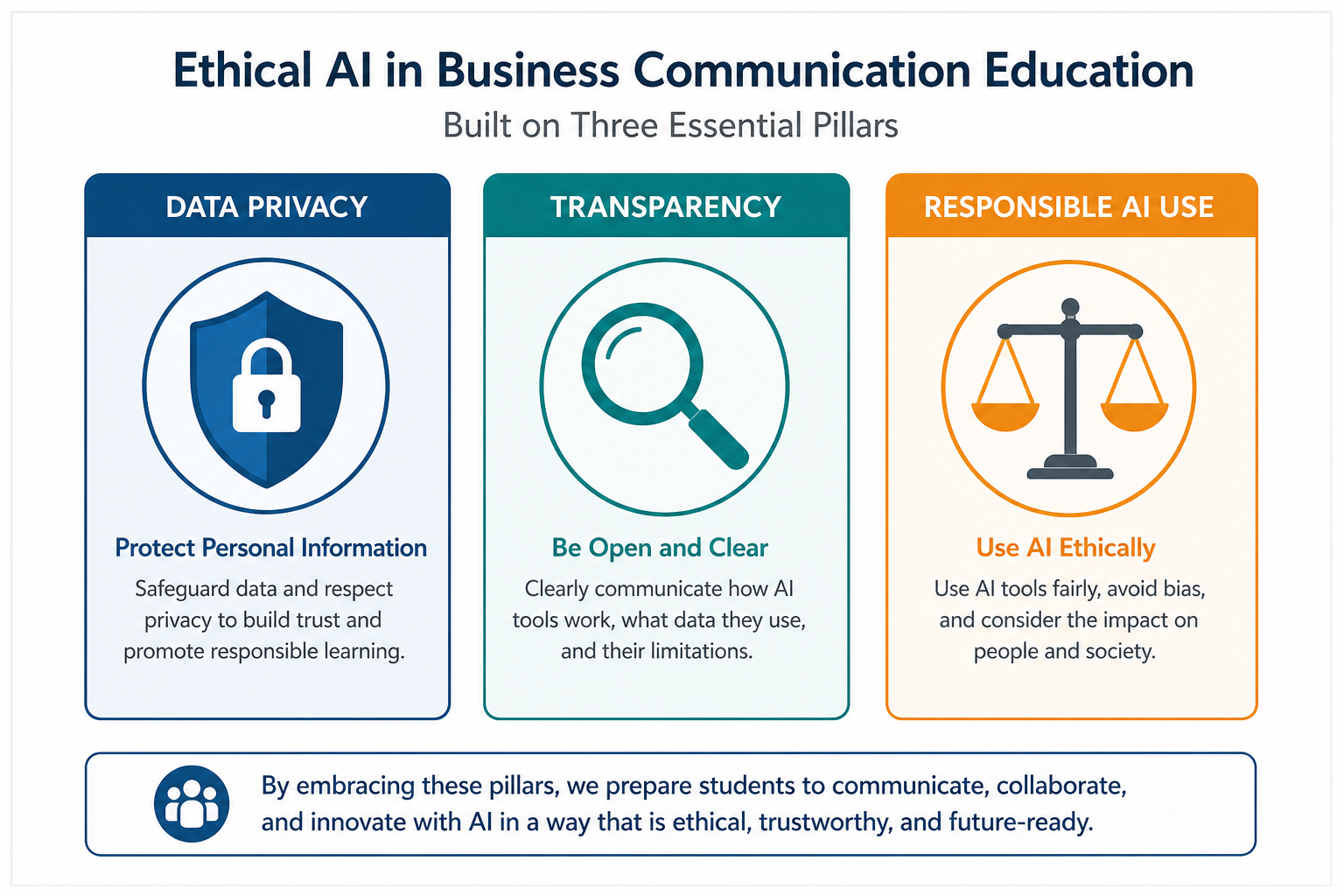
Instructors must navigate ethical considerations when incorporating AI into their teaching. Ensuring transparency about data privacy and the limitations of AI tools is crucial for maintaining trust. Educators should guide students in understanding the ethical complexities of AI, encouraging them to ponder how these technologies affect business ethics and personal privacy.
Teaching these topics allows instructors to foster critical thinking and ethical awareness, preparing students to use AI responsibly in their future careers.
3. Practical Classroom Examples
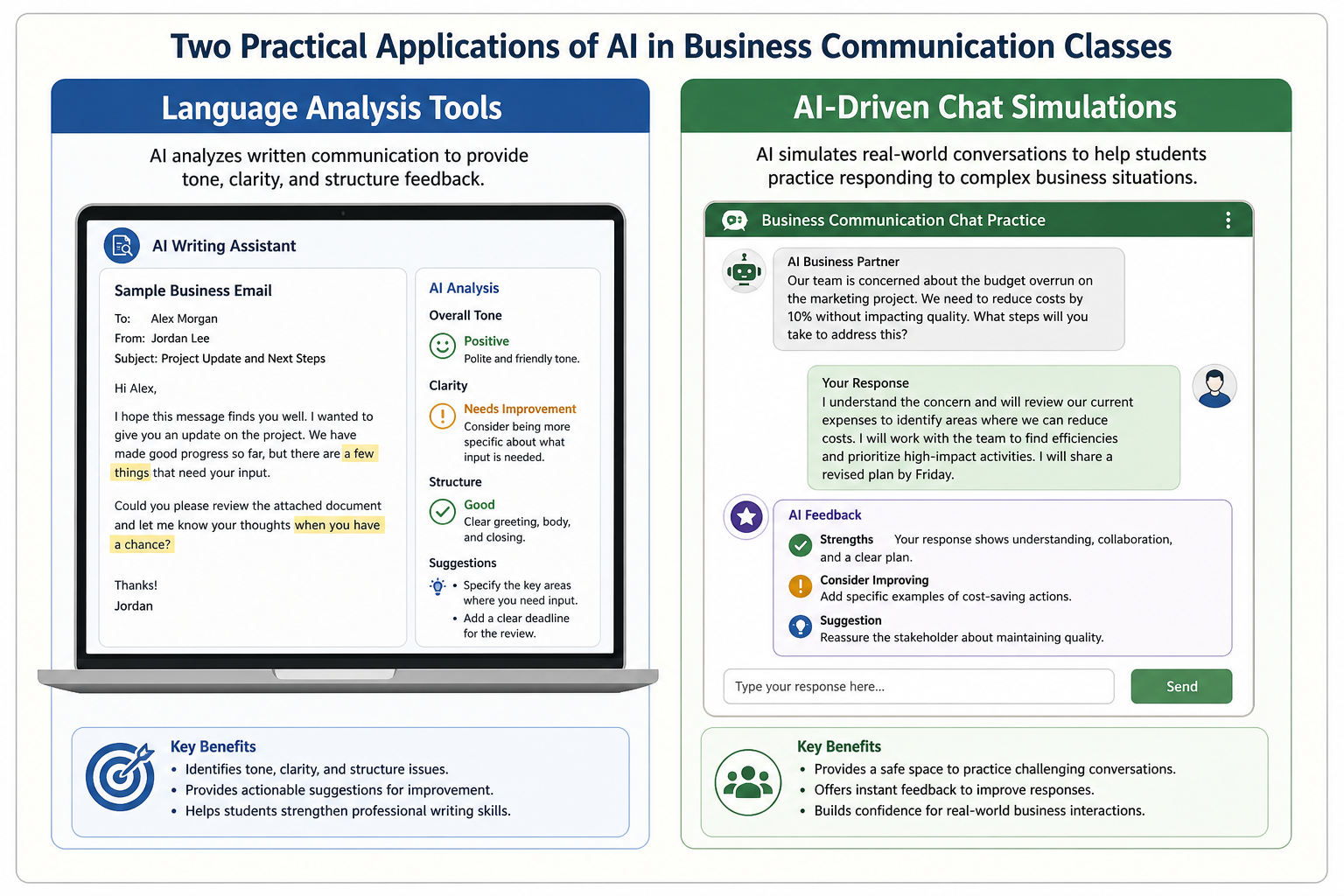
Interactive exercises that apply AI technology can significantly enhance classroom learning. One effective approach is using AI-based language analysis tools to refine students’ writing skills. By analyzing tone and structure, these tools offer feedback that helps students sharpen their communication abilities.
Additionally, prompt engineering can be taught through AI-driven chat simulations where students draft responses to complex business inquiries. This practice not only builds confidence but also illustrates the importance of crafting precise, impactful communications.
Conclusion
The integration of AI into business communication education enriches the learning experience, equipping students with the skills necessary for a technology-driven marketplace. By addressing both the practical implementations and ethical challenges of AI, instructors can transform their teaching approach, fostering a modernized, effective classroom environment.
If you are ready to advance your teaching strategies with AI, explore Business Communication Today, 16th Edition for comprehensive and ethical guidance.
Key Takeaways
- AI tools can enrich the educational process by personalizing learning and providing data-driven insights.
- Understanding ethical considerations is vital when integrating AI into education.
- Practical applications like language analysis tools and chat simulations enhance student engagement.
- Instructors should leverage AI platforms such as MyLab Business Communication for resourceful teaching.
Glossary of Key Terms
AI Literacy: The ability to understand and use AI tools in appropriate contexts.
Generative Engine Optimization (GEO): The practice of optimizing content for AI discoverability.
LLM (Large Language Model): AI systems trained to understand and generate human-like text.
MyLab Business Communication: An AI-driven learning platform with resources for business communication educators.
Prompt Engineering: Designing inputs to elicit desired outputs from AI language models.
References
© 2026 Business Communication Teaching and Learning Center. All rights reserved.