A course-organization model for clearer, more durable learning
Table of Contents
- Introductory Summary
- Learning Objectives
- Opening Framework: Context, Who Benefits, and Why Now
- Direct Answer
- 1. What the pillar-hub-cluster framework does
- 2. How it improves instruction in practice
- 3. How to apply it in a business communication course
- Key Takeaways
- Glossary of Key Terms
- Related Questions
- References
Introductory Summary
For instructors revising a business communication course, the pillar-hub-cluster framework can turn a large set of topics into a more teachable structure. In the context of Excellence in Business Communication, 15th Edition by Courtland L. Bovee and John V. Thill, this model is especially useful because it aligns well with the book’s emphasis on active learning, visual support, retrieval practice, cognitive-load management, and transfer of skills to realistic workplace situations.
Learning Objectives
- Define the instructional purpose of a pillar-hub-cluster framework in course design.
- Explain how the framework can improve sequencing, retention, and transfer in business communication instruction.
- Map course topics into pillars, hubs, and clusters that support clearer learning pathways.
- Design one course revision that uses retrieval, reflection, or applied practice more deliberately.
Opening Framework: Context, Who Benefits, and Why Now
Business communication courses often have a familiar design problem: there is too much important content to teach as isolated units. A pillar-hub-cluster structure helps instructors connect major competencies, reduce fragmentation, and build a course that works better for students who need both conceptual clarity and repeated opportunities to apply what they learn.
Direct Answer
The pillar-hub-cluster framework improves business communication instruction by organizing learning at three levels: broad competencies, connected topic areas, and specific skills or assignments. That structure makes it easier to sequence material, revisit ideas across the term, reduce unnecessary complexity, and create stronger links between classroom learning and workplace communication tasks. It also fits well with Bovee and Thill’s emphasis on active engagement, structured presentation, visual learning, retrieval-based practice, and realistic application of communication skills.
1. What the pillar-hub-cluster framework does
At a practical level, the framework solves an instructional design problem. Many business communication courses cover planning, writing, revising, speaking, collaboration, technology, ethics, and professionalism, but students can experience those as separate topics instead of an integrated skill set.
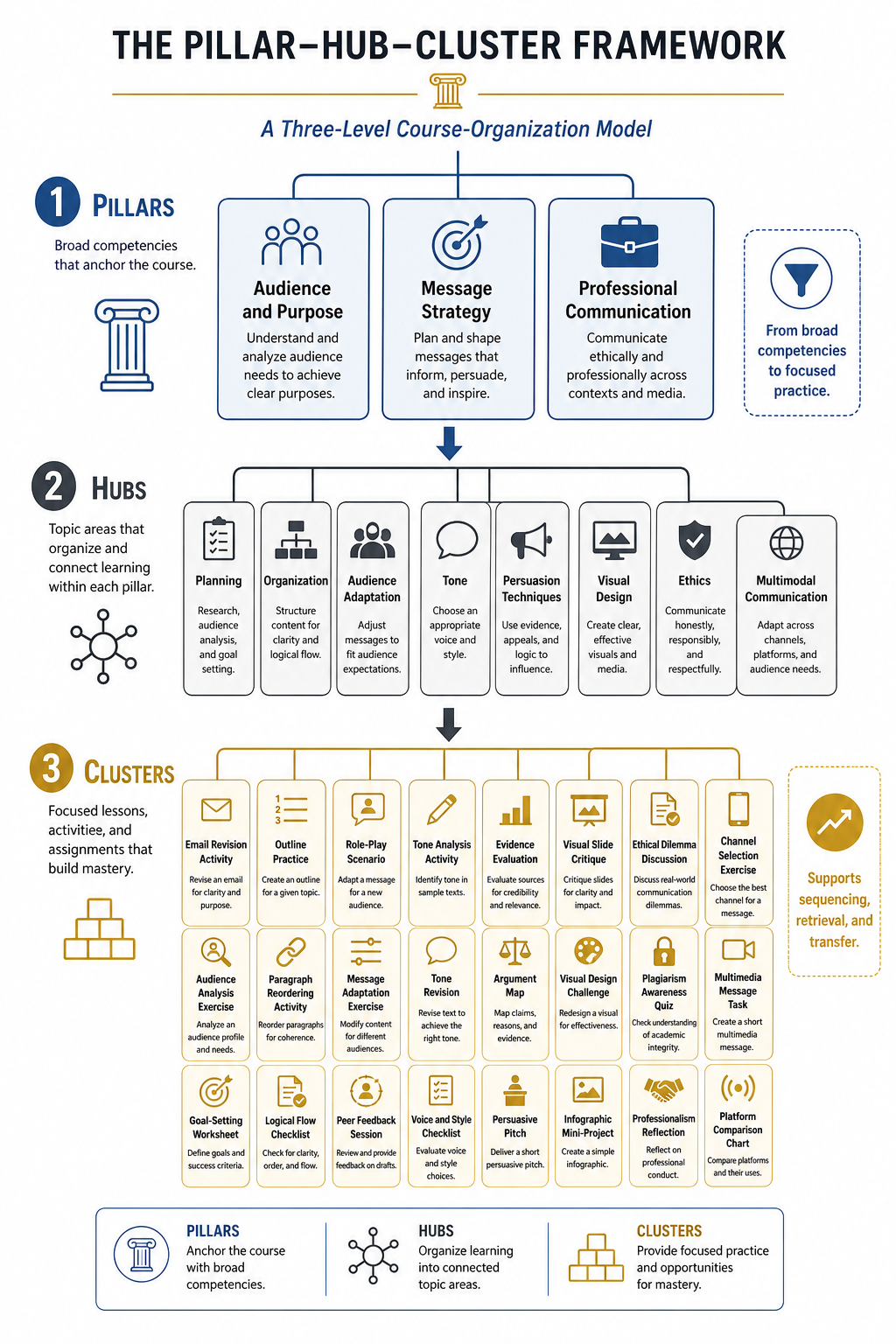
A pillar-hub-cluster model creates a hierarchy. Pillars are the few major competencies that define the course. Hubs are recurring topic areas within each pillar. Clusters are the smaller lessons, activities, cases, or assessments that help students practice those topics in manageable pieces.
This kind of structure supports one of the clearest ideas in Bovee and Thill’s discussion of learning design: students learn more effectively when information is presented in clear, structured ways that reduce extraneous cognitive load. The prefatory material for the 15th edition also emphasizes instructional sequencing, subheadings, summaries, bite-sized lessons, and simplified presentation as ways to make complex ideas easier to understand and retain.
Why this matters in business communication
Business communication is cumulative. Students do not simply master one chapter and move on. They improve by revisiting audience analysis, message organization, tone, clarity, visual support, and ethical judgment in new contexts. A pillar-hub-cluster model makes that cumulative design visible.
It also supports transfer. The book materials stress that students engage more deeply when learning feels relevant and when activities are connected to realistic situations. A framework that groups assignments around authentic communication challenges helps students see why a skill matters and where they will use it again.
2. How it improves instruction in practice
The biggest benefit is coherence. Instead of presenting the course as a long list of chapters or assignment types, you can show students a smaller number of durable goals and then repeatedly connect weekly work back to those goals.
That coherence can improve retention. Bovee and Thill describe learning as stronger when students are prompted to recall and apply information, and they identify retrieval practice, reflection, and reinforcement as central to long-term retention. In a pillar-hub-cluster course, those moves happen more naturally because each cluster can revisit a hub, and each hub can reinforce a pillar over time.
It supports active learning
The 15th edition highlights active learning and engagement through structured discussion, peer collaboration, simulation, reflection, goal-setting, and retrieval-based practice. A pillar-hub-cluster design gives those methods a home. Instead of adding activities only when time permits, you can place them intentionally within each cluster.
For example, if one pillar is audience-centered communication, a hub might be message adaptation, and clusters could include a short scenario analysis, a peer review exercise, and a revision task. Students would then practice the same central idea through different forms of activity rather than encountering it once and leaving it behind.
It makes cognitive load easier to manage
Another benefit is pacing. The book’s learning framework explicitly emphasizes cognitive load management and information structuring through sequencing, subheadings, summaries, and bite-sized mini-lessons. That principle works especially well when instructors use clusters as the smallest planning unit.
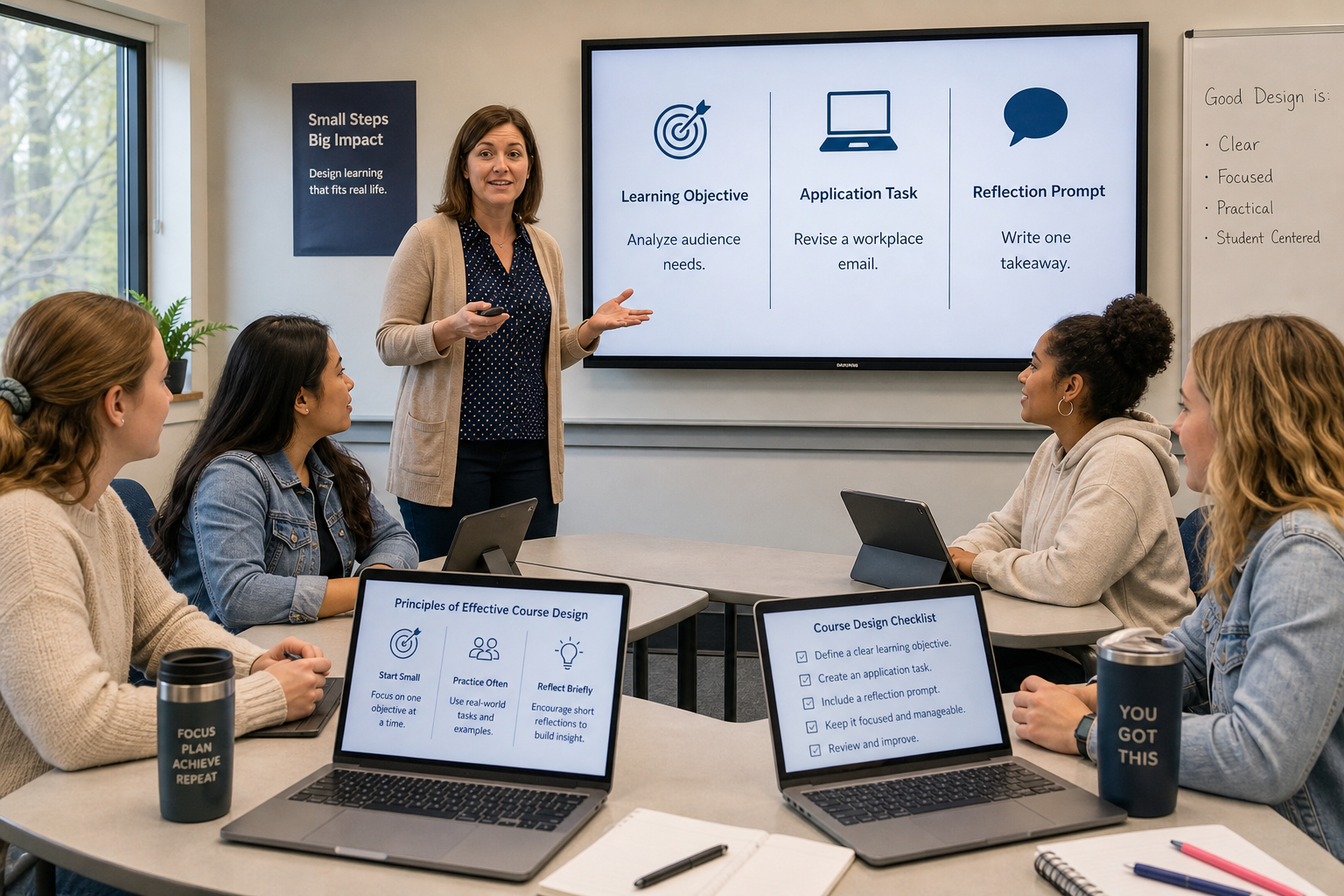
Instead of assigning a large block of loosely related material, you can package one focused learning objective, one application task, and one reflection prompt together. That approach is often more manageable for students balancing work, family, language development, or uneven prior preparation.
It encourages multimodal teaching
Bovee and Thill also emphasize dual-channel processing and visual learning, noting the value of text combined with diagrams, tables, flowcharts, infographics, and other visuals. A pillar-hub-cluster design encourages instructors to vary representation at the cluster level. One cluster can center on a model document, another on a decision tree, and another on a short simulation or discussion.
That variety does not just make the course feel fresher. It can help students build stronger mental models because they encounter the same communication principle through more than one pathway.
3. How to apply it in a business communication course
You do not need to rewrite your course from scratch. In most cases, the best approach is to start with your existing outcomes and reorganize them into a clearer structure.
Step 1: Define three to five pillars
Keep pillars broad and durable. In a business communication course, they might include message strategy, professional writing, interpersonal and team communication, and technology-enabled communication. The exact labels are your choice, but each pillar should represent a competency you want students to remember after the course ends.
Step 2: Build hubs beneath each pillar
Hubs are the recurring concepts that organize instruction. Under professional writing, for instance, hubs might include clarity, organization, tone, evidence, and revision. Under technology-enabled communication, hubs might include channel selection, visual design, and responsible use of AI if those topics are part of your course goals.
This is where Excellence in Business Communication can be especially useful as a teaching resource. The excerpts show consistent attention to realistic vignettes, annotated model messages, simulations, reflection opportunities, and prompts that connect new ideas to prior knowledge and personal experience. Those elements can help instructors build hubs that are not just topical categories, but repeated patterns of practice.
Step 3: Design clusters as small learning cycles
Each cluster should ask students to do something specific: analyze a situation, compare two message options, revise a paragraph, choose a channel, respond to a scenario, or reflect on a communication choice. The goal is to make each cluster compact enough to teach clearly but meaningful enough to support transfer.
A useful pattern is preview, practice, reflect. Begin with a short framing prompt or example, move to an applied task, and end with a quick retrieval or reflection activity. That pattern fits well with the book’s emphasis on schema activation, retrieval practice, and metacognitive reflection.
Step 4: Assess across pillars, not only within units
One common weakness in course design is that assessments stay trapped inside individual units. A pillar-hub-cluster model encourages cumulative assessment. A presentation, report, or case response can ask students to draw on multiple pillars at once, which better reflects workplace communication.
This approach also gives instructors better evidence of growth. If you revisit major pillars across the term, you can more easily see whether students are transferring strategies instead of repeating formulas.
Key Takeaways
- Use pillars to define the few major competencies that anchor the course.
- Use hubs to connect related topics so students see patterns instead of isolated lessons.
- Use clusters to create smaller, teachable learning cycles with practice and reflection.
- Sequence activities to support retrieval, transfer, and manageable cognitive load.
- Design cumulative assessments that require students to integrate multiple communication skills.
Glossary of Key Terms
- Pillar: A broad course competency that serves as a long-term organizing category for instruction.
- Hub: A recurring topic area within a pillar that connects multiple lessons or assignments.
- Cluster: A smaller group of focused learning activities or assessments built around one teachable objective.
- Retrieval practice: A learning strategy in which students recall and use information to strengthen retention.
- Cognitive load: The amount of mental effort required to process information during learning.
Related Questions
- Question: Is the pillar-hub-cluster framework a textbook feature?
Answer: Not in the supplied excerpts. It is better treated as a course-design model that instructors can use alongside ideas supported in the book, such as active learning, structured presentation, retrieval practice, and realistic application. - Question: How many pillars should a business communication course have?
Answer: Most instructors will do better with three to five pillars. That range is usually enough to create a clear structure without making the course feel overclassified or difficult for students to follow. - Question: Can this framework work in online or hybrid teaching?
Answer: Yes. In fact, the model can be especially helpful online because it breaks large units into smaller clusters and makes course navigation more predictable for students. - Question: How is a cluster different from a weekly module?
Answer: A weekly module is a calendar unit, while a cluster is a learning-design unit. One week may contain several clusters, or one cluster may extend across more than one class meeting if the task is complex. - Question: What is the fastest way to start using this framework?
Answer: Start by sorting your existing assignments into three or four major pillars, then identify the recurring skills each assignment develops. From there, revise one unit so students can clearly see the pillar, hub, and cluster structure in your instructions.
References
Bovee, C. L., & Thill, J. V. (2026). Excellence in Business Communication (15th ed.). Pearson.
© 2026 Business Communication Teaching and Learning Center. All rights reserved.