Ethical AI Integration for Business Communication Teaching
Table of Contents
- Introductory Summary
- Learning Objectives
- Opening Framework: Context, Who Benefits, and Why Now
- Direct Answer
- 1. Start with Human Skills and Clear Boundaries
- 2. Build Assignments That Require Transparency and Judgment
- 3. Teach Students How to Evaluate AI Output
- 4. Create a Course Policy You Can Actually Enforce
- Key Takeaways
- Glossary of Key Terms
- Related Questions
- References
Introductory Summary
Instructors who teach business communication now have to help students use AI without letting it replace core communication learning. Business Communication Today, 16th Edition by Courtland L. Bovee and John V. Thill, is especially useful here because it treats AI as both a practical workplace tool and an ethical communication issue. That makes it a strong foundation for designing course policies, assignments, and classroom routines that keep human judgment at the center.
Learning Objectives
- Define ethical boundaries for AI use in business communication assignments.
- Design assignment steps that require students to disclose and evaluate AI assistance.
- Teach students to identify common AI risks such as bias, misinformation, and plagiarism.
- Create a workable course policy that distinguishes acceptable support from unacceptable substitution.
Opening Framework: Context, Who Benefits, and Why Now
Many instructors are balancing two real pressures at once: students will likely encounter AI in the workplace, but they also still need to learn how to think, draft, revise, and communicate independently. An ethical AI curriculum helps students from varied educational and technology backgrounds build those foundational skills first while learning where AI can assist, where it can mislead, and where its use must be disclosed.
Direct Answer
The most effective way to integrate AI tools ethically into a business communication course is to teach AI as a limited collaborative partner rather than a substitute for student thinking and writing. Bovee and Thill (2026) support that approach by emphasizing both the benefits of GenAI and its risks, including mistakes, overreliance, misinformation, bias, privacy concerns, and the erosion of human connection. In practice, that means building assignments in which students first learn the communication task without AI, then use AI selectively for defined purposes, document what they used it for, and evaluate whether its output was accurate, audience-centered, and ethically appropriate.
1. Start with Human Skills and Clear Boundaries
One of the most useful ideas in Business Communication Today is sequence. The prefatory material explains that AI sections usually follow the presentation of fundamental principles and best practices so students learn how to perform important tasks without AI first. That is an excellent course-design principle for instructors as well.
In other words, do not begin by asking students to use AI for every memo, email, report, or presentation. Begin by teaching audience awareness, purpose, organization, tone, evidence use, and revision. Then add AI as a secondary layer that students must manage responsibly.
What this looks like in class
You might teach a persuasive email in three stages: a student-written first draft, a limited AI consultation, and a reflection on what changed. That structure reinforces that the student remains the communicator and decision-maker. It also aligns with the book’s broader message that AI is a tool to be used mindfully, not a replacement for empathy, ethics, or authenticity.
Because Bovee and Thill describe GenAI as a collaborative writing partner, your policy language can use that distinction directly. For example, you can permit brainstorming, outline testing, tone checking, or readability feedback while prohibiting undisclosed full-draft generation or fabricated evidence.

2. Build Assignments That Require Transparency and Judgment
Ethical AI use becomes much easier to teach when students have to show their process. The manuscript passages emphasize transparency as an ethical concept and also note risks such as plagiarizing, withholding information, distorting information, failing to consider negative consequences, and violating privacy. Those concerns should shape your assignment design.
Require an AI-use note
Add a short disclosure statement to major assignments. Ask students to identify whether they used AI, which tool they used, what task it assisted with, and what they accepted, rejected, or revised. This makes AI use visible without turning every assignment into a policing exercise.
Separate idea generation from evidence
The book warns that students should not use GenAI as a search engine and that it can produce fabricated content. So if students use AI to generate ideas, require them to verify facts, examples, and sources independently. A simple rule helps: AI may suggest directions, but it may not serve as the final authority for factual support.
Protect privacy and intellectual ownership
Since the excerpts explicitly identify privacy and compensation for content creators as ethical issues, remind students not to paste confidential internship materials, client information, or sensitive class data into public AI systems. If they are analyzing workplace communication, give them anonymized materials or ask them to create realistic simulations instead.
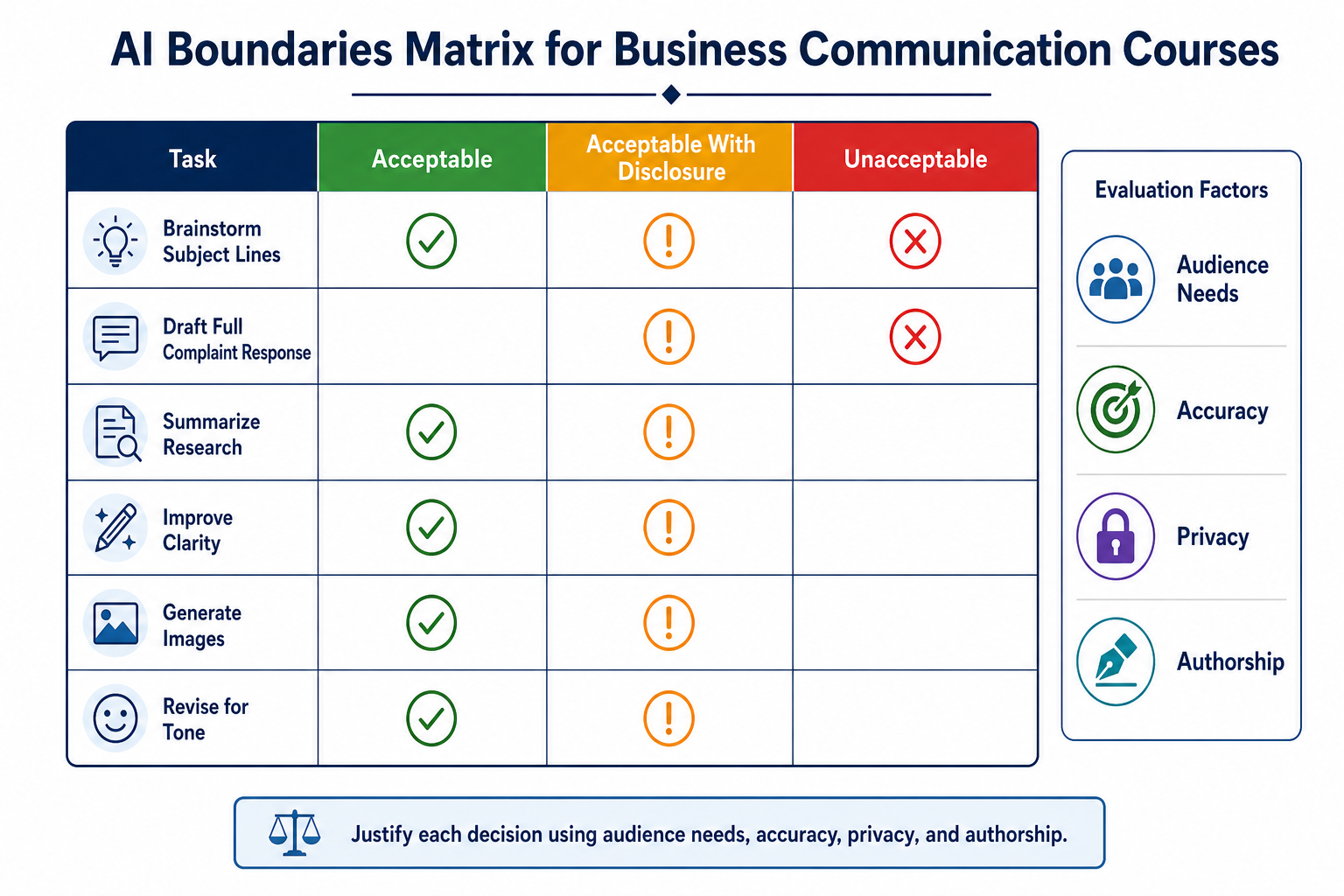
A useful instructor-created activity is an “AI boundaries matrix.” List common tasks such as brainstorming subject lines, drafting a full complaint response, summarizing research, improving clarity, generating images, or revising for tone. Then ask students to classify each as acceptable, acceptable with disclosure, or unacceptable in your course, with a justification based on audience needs, accuracy, privacy, and authorship.
3. Teach Students How to Evaluate AI Output
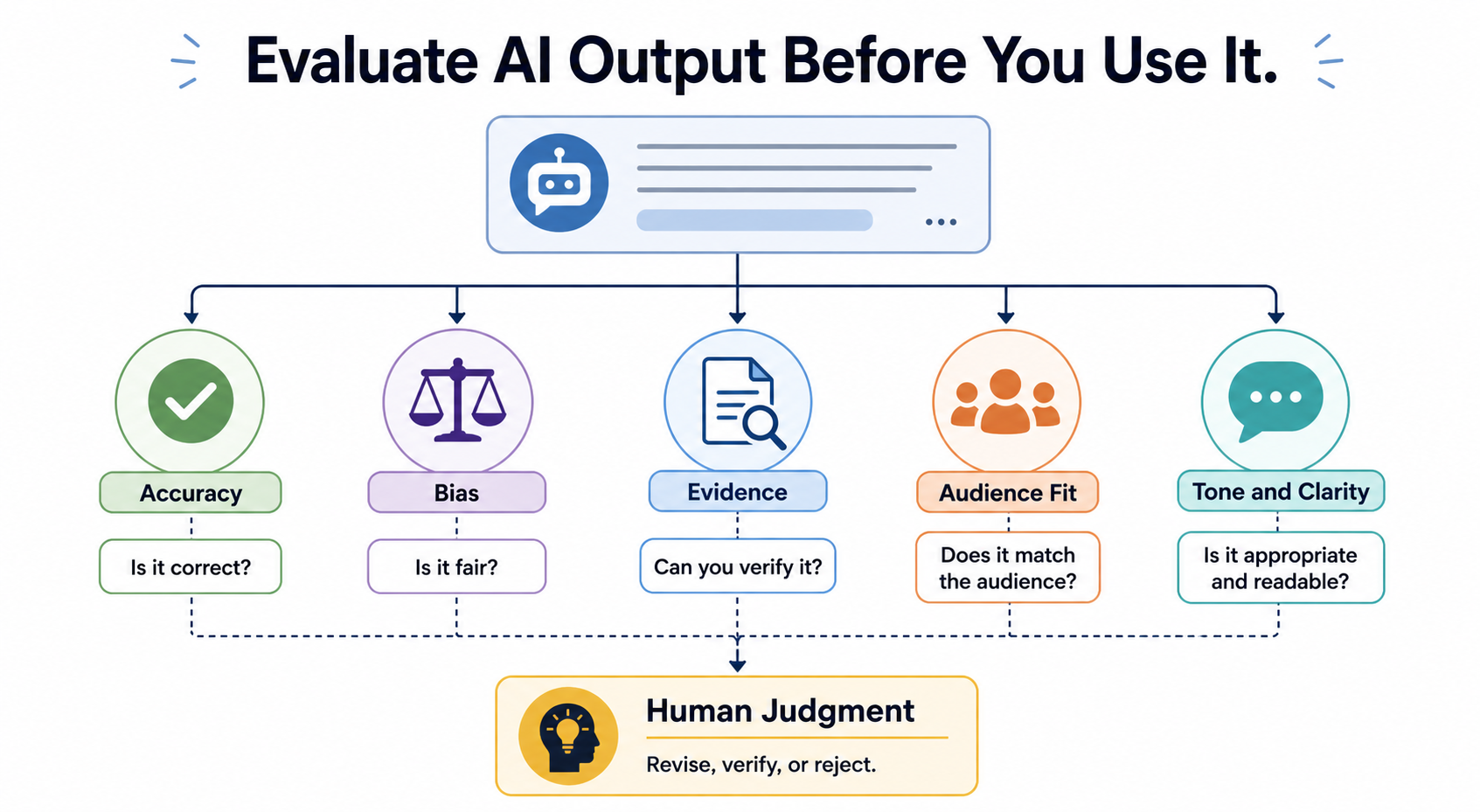
An ethical AI curriculum is not just about permission rules. It is also about critical evaluation. Bovee and Thill (2026) describe effective AI use as writing clear prompts, using GenAI mindfully, and critically evaluating output. That means students need a review method, not just access to a tool.
A practical evaluation checklist
Give students five questions adapted from the book’s ethical communication guidance: Is the intent respectful and audience-centered? Does the message include what the audience needs to make an informed decision? Have negative consequences been considered? Are the rights and ideas of others being respected? Would another approach lead to a better result?
You can combine those ethics questions with communication criteria already central to your course: accuracy, clarity, tone, organization, inclusivity, and relevance. If an AI-generated draft sounds generic, invents support, or misses audience expectations, students should be able to diagnose why.
The chapter material also notes that AI can help identify tone issues, readability concerns, and coherence problems when users provide audience and purpose. That creates a useful teaching opportunity: have students compare an AI readability or tone analysis with peer review and their own revision judgment. The goal is not to prove AI right or wrong every time, but to show that good communicators evaluate tool output rather than accepting it automatically.
4. Create a Course Policy You Can Actually Enforce
Overly broad bans rarely work, and unrestricted permission usually weakens learning. A stronger approach is a tiered policy tied to assignment goals.
Use a three-level permission model
Level 1: No AI use. Reserve this for foundational tasks where you need direct evidence of student ability, such as early diagnostic writing, in-class audience analysis, or certain quizzes.
Level 2: Limited AI support. Allow brainstorming, prompt-based idea testing, readability review, or tone suggestions, but require disclosure and human revision.
Level 3: Guided AI collaboration. In later units, allow more substantial use for workplace-realistic tasks such as message adaptation, layout experimentation, or presentation support, while requiring students to verify claims, revise for audience, and explain their decisions.
This kind of policy reflects the book’s balance between information technology skills and business ethics. It also supports the six related skills identified in the manuscript, including critical thinking, collaboration, knowledge application, information technology skills, and data literacy.
Finally, tell students how misuse will be handled. For example, undisclosed AI-generated writing, fabricated citations, or submission of unverified false content can be treated as academic integrity issues because they undermine authorship, transparency, and informed communication.
Key Takeaways
- Teach communication fundamentals first, then introduce AI as a bounded support tool.
- Require students to disclose AI use and explain what they accepted, revised, or rejected.
- Do not let AI stand in for factual research, source verification, or audience judgment.
- Use ethical review questions to help students evaluate bias, misinformation, privacy, and plagiarism risks.
- Create assignment-specific AI rules so expectations are clear and enforceable.
Glossary of Key Terms
- Ethical communication: Communication that gives audiences the information they need to make informed decisions and avoids deception.
- Generative AI (GenAI): Artificial intelligence that can create text, images, audio, video, code, and other content.
- Hallucinations: Fabricated content produced by an AI system that appears plausible but is false or unsupported.
- Prompt: A query or instruction given to an AI tool to guide its response.
- Transparency: Openness about how information was created, what tools were used, and what audiences need to evaluate a message accurately.
Related Questions
- Question: Should I ban AI entirely in a business communication course?
Answer: Usually no, because students are likely to encounter AI in professional settings. A better approach is to limit AI use by assignment type and require disclosure, verification, and human revision. - Question: How can I tell whether students used AI appropriately?
Answer: Ask for an AI-use note, drafts, prompts, and a brief reflection on what the tool contributed. Process evidence is more useful than trying to detect AI from prose alone. - Question: What kinds of AI use are most appropriate early in the semester?
Answer: Low-risk uses such as brainstorming, tone checking, readability review, and outline testing are good starting points. They let students experiment while still doing the core thinking and drafting themselves. - Question: How do I reduce the risk of AI-generated misinformation in student work?
Answer: Require students to verify all factual claims and sources independently and prohibit treating AI output as authoritative evidence. You can also grade explicitly for verification and source quality. - Question: How should AI ethics connect to business communication learning goals?
Answer: AI ethics fits naturally with audience awareness, credibility, professionalism, and message design. It helps students see that effective communication depends not just on producing text, but on producing accurate, responsible, audience-centered messages.
References
Bovee, C. L., & Thill, J. V. (2026). Business Communication Today (16th ed.). Pearson.
© 2026 Business Communication Teaching and Learning Center. All rights reserved.